
Quick Answer
A smart solar street light is an integrated lighting system that combines solar power generation, battery storage, LED illumination, and intelligent control electronics into a single infrastructure asset. Unlike conventional street lights, smart solar units can dim automatically based on traffic flow or preset schedules, report operational status remotely, and send fault alerts through communication protocols such as 4G, LoRa, or WiFi. They are increasingly specified not merely as lighting fixtures but as nodes in a city-wide IoT network. However, "smart" capability does not replace the fundamental engineering disciplines of solar sizing, battery autonomy, and photometric design. Project success depends more on matching the system to site conditions than on the number of smart features a controller can advertise.
Key Takeaways
- A smart solar street light combines PV generation, battery storage, LED lighting, and a controller with remote communication and sensing capabilities.
- Common connectivity options include 4G, LoRa, WiFi, and project-specific protocols; the right choice depends on coverage, data volume, and infrastructure availability.
- Remote dimming, status monitoring, and fault alerts are the most practical smart features today; full smart-city integration is possible on selected platforms.
- Wattage alone is a poor specification metric. Lumen output, IES distribution, battery capacity, autonomy, and controller behavior matter more.
- All-in-one and split-type systems serve different project needs; neither is universally superior.
- Buyers should verify technical claims through IES files, datasheets, DIALux simulations, and project-specific engineering reviews.
1. Why This Topic Matters
Street lighting is one of the largest recurring energy costs for municipalities and private infrastructure operators. As energy prices rise and carbon-reduction targets tighten, many buyers are shifting from conventional grid-powered lighting toward solar alternatives. The added promise of "smart" control extends the value proposition beyond energy savings into operational efficiency: technicians no longer need to drive a route to check whether each light is working when a centralised platform can report faults instantly.
Yet the term "smart solar street light" is not always used consistently. Some suppliers use it to describe a light with a built-in motion sensor. Others use it to mean full IoT integration with remote management. Between these two extremes lies a practical middle ground that most projects actually need: reliable solar generation, robust battery storage, a controller that supports programmable dimming, and connectivity that enables remote monitoring and fault detection.
Understanding what smart solar street lights actually do, how they communicate, and where they make economic sense helps buyers avoid two common mistakes. The first is over-buying: specifying a fully connected IoT system for a rural road where there is no network coverage or no maintenance team to act on data. The second is under-specifying: installing a conventional solar light on a busy arterial road where adaptive lighting or remote management is genuinely required. This article provides a structured overview of the technology, connectivity options, and use cases so that buyers can make more informed procurement decisions.
2. Core Concept / How It Works
A smart solar street light operates on the same fundamental principles as any solar lighting system. A photovoltaic (PV) panel converts sunlight into electricity during daylight hours. This energy is stored in a battery, typically lithium iron phosphate (LiFePO4) for project-grade installations. At night, the battery powers an LED luminaire, and the entire charge-discharge cycle is managed by a solar charge controller.
What makes the system "smart" is the addition of a communication module and sensing capabilities on top of this core architecture. These typically enable:
- Remote dimming control: Operators can adjust light output according to time-based schedules or real-time conditions (for example, dimming to 40% during low-traffic late-night hours and returning to full output during peak pedestrian or vehicle flows).
- Status monitoring: The system reports battery voltage, solar input, load status, and temperature data to a central management platform, allowing operators to verify that each light is functioning normally.
- Fault alerts: If a light fails, a battery underperforms, or a panel is damaged or stolen, the system sends an alert that identifies the specific unit and the type of anomaly.
- Motion-responsive lighting: Some configurations integrate motion sensors that brighten the light when pedestrians or vehicles approach and dim back down to a lower level when the area is clear.
The controller is the central nervous system of a smart solar street light. It coordinates charge management, load output, communication, and protection functions such as over-current and over-temperature shutdown. The quality and programmability of the controller often matter more than the choice of LED chip or battery chemistry, because the controller determines how the entire system behaves over months and years of operation.
For lighting design purposes, a smart solar street light must still satisfy the same photometric requirements as a conventional LED street light. A common mistake is to select a fixture based on wattage alone, which fails to account for actual lumen output, light distribution, and lux levels on the road surface. Verified IES files and DIALux simulations are necessary to confirm that a proposed configuration will meet the project’s target illuminance. For applicable projects, DIALux simulation and IES-based lighting design support can be provided.
Two common form factors exist. All-in-one systems integrate the PV panel, battery, controller, LED module, and sometimes the sensor into a single unit. These are fast to install and well suited to lighter applications such as residential roads, pathways, and rural streets. Split-type systems separate the PV panel and battery from the luminaire, offering greater flexibility for higher-power applications, larger battery banks, and more robust wind-load design. For tall poles and high-power road lighting, split-type configurations are generally preferable.
| Feature | All-in-One Solar Street Light | Split-Type Solar Street Light |
|---|---|---|
| Installation | Rapid, single-unit mounting | More complex; separate components need assembly |
| Power range | Typically lower (up to ~40W–60W practical range) | Scalable from ~25W to 150W+ for high-mast and roadway applications |
| Battery capacity | Limited by housing dimensions | Larger battery banks possible for high autonomy requirements |
| Wind-load design | Compact, but still requires engineering verification | More flexibility for pole structural design and PV orientation |
| Maintenance | Replacement of integrated unit | Individually serviceable components |
| Suitable use cases | Residential, rural roads, pathways, compact installations | Municipal roads, highways, ports, large industrial sites |
3. What Determines Real-World Performance
The smart features of a solar street light cannot compensate for poor fundamental design. Real-world performance is determined by a set of well-understood engineering variables:
Solar resource and PV sizing. The amount of daily solar irradiation at the installation site determines how much energy the PV panel can generate. A panel that is correctly sized for a sun-rich region such as Northern Nigeria will be inadequate for a location with frequent winter overcast such as the Netherlands. Climate data, not rule-of-thumb assumptions, should drive the sizing calculation.
Battery capacity and rainy-day autonomy. There is no universal number for how many rainy days a solar street light can operate. Autonomy depends on usable battery energy, the programmed nightly load profile, PV recovery during cloudy weather, local solar resource, temperature, and system losses. Project-grade sizing always accounts for the worst historical weather periods, not just the average sunny day.
Nightly energy profile. A light that runs at 100% for 12 hours every night consumes far more energy than one that runs at 60% after midnight or dims to 30% during low-activity hours. The programmed dimming schedule is one of the most powerful levers for reducing battery requirements and cost.
Controller intelligence and protection. A good controller ensures that the battery is charged efficiently, prevents over-discharge, and protects the system from overheating or overcurrent. Some controllers support MPPT (maximum power point tracking), which extracts more usable energy from the PV panel under cloudy or partially shaded conditions. MPPT tracking efficiency should not be confused with overall system efficiency.
Thermal management. High temperatures accelerate battery degradation. In tropical regions, battery enclosures must be designed to dissipate heat effectively to preserve cycle life and safety. Selected project-grade LiFePO4 configurations offer around 3,500+ cycles on supported models; higher cycle ratings such as 6,000+ cycles are optional configurations, not universal values.
Photometric performance and optical design. A fixture that produces a tightly controlled, road-appropriate beam pattern will deliver better illumination at a lower wattage than a fixture with a generic wide distribution. Comparing IES files is the only reliable way to evaluate optical performance.
Documentation and verification. Datasheets, IES files, test reports, and battery datasheets should be reviewed before procurement. Claims about IP ratings, wind resistance, or system lifetime should be verified against the applicable documentation for each specific model.
4. How Requirements Change by Project Scenario
One of the most common procurement errors is to assume that a single solar lighting configuration can serve all project types. In practice, requirements vary significantly across scenarios:
Municipal and urban roads. These projects usually demand high lumen output, precise photometric distribution, and compliance with local road lighting standards. Smart features such as remote dimming and fault alerting add real value in dense urban areas where lighting performance affects public safety and maintenance access. Split-type systems on 8–12-meter poles are commonly used.
Rural and remote villages. Reliability and low maintenance are priorities. Network availability may be limited, and local maintenance expertise may be scarce. An all-in-one design can reduce installation complexity — a significant advantage where skilled installation teams are not readily available. A simple, robust system without cloud connectivity may be preferable to a fully smart light that cannot receive firmware updates or data coverage in a remote area.
Coastal and high-humidity environments. Salt spray accelerates corrosion of metal components. Complete-solution IP ratings and corrosion-resistant coatings become critical. The lighting community should verify corrosion protection claims for each component and the fully assembled light.
High-temperature regions. In tropical and desert climates, battery thermal management is the dominant factor affecting lifespan. A smart controller that monitors battery temperature and adjusts charge voltage accordingly is an advantage, rather than a luxury.
High-wind regions. Poles and PV panels must be engineered for the actual local wind loads — wind design is a project-specific engineering task and should not be treated as a universal rating. Requirements vary by site so much that buyers should provide local climate data as part of the specification.
Smart-city pilot projects. When solar street lights are intended to function as smart-city IoT nodes — carrying sensors for traffic measurement, air quality monitoring, or public safety cameras — integration requires careful planning. A smart-pole deployment should specify the communication infrastructure, power budget for auxiliary devices, and data management platform. Note that smart-pole electronics and third-party modules may use different warranty terms from the lighting system itself.
5. What Buyers Commonly Overlook
Several risks in solar street light procurement are consistently underestimated. Awareness of these pitfalls can significantly improve project outcomes.
Comparing lights by wattage instead of lumen output and IES distribution. Wattage tells you how much electrical power a fixture consumes; it says nothing about how much visible light it produces or where that light goes. A high-wattage fixture with an inefficient LED and poor optics can deliver worse illumination than a lower-wattage fixture with high-efficiency LEDs and well-designed optics. Complete-luminaire engineering efficacy may be approximately 160–180 lm/W depending on the model and IES result.
Assuming all-in-one designs are always the best choice. All-in-one systems simplify installation, but split-type systems often serve higher-power or taller-pole projects better because they provide greater flexibility for PV, battery, wind-load, and maintenance design. The choice must be driven by project requirements.
Ignoring the thermal environment. Battery performance and cycle life are strongly affected by operating temperature. A battery that performs well in a temperate climate may degrade prematurely in a hot coastal location. Request battery datasheets and confirm the operating temperature range for each configuration.
Confusing different lifetime claims. LED theoretical lifetime, battery cycle life, complete-system warranty, and pole structural service life are distinct parameters. They should not be merged. MCL Solar’s standard warranty is 5 years; extended warranty applies only when explicitly specified in the PI or sales contract.
Not validating localisation. Standards, tender documents, site conditions, and actual climate data must all be validated for each project. A light designed for one district may not comply with lighting or solar installation standards in another. Buyers should use local standards and tender documents as the baseline — not generic marketing specifications.
Considering only the initial price. The lowest-tender bid may omit the engineering design, testing documentation, or structural calculations that the project actually needs. Complete-system engineering is a cost component, not an optional additive.
6. MCL Solar Practical Perspective
MCL Solar, formally Zhongshan Chengyu New Energy Technology Co., Ltd., is backed by a core team with more than 10 years of experience in solar street lighting, outdoor lighting manufacturing, and project solutions. In practical terms, this translates into a set of engineering policies that shape how projects are delivered:
- Selected systems support remote dimming, status monitoring, fault alerts, and platform management through communication options such as 4G, LoRa, WiFi, or other project-specific protocols. Not every configuration does, and that distinction is clearly communicated at the selection stage.
- Project-grade LiFePO4 batteries are the standard battery direction. The exact capacity, voltage, BMS, and cycle-life rating depend on the model and project. Buyers verify these against the applicable datasheet rather than relying on marketing summary statements.
- DIALux simulation and IES-based lighting design support can be provided for applicable projects. The photometric design is part of the engineering deliverable, not an afterthought.
- The company maintains a knowledge centre with product documentation and engineering guidance, allowing buyers to review technical boundaries before procurement.
- Warranty terms are defined contractually rather than through generalised promises. The standard warranty period is 5 years; extended warranty applies only when explicitly specified in the PI or sales contract.
Buyers evaluating MCL Solar products are encouraged to request the specific datasheet, IES file, and project-specific configuration documents relevant to their application. Engineering judgment is always applied to local climate data rather than generic assumptions.
7. FAQ
Q: What is the difference between a solar street light and a smart solar street light?
A: A conventional solar street light operates on a fixed schedule with basic charge and discharge protection. A smart solar street light adds communication and control capabilities — typically remote dimming, status monitoring, fault alerts, and in some cases motion-sensor integration. The smart layer enables operational efficiency and data collection that a conventional system cannot provide.
Q: Can smart solar street lights be remotely controlled over the internet?
A: For selected configurations, yes. Remote dimming, status monitoring, fault alerts, and platform management can be supported through 4G, LoRa, WiFi, or project-specific communication protocols. The appropriate option depends on network availability, data volume, and whether a management platform is required.
Q: Are all-in-one or split-type solar street lights better?
A: Neither is universally better. All-in-one systems simplify installation and are suited to lighter applications. Split-type systems are often better suited to higher-power or taller-pole projects because they provide greater flexibility for PV, battery, wind-load, and maintenance design. Use the project conditions as the deciding factor.
Q: How many rainy days can a smart solar street light operate?
A: There is no universal number. Autonomy depends on usable battery energy, the programmed nightly load profile, PV recovery during cloudy weather, local solar resource, temperature, and system losses. MCL Solar sizes rainy-day autonomy on a project basis using the actual site conditions.
Q: What battery type is used in MCL Solar smart street lights?
A: Grade-A LiFePO4 is the standard project-grade battery direction. The exact capacity, voltage, BMS, and cycle-life rating depend on the model and project. Battery cycle life should be confirmed against the applicable datasheet for each configuration.
Q: How can I verify a supplier’s lighting specifications?
A: Request the IES file for the specific luminaire, run or request a DIALux simulation for the proposed road layout, and compare lux values against the project target. Ask for the battery datasheet, controller specifications, and any relevant test reports or warranty terms. Verifiable documentation is the backbone of a sound procurement decision.
8. Conclusion
Smart solar street lights are a practical evolution of solar infrastructure. They enable remote monitoring, adaptive dimming, and diagnostic insight that reduce operating costs and improve service reliability. But their success rests on the same fundamentals as every other solar lighting system: accurate solar resource assessment, correct battery sizing, disciplined thermal management, and verified photometric performance.
The smart layer adds value when it is matched to operational needs and network realities. A well-designed basic system that meets the local standard is better than a badly sized "smart" system that adds data problems to an already failing installation.
For project procurement, the most effective path is to start from local standards and site conditions, define the autonomy and dimming requirements, and then ask for verifiable design documentation — IES files, DIALux simulations, battery datasheets, and structural calculations — before comparing prices.
If you are planning a solar street lighting project, Zhongshan Chengyu New Energy Technology Co., Ltd. (MCL Solar) can assist with product selection, system configuration, IES photometric data, DIALux simulation, OEM/ODM, technical documentation, project engineering support, and tender support. To receive an accurate configuration recommendation, please provide the following project information:
- Country / city
- Application (municipal road, highway, residential area, industrial park, etc.)
- Road width
- Pole height
- Pole spacing
- Project quantity
- Target lux or lumen requirement
- Operating hours per night
- Required rainy-day autonomy
- Coastal / high-wind / high-temperature conditions
- BOQ, drawings, or tender specifications (if available)
Contact MCL Solar directly:
- Email: sales@mclsolar.com
- WhatsApp: +86 18030335122
- Website: https://mclsolar.com
Visit the MCL Solar Knowledge Center for ongoing educational content on solar lighting engineering, and explore the product range to identify suitable configurations for your project.
Engineering & Manufacturing Verification at MCL Solar
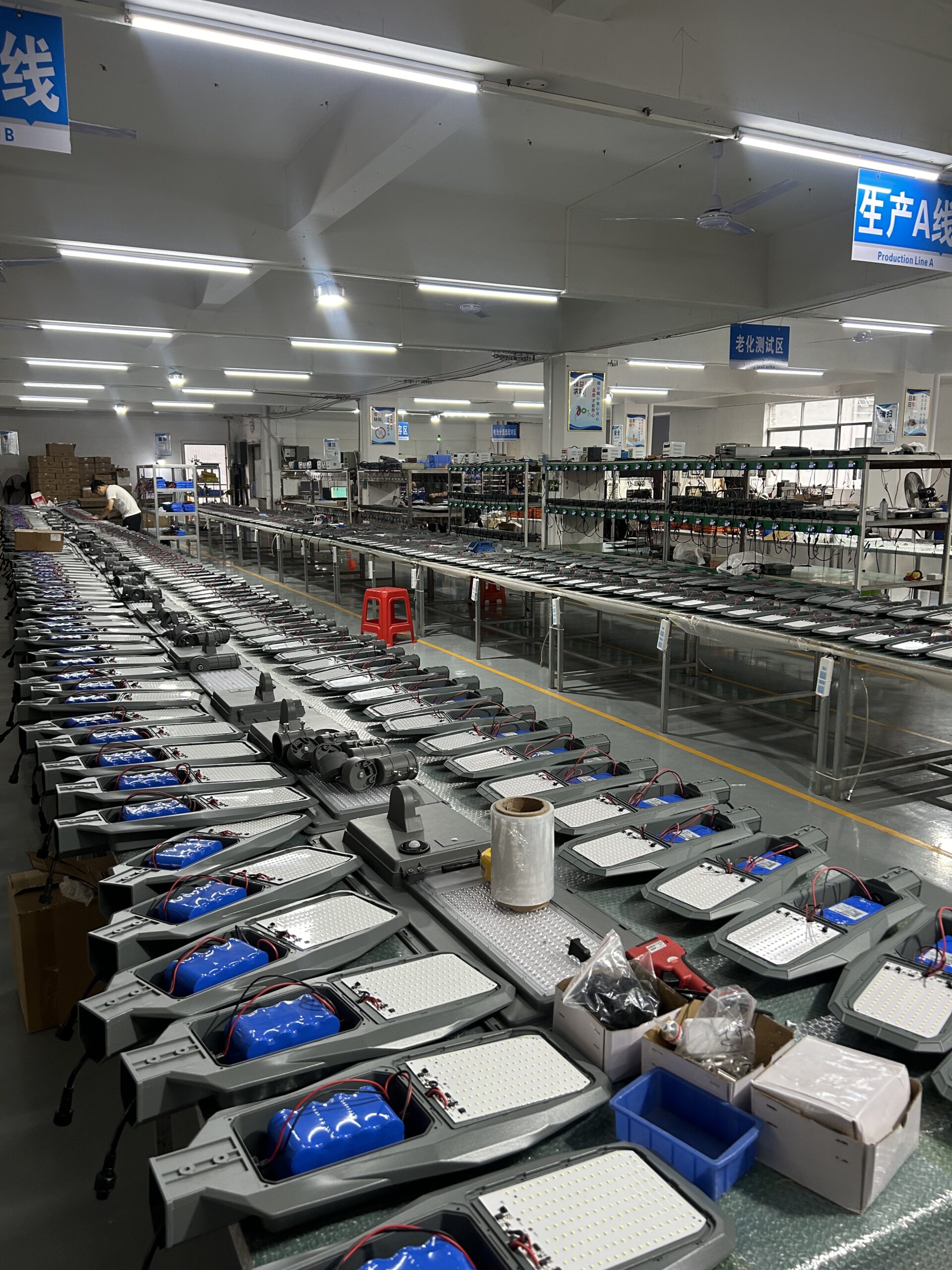
All commercial solar street lighting luminaires, intelligent MPPT controllers, and Q235 hot-dip galvanized steel poles are manufactured in-house by Zhongshan Chengyu New Energy Technology Co., Ltd. at our 35,000 m² production facility in Guzhen Town, Zhongshan, Guangdong, China.
Explore our verified municipal track record: Saudi Arabia 253 Sets 55°C Desert Highway Project, Philippines Coastal Highway Typhoon-Resistant Installation, or inspect third-party IEC/CE/ISO test reports at our Compliance Verification Center.
Need Engineering Sizing or EPC Tender Support?
Contact MCL Solar’s engineering division for complimentary DIALux road lighting simulations, solar autonomy calculations, and direct factory pricing for municipal and commercial infrastructure projects.