
Quick Answer
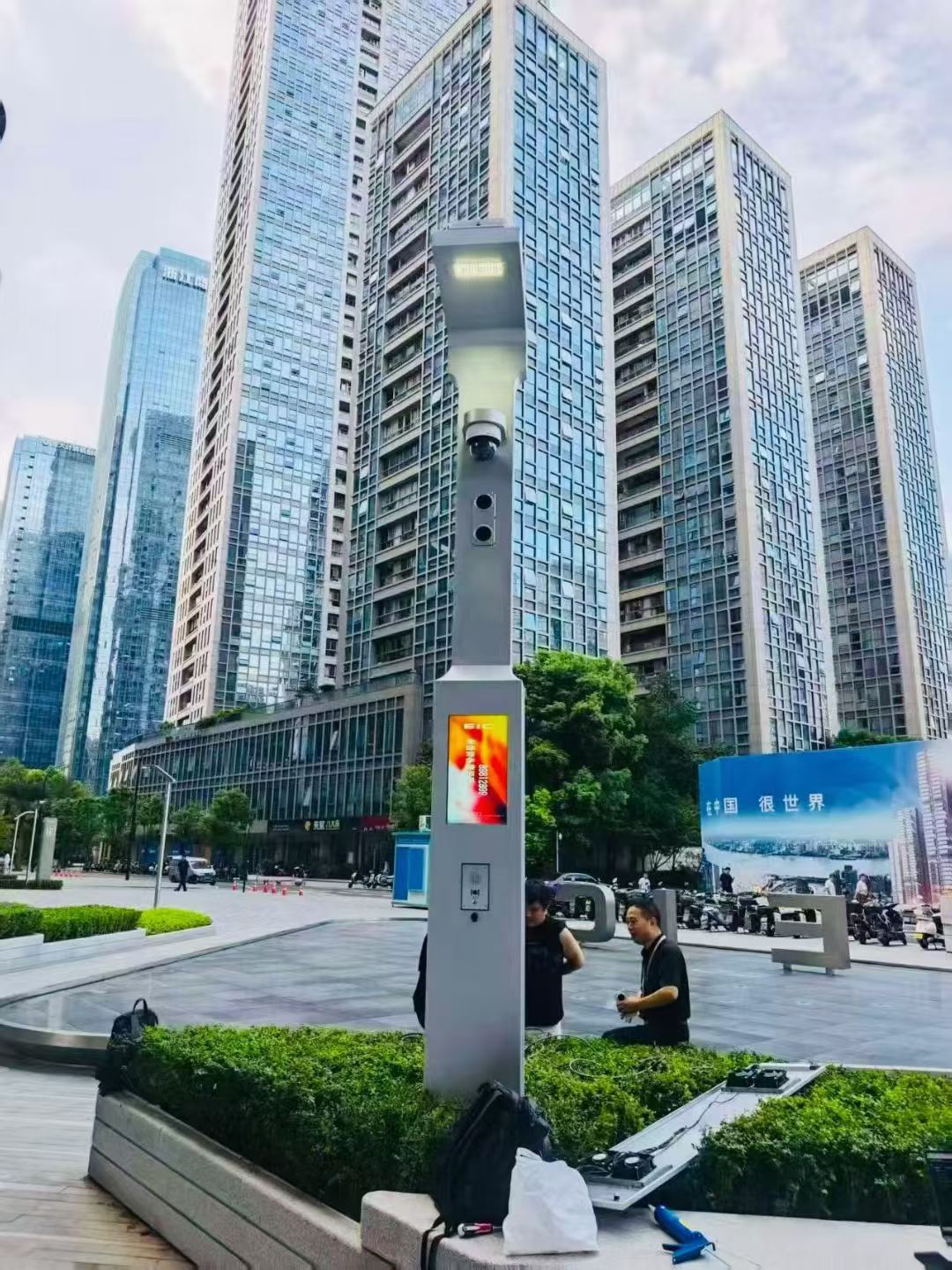
A smart street light can integrate far more than an LED lamp and a photocell. Typical devices include dimming controllers, motion sensors (PIR or radar), environmental sensors (air quality, temperature, humidity, noise), cameras, emergency call buttons, communication modules (4G, LoRa, NB-IoT, WiFi), smart meters, EV charging outlets, digital signage, public-address speakers, and even 5G small-cell equipment. The exact set of devices depends on the pole structure, power budget, communication backbone, enclosure rating, and project-specific city platform. Not every function is available on every pole; compatibility, mounting space, heat management, and cybersecurity must be verified against the selected configuration before procurement.
Key Takeaways
- Smart street lights are modular platforms, not single-function luminaires. Devices are added by need and project budget.
- The most common integrated functions fall into six categories: lighting control, sensing, safety and security, communication, energy management, and public services.
- Communication choice (4G, LoRa, WiFi, or wired fiber) determines how far the system can scale and how quickly data is transmitted.
- Solar-powered smart poles have a limited energy budget; power-hungry devices such as EV charging or large displays may require AC backup or generous PV and battery sizing.
- Buyers should verify device compatibility, IP ratings, certification scope, and platform integration with the manufacturer before committing to a full smart-pole rollout.
1. Why This Topic Matters
Municipalities, utilities, campus developers, and industrial park owners are no longer buying street lights as standalone products. They are buying infrastructure that can host lighting, safety, environmental monitoring, and communication equipment on one pole. The reason is practical: a pole is already installed, already powered, and already networked or ready to be networked. Adding a device later costs more in labor, permitting, and civils than specifying it from the beginning.
The user problem is not "which gadget is newest." It is: Which devices can genuinely share a street-light platform without compromising the primary lighting function or creating maintenance and safety risks? This article gives a complete device list, explains what actually drives performance, and highlights what is commonly overlooked during specification.
2. Core Concept: The Smart Street Light as a Host Platform
A smart street light is a light pole with a control system, a communication link, and optional peripheral devices mounted on or inside the pole. The lighting controller remains the master function, but the pole carries a data bus, a power distribution module, and mounting provisions for third-party equipment.
2.1 Devices by Function Group
Lighting control and optimization
- Photocell (daylight sensor)
- Astronomical timer / sunrise-sunset scheduling
- 0–10 V or DALI dimming controller
- Motion sensor (PIR or microwave radar) for on-demand dimming
- Ambient-light sensor for adaptive lumen output
- Remote monitoring and fault-alert module
Communication and networking
- 4G / 5G cellular router
- LoRa / LoRaWAN gateway or node
- NB-IoT module
- WiFi hotspot (public access or backhaul)
- Zigbee / Bluetooth mesh
- Ethernet or fiber-optic interface for wired backhaul
Environmental sensing
- Air-quality sensors (PM2.5, PM10, CO, NO₂, SO₂, O₃)
- Temperature and humidity sensor
- Wind speed and direction (anemometer)
- Rain gauge
- Noise / decibel sensor
- Atmospheric pressure sensor
Safety and security
- CCTV / IP surveillance camera
- Emergency call button (SOS)
- Two-way intercom
- License-plate recognition camera
- Gas-leak or flood detection (for industrial sites)
Traffic and mobility
- Vehicle detection and counting sensor
- Radar-based traffic flow monitoring
- Smart parking detection
- EV charging outlet
- Bicycle and pedestrian detection for adaptive crosswalk lighting
Public services and information
- LED information display / digital signage
- Public-address speakers and siren
- Wayfinding kiosk
- 5G small-cell mounting point
- Waste-bin fill-level sensor (when co-located with smart bins)
Energy management (important for solar poles)
- Smart kWh meter
- Battery management system (BMS) with remote telemetry
- Solar charge-controller status module
- DC and AC power distribution box for auxiliary devices
2.2 Typical System Architecture
Solar PV / AC Mains ──► Power Distribution ──► LED Driver ──► Luminaire
                          │
                          ├──► Sensor Bus (RS485 / CAN / DALI)
                          ├──► Communication Module (4G / LoRa / WiFi)
                          ├──► Auxiliary Device Ports (12 V / 24 V DC or AC)
                          └──► Central Management System (CMS) / City Platform
This architecture is why the same physical pole can host lighting control, environmental sensing, and CCTV on one shared power and data bus.
3. What Determines Real-World Device Performance
Having a long device list is not the same as having a working smart pole. The table below shows the key boundary conditions that decide whether an integrated device will actually perform over years of outdoor operation.
| Factor | Why It Matters | What Can Go Wrong | Verification Method |
|---|---|---|---|
| Power budget | Each device draws current; solar poles have limited daily energy | Battery drains before dawn; lighting dims or cuts out | Calculate nightly load vs PV yield and battery capacity |
| Enclosure / IP rating | Devices are exposed to rain, dust, humidity, salt spray | Moisture ingress, corrosion, premature failure, short circuit | Check component IP rating and complete assembly rating |
| Heat management | Modems, cameras and drivers generate heat inside sealed pole cabinets | Thermal shutdown in hot climates; shortened service life | Review thermal design and operating temperature range |
| Communication coverage | 4G, LoRa and WiFi have different range and bandwidth limits | Dead zones; delayed alerts; poor video streaming | Perform site radio survey before deployment |
| Data platform integration | Devices from different vendors must talk to one CMS | "Islands" of data; no central view; manual reconciliation | Require open APIs / OCPP / standard IoT protocols |
| Mast arm and wind load | Extra surface area increases wind design load | Pole fatigue, bracket failure in storms | Confirm wind-load calculation per pole and project location |
| Certification scope | A certificate may cover only one component, not the whole pole | False compliance claims; customs or tender rejection | Ask for certificates that explicitly list the complete product or model |
Engineering boundary to remember: a component IP rating or a component certificate does not automatically apply to the complete smart pole. For example, an IP-rated camera mounted on a pole does not make the entire pole IP-rated. Buyers should confirm the full-assembly rating and model scope with the datasheet or test report.
4. How Requirements Change by Project Scenario
4.1 Municipal Street Lighting
Municipalities usually want remote dimming, fault alerts, and centralized management. Cameras and emergency call buttons are increasingly common in city-center projects, but they require more complex approval, data-privacy compliance, and higher-bandwidth communication. A 4G-based architecture with a secure central management platform is the typical starting point.
Scenario: a capital city upgrading a 5 km main avenue with smart poles, expecting remote control and one-way video monitoring. The operator must plan for both lighting data and video data flowing through the same communication link.
4.2 Rural or Off-Grid Areas
Off-grid sites rely on solar power. The energy budget is the dominant constraint. High-power devices such as EV charging, continuous video analytics, or large LED displays are rarely practical unless the PV array and battery bank are substantially oversized. Low-power devices—motion-triggered lighting, LoRa-based environmental sensing, and emergency calling—are a better match. Wind-load and battery cold-temperature performance also need attention.
Scenario: a remote village road with all-in-one solar street lights. Adding a 24/7 4G camera would multiply nightly power consumption, potentially requiring a split-type system with an oversized battery rather than a compact all-in-one unit.
4.3 Coastal and High-Humidity Environments
Salt spray and humidity attack unsealed connectors, exposed PCBs, and low-grade enclosures. Devices must be rated for marine or coastal environments. Stainless-steel hardware, sealed gaskets, corrosion-resistant coating, and shrouded connectors are essential. The same applies inside the pole: condensation management and venting or desiccant systems prevent internal corrosion.
Scenario: a seaside smart-pole project with environmental sensors. The complete pole must have the same corrosion protection as the lighting system; a UV-degraded enclosure or a corroded sensor connector will fail within one season.
4.4 Industrial and Port Applications
Industrial sites and ports add safety-critical functions: gas detection, flood warning, heavy-vehicle detection, and control-room alerts. Devices in these zones must meet site-specific safety standards and often use industrial-grade communication. Power reliability is higher, but the hardware must tolerate vibration, dust, and accidental impact.
Scenario: a port terminal replacing old floodlights with smart high-mast poles. Additional devices include radar traffic sensors, security cameras, and loudspeakers. The high-mast structure provides mounting height and space, but every added device must be included in the wind-load analysis and an emergency manual override must be maintained.
4.5 Campus, Park, and Commercial Zones
These projects often prioritize WiFi hotspots, digital signage, public-address, and smart parking. The visual appearance of the pole matters as much as its function, so device integration must be flush-mounted or concealed where possible. Maintenance intervals and vandal-resistance are also important.
Scenario: a university campus installing smart lighting and signage. The design must protect devices against physical tampering, and the platform must be open enough for the IT department to manage WiFi and the facilities team to manage lighting separately.
5. What Buyers Commonly Overlook
5.1 The certification gap
A common mistake is assuming that a certificate on one component covers the whole smart pole. That is rarely true. A camera may carry a rating, and a luminaire may carry another, but the complete assembly does not automatically inherit those qualifications. Buyers should request the original supporting documentation and verify the model scope before claiming compliance in a tender.
5.2 Wattage is not a performance specification
In solar lighting, comparing products by wattage alone is misleading. Actual lumen output, IES photometric distribution, nightly energy profile, PV and battery sizing, controller type, thermal design, and IP protection all matter more than nominal power. The same principle applies to smart-pole devices: a "100 W" audio speaker or a "4 W" sensor may have very different real-world performance depending on efficiency, antenna design, and enclosure quality.
5.3 Power budget arithmetic
Every additional device changes the nightly energy consumption. On a solar pole, the calculation is straightforward: sum of device loads multiplied by operating hours must be lower than the energy that the PV array can generate and the battery can store over the required autonomy days. Buyers should ask the manufacturer for a complete energy balance table rather than assuming the pole can "just add one more device."
5.4 Platform lock-in
Some manufacturers only allow their own devices to operate on their platform. If the project plans to integrate third-party sensors or the city’s existing management platform, confirm that the controller and communication module support open protocols or APIs. Otherwise, the buyer inherits a proprietary system with limited upgrade options.
5.5 Documentation and long-term maintenance
Smart poles contain electronics that will be replaced sooner than the pole structure or the luminaire housing. Buyers should request spare-part lists, replacement procedures, and firmware update policy before purchase. A system that requires sending the whole pole back for a sensor replacement is not a scalable smart-city solution.
6. MCL Solar Practical Perspective
Zhongshan Chengyu New Energy Technology Co., Ltd. (MCL Solar) supplies solar street lighting, AC outdoor lighting, and smart city IoT poles. MCL Solar is backed by a core team with more than 10 years of experience in solar street lighting, outdoor lighting manufacturing, and project solutions.
From a practical standpoint, MCL Solar works on a configuration basis. Remote dimming, status monitoring, fault alerts, and platform management are available for selected systems through communication options such as 4G, LoRa, WiFi, or other project-specific protocols. All-in-one systems simplify installation and are suitable for lower-power applications, while split-type systems are often better suited to higher-power or taller-pole projects because they provide greater flexibility for PV, battery, wind-load, and maintenance design.
The company does not claim that every product is equally equipped for every function. Device integration, certification scope, and complete-system performance are confirmed according to the selected model and project requirements. Buyers should verify the exact model scope in the applicable datasheet or test report before procurement. For a closer look at integrated pole solutions, review the Smart City IoT Pole product page and the broader outdoor lighting product range. Additional engineering and application references are available in the Knowledge Center.
7. FAQ
Q1: Can a regular solar street light be upgraded to a smart street light later?
Generally yes, if the controller, communication module, and power budget allow it. However, adding devices to an existing pole may require a new battery, a larger enclosure, or additional wiring. It is more cost-effective to specify future expansion slots during the initial design.
Q2: Do smart street lights work without internet?
Selected systems can operate standalone with local scheduling and sensor control. Remote monitoring, alerts, and platform management require a communication link such as 4G, LoRa, WiFi, or wired backhaul. The pole can still light the road without connectivity, but it cannot report faults.
Q3: Which communication protocol is best for smart street lighting?
There is no universal best answer. LoRa and NB-IoT are efficient for low-bandwidth sensor data and fault alerts over wide areas. 4G/5G provides higher bandwidth for video and firmware updates but consumes more power. WiFi and Zigbee suit local mesh configurations. The choice depends on terrain, density, existing networks, and data volume.
Q4: Can EV charging and solar street lighting be combined on one pole?
Yes, but only with careful energy planning. A solar-powered pole has limited daily generation; a typical EV charger consumes far more energy than the lighting load. In most cases, the pole requires AC mains connection or a purpose-designed oversized PV and storage system to support frequent EV charging.
Q5: Are smart street lights safe from cyberattacks?
Every connected device introduces cybersecurity risk. Buyers should require encrypted communication, secure authentication, firmware signing, and regular security updates from the manufacturer and platform provider. Cybersecurity is part of procurement, not an afterthought.
Q6: Does an IP rating on one component make the whole pole weatherproof?
No. IP ratings are typically certified per component or per enclosure. The complete smart pole must be evaluated as an assembly, including cable glands, gaskets, and device interfaces. Confirm the full-product rating and its certification scope with the manufacturer.
8. Conclusion
Smart street lights can integrate a wide range of devices: lighting controllers, motion and environmental sensors, cameras, emergency call buttons, communication modules, smart meters, EV chargers, displays, speakers, and 5G small cells. The practical limit is not technology—it is power budget, communication infrastructure, enclosure durability, certification scope, and platform compatibility.
Every project needs a different device mix. Municipal corridors prioritize remote control and surveillance; off-grid villages prioritize low-power reliability; coastal cities prioritize corrosion resistance; industrial sites prioritize safety detection. Whatever the scenario, buyers should verify the complete-system rating and documentation behind each integrated function rather than assuming that a long feature list guarantees field performance.
For solar-powered smart poles, the engineering rule is simple: sum every device’s energy consumption, multiply by operating hours, and check that the PV array and battery can sustain it across the required rainy-day autonomy. If the numbers do not close, the system is over-specified—either reduce the device load or move to a split-type configuration with a larger energy package.
Ready to Define Your Smart Street Light Configuration?
Smart-pole projects depend on accurate site data and a clear device list. Zhongshan Chengyu New Energy Technology Co., Ltd. (MCL Solar) can assist with product selection, system configuration, IES photometric data, DIALux simulation, OEM/ODM, technical documentation, project engineering support, and tender support for applicable projects.
To receive a configuration recommendation, please provide the following project information:
- Country / city
- Application type
- Road width and pole height
- Pole spacing and quantity
- Target lux or lumen requirement
- Operating hours per night
- Required rainy-day autonomy
- Coastal, high-wind, or high-temperature conditions
- BOQ, drawings, or tender specifications
Contact us directly:
- Email: sales@mclsolar.com
- WhatsApp: +86 18030335122
- Website: https://mclsolar.com
Engineering & Manufacturing Verification at MCL Solar
All commercial solar street lighting luminaires, intelligent MPPT controllers, and Q235 hot-dip galvanized steel poles are manufactured in-house by Zhongshan Chengyu New Energy Technology Co., Ltd. at our 35,000 m² production facility in Guzhen Town, Zhongshan, Guangdong, China.
Explore our verified municipal track record: Saudi Arabia 253 Sets 55°C Desert Highway Project, Philippines Coastal Highway Typhoon-Resistant Installation, or inspect third-party IEC/CE/ISO test reports at our Compliance Verification Center.
Need Engineering Sizing or EPC Tender Support?
Contact MCL Solar’s engineering division for complimentary DIALux road lighting simulations, solar autonomy calculations, and direct factory pricing for municipal and commercial infrastructure projects.