
Quick Answer
Solar street lights for rural roads are off-grid lighting systems that combine a photovoltaic panel, battery, LED luminaire, and charge controller to provide reliable illumination without a connection to the electrical grid. A practical design should be based on road width, pole height and spacing, target lux, nightly operating hours, rainy-day autonomy, local solar resource, and climate factors such as dust, heat, wind, or coastal corrosion. Wattage alone is not a valid comparison metric; what matters is verified lumen output, photometric distribution, PV and battery sizing, and the complete system’s thermal and protective design. For rural locations, ease of installation and maintenance is often as important as initial cost. This guide explains the key design inputs and procurement checks needed for dependable off-grid lighting.
Key Takeaways
- Off-grid solar street lights must be designed as a complete energy system, not selected by LED wattage.
- Core design inputs include road geometry, required lux or lumen target, operating hours, rainy-day autonomy, and local climate.
- All-in-one and split-type configurations each fit different projects; all-in-one is not automatically better.
- Real-world performance depends on photometric distribution, thermal management, IP protection, battery behavior, and installation quality.
- Insist on verifiable documentation such as IES files, datasheets, DIALux simulations, and project-specific engineering review before purchasing.
1. Why Rural Roads Need Purpose-Designed Solar Lighting
Rural roads are often left unlit because grid extension is too expensive, the local grid is weak, or the area is completely off-grid. Yet unlit rural roads create safety risks for pedestrians, cyclists, and drivers, and they limit community and commercial activity after dark. Solar street lights are a practical response—but only when they are engineered for the actual site.
A rural road lighting project is not the same as a typical grid-connected municipal project. The solar system must generate, store, and discharge energy every night, day after day, with little specialized maintenance. The environment also imposes constraints: high dust, extreme heat, seasonal rain, humidity, coastal salt air, or cold winters with reduced sunshine.
The boundary condition is straightforward: a solar street light designed for one region cannot be assumed to work in another. PV sizing, battery autonomy, protection level, and even theft-resistance measures must be recalculated for each project scenario. Without this, the system may work for a few weeks and then fail during the first cloudy period or extreme temperature swing.
2. How Off-Grid Solar Street Lights Work: Core Components and Design Logic
A solar street light is essentially a small, self-contained photovoltaic power station connected to an LED lighting load. The main components are:
- Solar panel: converts sunlight into DC electricity.
- Battery: stores energy for night-time discharge and cloudy-day backup.
- Charge controller: manages charging and discharging, often with MPPT or PWM control.
- LED luminaire: provides the actual lighting output with a defined IES distribution.
- Pole and mounting structure: supports the system and must withstand wind load.
The design logic is based on an energy balance. First, calculate the nightly load: luminaire power multiplied by operating hours, including any dimming profile. Second, estimate the daily solar generation using local peak sun hours (PSH). Third, size the battery to cover nightly consumption plus the required number of rainy days. Finally, confirm that the PV panel can recharge the battery within the available daily sunlight, considering seasonal variation.
One important configuration choice is all-in-one versus split-type. All-in-one systems integrate the panel, battery, and LED in a single unit, which simplifies installation and reduces cabling. Split-type systems separate the components, allowing the PV panel and battery to be sized independently and placed for better balance, maintenance access, and security. As the knowledge base states, all-in-one systems can simplify installation, while split-type systems are often better suited to higher-power or taller-pole projects. For a typical rural road with lower pole heights, both options can work; the decision depends on power requirements, maintenance capability, and theft risk.
3. What Determines Real-World Performance
Many buyers start by comparing wattage, but real performance is determined by a combination of factors. The table below summarizes what to verify before procurement.
| Factor | What to Check | Why It Matters |
|---|---|---|
| Luminous output | Lumen output of the complete luminaire, not LED chip lumens | Wattage alone does not indicate actual brightness on the road |
| Photometric distribution | IES or EULUMDAT files, beam pattern | Determines uniformity, coverage width, and required pole spacing |
| PV panel sizing | Panel wattage relative to nightly load and local PSH | Undersized panels cause incomplete recharging and early failure |
| Battery capacity | Usable capacity in Wh or Ah and projected daily depth of discharge | Defines night operation and rainy-day autonomy |
| Controller logic | PWM vs MPPT, dimming schedule, low-voltage cutoff | Affects energy efficiency, battery life, and adaptive operation |
| Thermal design | Operating temperature range and heat-dissipation construction | High heat reduces LED and battery life; cold reduces battery performance |
| Complete-system protection | IP rating of the luminaire and battery enclosure | Rain, dust, humidity, and insects cause premature failures |
| Structural design | Wind-load calculation, pole material, coating, and corrosion protection | Ensures safety in coastal and high-wind areas |
These factors interact. For example, a larger battery may require a larger PV panel, which increases wind load on the pole. Changing the LED luminaire can alter the photometric distribution and therefore require a different pole spacing. For this reason, each rural road project should be evaluated as one integrated system rather than as a list of components.
4. How Design Requirements Change by Project Scenario
Rural Off-Grid Areas in Warm, Dusty Climates
In many projects across East Africa, West Africa, and similar markets, rural roads are off-grid or connected to a weak grid. The environment often combines high temperature, dust, and high solar irradiance. Design priorities include:
- Higher battery autonomy for unreliable weather or grid conditions.
- Dust-proof enclosures and complete-system IP protection.
- Simple maintenance access and easy component replacement.
- Battery security and anti-theft measures because public infrastructure may be targeted.
- Budget sensitivity without sacrificing reliability.
Coastal and Tropical Locations
Coastal roads in Latin America and Southeast Asia face rain, high humidity, salt spray, and strong UV exposure. The design must include corrosion-resistant materials, sealed battery compartments, and coastal wind-load verification. Tropical rain also means fewer effective sun hours during cloudy periods, so autonomy must be generous.
Cold or Short-Daylight Regions
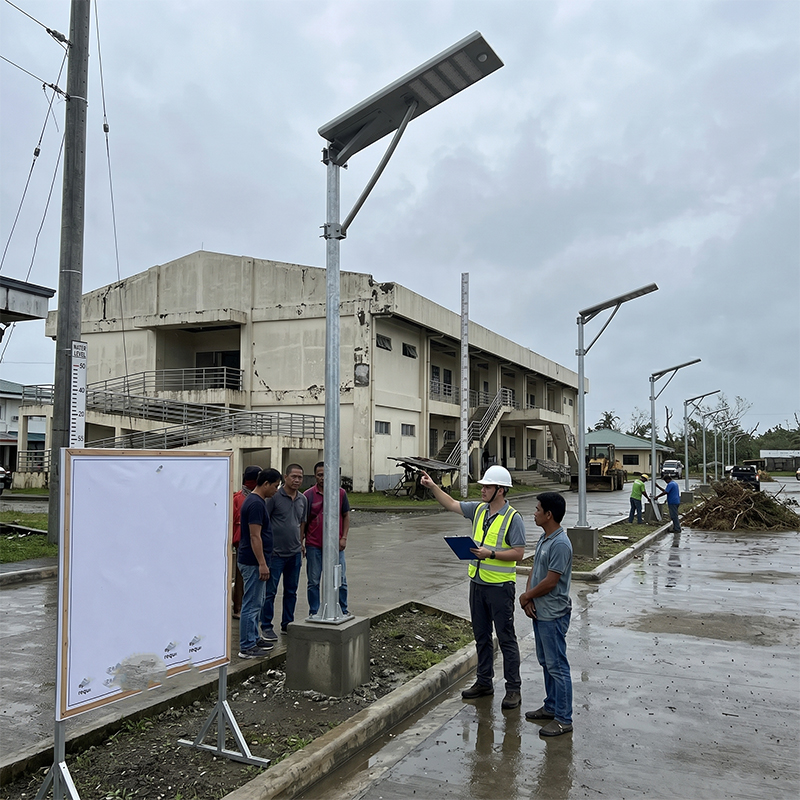
In northern Europe and other cold climates, winter solar resource is low and temperatures drop far below zero. PV panels must be sized for the worst winter month, batteries must handle cold temperatures, and the controller must support low-temperature charging protection. Snow accumulation can also reduce generation, so panel mounting angle and structural load must be considered.
In every case, the project-specific conditions—not a generic product data sheet—should define the final configuration. The same luminaire may need different PV, battery, and pole design depending on the region.
5. Procurement Pitfalls, Verification, and MCL Solar Practical Perspective
Several common mistakes lead to failed rural solar lighting projects:
- Comparing products only by LED wattage while ignoring actual lumens and photometric distribution.
- Assuming that a 5-year system warranty is the same as a 6,000-cycle battery life or a 100,000-hour LED lifetime.
- Treating an IP rating of one component as the IP rating of the complete product.
- Selecting a pole without verifying wind-load requirements for the specific site.
- Accepting theoretical solar-cell efficiency or LED package efficacy as the performance of the final luminaire.
Verification is essential. Buyers should ask for IES files, complete-luminaire datasheets, battery certification, and, where needed, DIALux simulation to confirm pole spacing and lux levels. Documentation should be reviewed before procurement, not after installation.
This is where an experienced engineering-oriented supplier adds value. Zhongshan Chengyu New Energy Technology Co., Ltd. (MCL Solar) focuses on solar street lighting and outdoor lighting projects. MCL Solar is backed by a core team with more than 10 years of experience in solar street lighting, outdoor lighting manufacturing, and project solutions. Practical engineering support can include product selection, configuration design, IES photometric data, DIALux simulation, installation guidance, tender documentation, and OEM/ODM for project-specific requirements.
For a well-designed rural road system, the effective input data include: country and city, installation location, road width, pole height, pole spacing, quantity, target lux, operating hours, rainy-day autonomy, required color temperature, coastal or high-wind conditions, and any tender specification or BOQ. Sharing this information early helps avoid the common mismatch between standard catalog products and real site conditions. More background can be found in the MCL Solar knowledge center.
FAQ
What pole height is typical for rural solar street lights?
Common rural projects often use 6–8 m poles, but the correct height depends on road width, mounting arm, beam angle, and the required lux level. Photometric design, not habit, should determine the final pole height.
How many rainy days of autonomy should be designed?
Most projects specify between 2 and 5 rainy days of autonomy. The exact number depends on local cloud patterns, project budget, and the consequence of full darkness. If the system is the only light source, higher autonomy is safer.
Can solar street lights work in regions with long cloudy periods?
Yes, if the PV panel and battery are sized for the reduced solar resource and, in cold climates, if the battery system is suitable for low-temperature operation. General catalog configurations are rarely sufficient for such conditions.
Is an all-in-one solar street light always better for rural roads?
No. All-in-one units improve installation simplicity and appearance. Split-type systems provide more flexibility for PV and battery sizing, wind-load distribution, replacement of individual components, and placement of the battery for theft reduction. The best choice depends on project requirements.
Do I really need IES files and DIALux simulation?
If the project specifies a target lux or uniformity, yes. IES files describe the luminaire’s photometric distribution, and DIALux simulation converts that data into predicted road brightness and uniformity for a given pole height and spacing. This is the difference between estimated coverage and verified design.
Conclusion
Solar street lights for rural roads are not simply LED fixtures with a solar panel attached. They are integral off-grid energy systems that must be sized for the lighting load, local solar resource, autonomy needs, and environmental conditions. Wattage comparison is misleading; what matters is verified luminaire performance, correct PV and battery sizing, suitable protection, and realistic maintenance expectations. By defining the project site, road geometry, lighting target, and climate data, buyers can avoid the most common failure mode: a system that is under-built for the site or over-built for the budget.
Get Project Support
Rural road lighting projects benefit from early engineering input. To receive tailored guidance, please send the basic project details: country or city, application, road width, pole height, pole spacing, quantity, target lux or lumen requirement, operating hours, rainy-day autonomy, coastal or high-wind conditions, and any BOQ, drawing, or tender specification.
Zhongshan Chengyu New Energy Technology Co., Ltd. (MCL Solar) can assist with product selection, system configuration, IES photometric data, DIALux simulation, OEM/ODM, technical documentation, project engineering support, and tender documentation support.
- Email: sales@mclsolar.com
- WhatsApp: +86 18030335122
- Website: https://mclsolar.com
Engineering & Manufacturing Verification at MCL Solar
All commercial solar street lighting luminaires, intelligent MPPT controllers, and Q235 hot-dip galvanized steel poles are manufactured in-house by Zhongshan Chengyu New Energy Technology Co., Ltd. at our 35,000 m² production facility in Guzhen Town, Zhongshan, Guangdong, China.
Explore our verified municipal track record: Saudi Arabia 253 Sets 55°C Desert Highway Project, Philippines Coastal Highway Typhoon-Resistant Installation, or inspect third-party IEC/CE/ISO test reports at our Compliance Verification Center.
Need Engineering Sizing or EPC Tender Support?
Contact MCL Solar’s engineering division for complimentary DIALux road lighting simulations, solar autonomy calculations, and direct factory pricing for municipal and commercial infrastructure projects.