Quick Answer
Yes, solar street lights with remote control are available in several configurations. Communication options can include 2.4 GHz wireless, infrared, TTL, 4G, WiFi, LoRa, and Zigbee. Depending on the system architecture, supported functions may include remote monitoring, parameter configuration, dimming control, and fault alerts. In practice, 2.4G handheld remote controls are convenient for on-site setup, infrared requires line-of-sight, and IoT configurations enable centralized platform management. Not every system supports every option, so the specific model and project documentation should always be confirmed. Zhongshan Chengyu New Energy Technology Co., Ltd. (MCL Solar) can help match remote-control configurations to project needs.
Key Takeaways
- Remote control is not a single standard feature: solar street lights may use 2.4G, infrared, TTL, 4G, WiFi, LoRa, Zigbee, or a combination, depending on the system architecture.
- 2.4G handheld controls are typically suitable for field commissioning and maintenance; infrared supports short-range, line-of-sight operation.
- IoT configurations can provide remote monitoring, parameter configuration, dimming control, and fault alerts through platforms.
- Performance should be compared by actual lumen output, IES distribution, PV/battery sizing, controller type, thermal design, and protective rating — not by marketing wattage.
- Remote-control availability and functions must be verified by model, datasheet, test report, or project-specific documentation before procurement.
1. Why Remote Control Configuration Matters
Remote control matters because it directly affects installation efficiency, maintenance costs, and the ability to adapt lighting behavior to changing site conditions.
Solar street lights are often installed on tall poles, along highways, in rural areas, or in large campuses where manual access is time-consuming. A traditional fixture may require a lift truck or a technician to climb the pole just to change a dimming profile or check a fault. With a suitable remote-control configuration, many of these tasks can be done from the ground, or even from a central management office.
For example, a facility manager may want to reduce lighting levels during late-night hours, or increase brightness during a special event. A 2.4G handheld remote control can allow quick on-site adjustment without opening the light. In a larger smart-city deployment, an IoT-based configuration using 4G, LoRa, or WiFi can enable the operator to monitor several hundred lights from one dashboard.
However, remote control is not free from constraints. The operating range of 2.4G and infrared communication can be affected by terrain, pole height, housing materials, and environmental interference. IoT configurations depend on network coverage and platform compatibility. Therefore, the choice of remote-control technology should be based on the physical site, the number of units, the available network infrastructure, and the level of control required.
MCL Solar’s product range includes both all-in-one solar street lights and split-type solar street lights, and the remote-control options available for each depend on the model and system architecture.
2. Core Concept: How 2.4G, Infrared, and IoT Control Work
Remote control in solar street lights can be understood as a communication link between a user interface and the light controller. That link can be a short-range handheld device, a wireless sensor network, or a cloud-connected management platform.
2.4G Wireless Handheld Control
2.4 GHz wireless uses short-range radio communication, similar to many consumer wireless devices. A handheld remote control sends commands to a receiver inside or attached to the solar light. This is generally convenient for installation and maintenance because it does not require the user to point the remote directly at the light. Common tasks include turning the unit on or off, adjusting dimming levels, switching operating modes, and updating timer settings.
Key limitations include limited communication distance and possible interference from obstacles or other 2.4 GHz equipment. The actual usable range depends on antenna design, housing material, and site layout.
Infrared Remote Control
Infrared (IR) control uses line-of-sight communication, similar to a television remote. The user must point the remote toward the light’s receiver from a relatively close distance. This works well for quick adjustments on a single fixture, especially during installation or bench testing.
IR is generally less suitable for fleet-level management because of its short range and the need for a clear optical path. It is not typically a replacement for wireless networking in large projects.
IoT-Based Configuration
IoT configurations refer to remote management through network-connected protocols such as 4G, WiFi, LoRa, or Zigbee. Depending on the system architecture, functions may include:
- Remote monitoring of operating status
- Parameter configuration, such as dimming schedules and light output profiles
- Fault alert generation
- Platform-based management, including data aggregation and reporting
These options are most relevant for smart-city projects, large municipal road networks, industrial parks, and campuses where centralized control reduces the cost of site visits. The system can be configured to allow the operator to see the real-time status of each light and respond to faults without dispatching a vehicle to every pole.
For higher-level integration, a luminaire or network architecture may be connected through an IoT-enabled smart pole system or similar platform. However, the specific protocols and system architecture determine which remote-control functions are actually available.
As a summary, 2.4G and infrared are typically used for local, person-to-fixture control, while IoT configurations support platform-level remote management over a wider area. The two approaches are not exclusive; some projects use a handheld 2.4G remote for installation and a network communication module for long-term centralized management.
3. What Determines Real-World Performance
Several factors determine how well a solar street light remote-control system works in real conditions. The table below compares the main configuration types.
| Configuration | Typical Control Method | Main Advantages | Common Limitations | Best-Suited Scenario |
|---|---|---|---|---|
| 2.4 GHz wireless | Handheld remote control | Non-line-of-sight, easy field commissioning, flexible parameter adjustment | Shorter range, possible interference, requires proximity | Installation, maintenance, on-site troubleshooting |
| Infrared | Direct line-of-sight remote | Simple, low complexity, low cost | Requires clear line of sight, short range, one-at-a-time control | Single-unit quick testing or local adjustment |
| IoT / platform-based | 4G, WiFi, LoRa, Zigbee, or other network protocol | Remote monitoring, parameter configuration, fault alerts, centralized management | Network coverage required, platform setup, higher initial system complexity | Municipal roads, smart cities, large campuses, remote area monitoring |
The practical performance of any configuration also depends on:
- Controller type: The controller must be designed to accept and process remote commands. Not every controller supports every protocol.
- System architecture: A system with a separate communication module can offer more integration flexibility than a simple all-in-one controller.
- Antenna and receiver placement: Metal housings and pole structures can shield or weaken wireless signals.
- Environmental conditions: High temperatures, humidity, salt air, and extreme cold can affect electronics and communication reliability. A model designed for tropical humidity or coastal salt exposure may behave differently from one designed for a temperate climate.
- Protective ratings: Outdoor luminaires commonly use IP65 or IP66, while selected components or configurations may be available in IP67 or IP68. A remote-control receiver mounted inside the fixture inherits part of the enclosure protection, but the complete product should be verified by the actual IP test evidence.
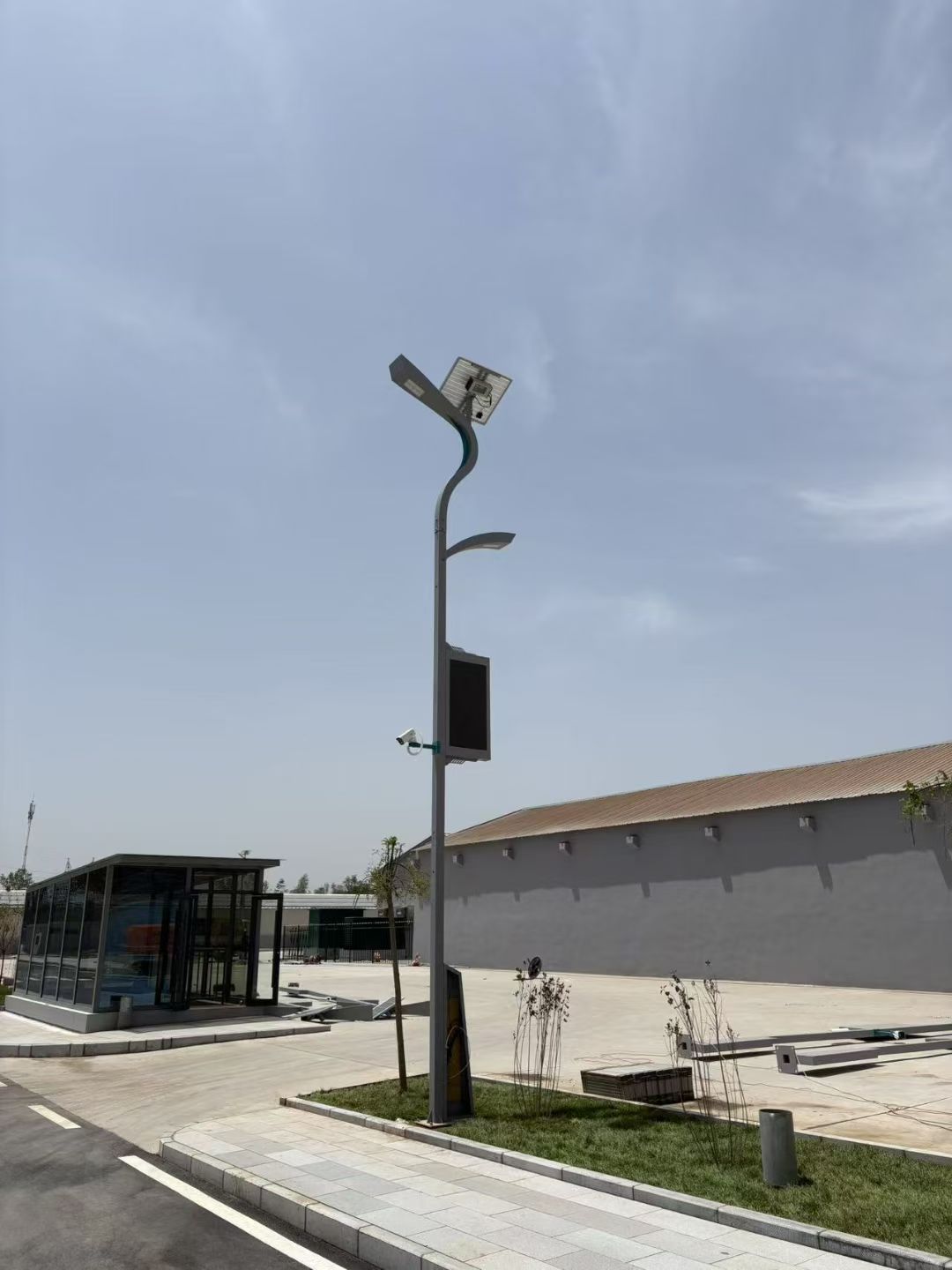
It is important to compare lights by actual lumen output, IES photometric distribution, PV and battery sizing, controller capability, thermal design, and protective rating, rather than by wattage or marketing claims.
4. How Requirements Change by Project Scenario
Different projects require different trade-offs between cost, convenience, and remote-control capability.
Municipal Road Lighting
Municipal projects often involve hundreds of poles spread over a wide area. The priority is usually centralized monitoring, fault detection, and dimming control. For this reason, IoT configurations using 4G, LoRa, WiFi, or Zigbee are more likely to be specified. Operators want to reduce reactive maintenance and respond quickly to outages. A handheld 2.4G remote may still be used during commissioning, but the long-term management depends on the platform.
Rural and Village Roads
In rural projects, budget constraints and lower network availability often favor a simpler approach. A 2.4G handheld remote can be used to set brightness levels and operating hours before the light is installed, or when a maintenance crew visits the site. This reduces the need for network infrastructure while still enabling flexible control.
Industrial Parks and Campuses
Such sites usually have existing network infrastructure and a facility management team. An IoT-based system can be integrated into a building management system or a separate lighting platform. Since the environment may include dust or heat, the enclosure and component selection become important. The remote-control antenna and controller must be compatible with the operating environment.
Coastal and Salt-Exposure Areas
Coastal projects require corrosion-resistant materials and higher protective ratings. The presence of salt spray can affect electrical contacts and enclosure seals. Communication modules, antennas, and connectors must be selected accordingly. It is also necessary to verify that the complete product, including the receiver and controller, has an appropriate IP rating for the intended location rather than assuming every model is IP68.
Hot Desert and Cold-Weather Environments
Temperature extremes affect battery capacity, controller behavior, and electronic stability. The general working-temperature reference is often approximately -20°C to 65°C, but that is model-dependent. A remote-control system that functions well in a warm climate may not have the same reliability at very low temperatures unless the battery and electronics are specifically designed for the project. Final design must consider the specific battery, controller, LED driver, enclosure, and site conditions.
Smart City and Connected Infrastructure
When solar street lights are part of a broader smart-city platform, the remote-control configuration becomes part of the data network. Communication options may include multiple protocols, and the luminaire may be connected to sensors, cameras, or environmental monitors. In this scenario, compatibility between the light controller and the city platform is critical. The buyer should specify the required protocol and the level of data access before procurement.
In all scenarios, the choice between an all-in-one and a split-type system can affect remote-control flexibility. All-in-one systems simplify installation, but split-type systems are often better suited to higher-power or taller-pole projects because they provide greater flexibility for PV, battery, wind-load, and maintenance design.
5. What Buyers Commonly Overlook
Several pitfalls commonly appear in solar street light procurement related to remote control and smart features.
1. Assuming Every Model Has the Same Remote Functions
The phrase "remote control" is often used loosely. One model may support simple on/off or dimming through a 2.4G handheld remote, while another supports full platform management through 4G or LoRa. These are not interchangeable. The buyer should ask which communication protocols are actually available, what functions are supported, and whether the controller can be upgraded or replaced for future needs.
2. Comparing Lights by Wattage
Wattage alone is not a reliable indicator of real performance or energy efficiency. Two lights with the same wattage can produce very different lumen outputs and distributions. Actual lumen output, IES photometric distribution, PV and battery sizing, controller type, thermal design, and protective rating are more important. These factors also influence how well the remote-control system functions in the field because they affect the controller’s power budget and thermal environment.
3. Confusing Component IP Ratings with Complete-Product Ratings
A communication module inside a solar street light may be rated IP67, but that does not mean the complete luminaire is IP67. Many outdoor luminaires use IP65 or IP66 as a common configuration. Selected components or specially designed products may be available in IP67 or IP68, but the full assembled product must have applicable test evidence. Buyers should request the complete-product IP test report and verify the rating for their specific installation site.
4. Ignoring Warranty and Documentation Boundaries
Warranty terms can vary. The standard warranty period for MCL Solar is 5 years, but extended warranty applies only when explicitly specified in the PI or sales contract. Warranty should not be confused with the theoretical lifetime of an LED, battery cycle life, solar panel service life, or pole structural service life. These are different engineering values and should be documented separately.
5. Not Asking for Photometric and Design Support
Lighting design is not a number chosen from a catalogue. For a project with remote-control requirements, the lighting layout should still be checked against the site’s road geometry, pole height, spacing, and target illuminance. According to available documentation, MCL Solar can provide DIALux simulation and IES-based lighting design support for applicable projects. Requesting this information before procurement helps verify that the selected fixture and control configuration will actually meet the project’s lighting standard.
6. Overlooking the MCL Solar Engineering Background
For procurement managers or specifiers, it is useful to know that MCL Solar is backed by a core team with more than 10 years of experience in solar street lighting, outdoor lighting manufacturing, and project solutions. That experience is relevant when discussing remote-control architecture, communication protocols, and the practical constraints of a specific site. More importantly, the buyer should require the same technical rigor in the datasheets and test reports as they would from any system integr
Engineering & Manufacturing Verification at MCL Solar
All commercial solar street lighting luminaires, intelligent MPPT controllers, and Q235 hot-dip galvanized steel poles are manufactured in-house by Zhongshan Chengyu New Energy Technology Co., Ltd. at our 35,000 m² production facility in Guzhen Town, Zhongshan, Guangdong, China.
Explore our verified municipal track record: Saudi Arabia 253 Sets 55°C Desert Highway Project, Philippines Coastal Highway Typhoon-Resistant Installation, or inspect third-party IEC/CE/ISO test reports at our Compliance Verification Center.
Need Engineering Sizing or EPC Tender Support?
Contact MCL Solar’s engineering division for complimentary DIALux road lighting simulations, solar autonomy calculations, and direct factory pricing for municipal and commercial infrastructure projects.