
Case Study Ref: MCL-TJ-SSL-20260806-V6 | Project Location: Hashemite Kingdom of Jordan (Trans-Jordan Municipal & Highway Corridor) | Scale: 1,131 Turnkey Sets | Primary Application: Municipal Arterials, Dual-Carriageway Roadways & Public Infrastructure Lighting
When municipal governments and institutional EPC engineering contractors evaluate a solar street light manufacturer for municipal tenders, generic marketing claims and brochure specifications collapse under technical scrutiny. Large-scale public lighting bids—such as the landmark 1,131-set Trans-Jordan municipal roadway lighting project—require audited electrical calculations, traceable optical certifications (IES LM-79/LM-80), heavy structural wind load engineering, and verified thermal resilience capable of withstanding the Levant’s severe climatic shifts.
This technical whitepaper details the engineering architecture, Bill of Quantities (BOQ), structural pole fabrication drawings, and photometric validation of the 1,131-set 120W split-type solar street lighting system manufactured and delivered by MCL Solar (Zhongshan Chengyu New Energy Technology Co., Ltd.).
1. Project Profile & Operating Environment Challenges
The municipal corridor across Jordan presents severe environmental challenges that frequently destroy commercial-grade and consumer-grade integrated solar lights within 18 to 24 months:
- Extreme Desert Thermal Cycling: Summer ambient temperatures exceed 48°C (118°F) with intense direct solar irradiance exceeding 6.2 kWh/m²/day, followed by sharp winter drops to near-freezing temperatures in high-elevation plateau regions.
- Airborne Particulate & Sandstorms (Chamsin Winds): Fine silica dust coats solar panels and infiltrates luminaire driver compartments, requiring strict IP66/IP68 ingress ratings and optimized tilt angles to facilitate self-cleaning via seasonal rainfall.
- High-Speed Multi-Lane Roadway Illumination: Multi-lane dual-carriageway arterial highways demand uniform roadway luminance (EN 13201 Class M3/M4) and strict glare cutoff (TI < 15%), which compact “all-in-one” solar fixtures with fixed lenses cannot achieve.
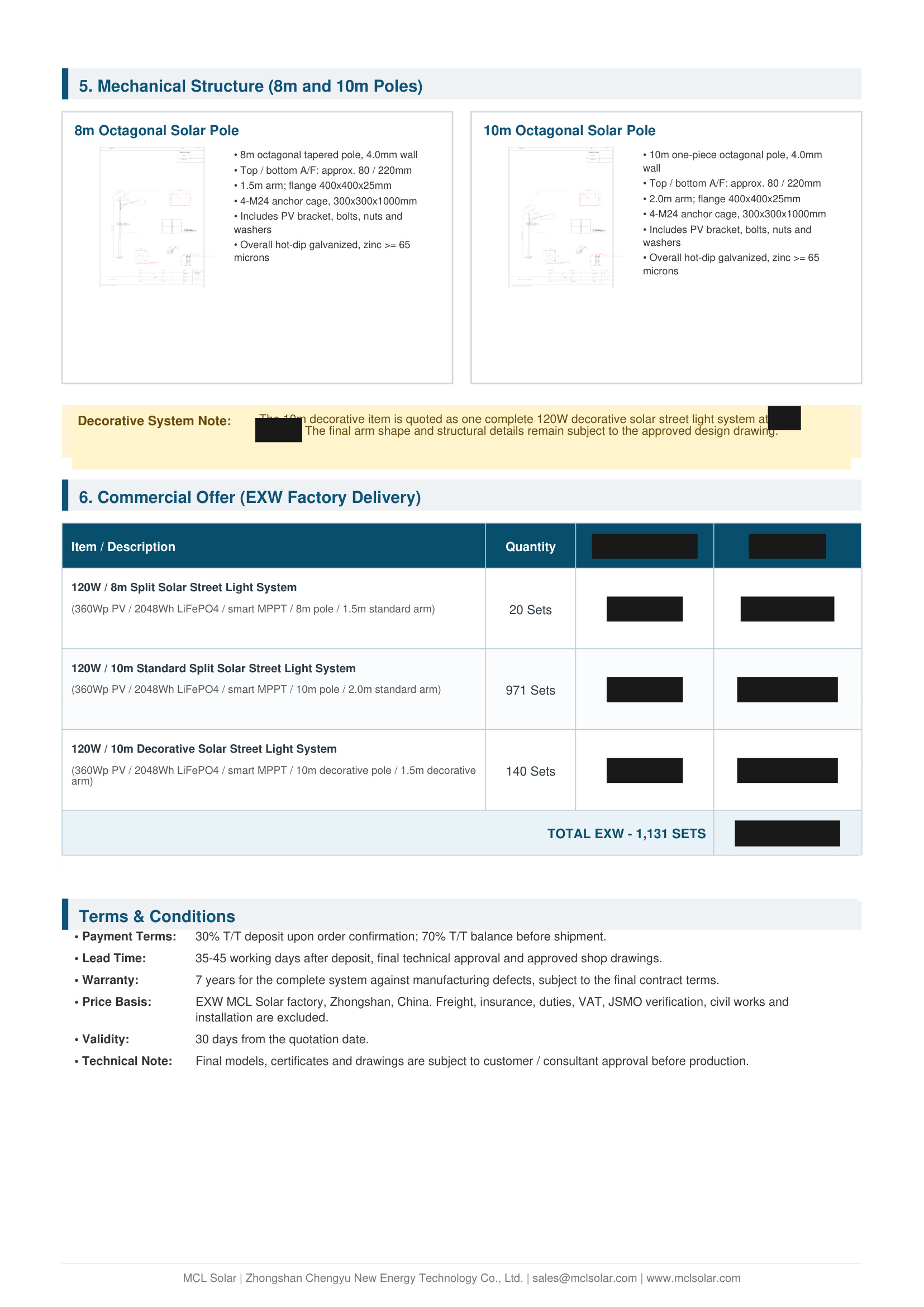
Figure 1: Official Verified Commercial Offer & Bill of Quantities (BOQ) for 1,131 Sets Turnkey Solar Street Lighting Systems across 8M and 10M Configurations (Confidential buyer contact details and unit prices strictly redacted for corporate compliance).
2. 120W Split Architectural System Specifications
To meet the municipal tender requirements, MCL Solar deployed a heavy-duty, fully modular split architecture where optical generation, solar harvesting, energy storage, and structural support are decoupled to maximize thermal dissipation and maintenance accessibility:
| System Subsystem | Technical Engineering Specification | Municipal Tender Compliance Standard |
|---|---|---|
| LED Luminaire & Optical Engine | 120W Heavy-Duty Die-Cast Aluminum Fixture; Philips Lumileds / Bridgelux 5050 SMD; 4000K neutral white; System Efficacy ≥ 180 lm/W at 50°C; Measured flux 20,895 lm. | IES LM-79, LM-80, TM-21 (L70 ≥ 50,000 hrs); IEC 60598-2-3; IP66; IK08. |
| Solar PV Generation Array | 360Wp Total Capacity (2 pcs × 180W Monocrystalline Half-Cut High-Efficiency Modules connected in parallel); 36V nominal bus. | IEC 61215, IEC 61730; PID-Free; Wind load tested up to 2,400 Pa / Snow load 5,400 Pa. |
| Energy Storage (Battery Bank) | 25.6V 80Ah (2,048Wh) Brand-New Grade-A LiFePO4 Chemistry (8S13P configuration, 104 cylindrical cells); Independent ventilated insulated enclosure mounted high on pole; Smart BMS with cell balancing and dual over-temperature cutoff. | UN38.3, IEC 62133 (CB), MSDS; >3,500 cycles @ 80% DOD; 2 full cloudy-day autonomous reserve. |
| Charge Controller & Dimming | Digital Intelligent MPPT Controller; Peak tracking efficiency ≥ 99.9%; IP68 waterproof epoxy encapsulated; 5-stage programmable dimming profile (60% → 100% → 70% → 50% → 30%); 2.4G wireless + 4G IoT telemetry ready. | EN 61000 EMC; Reverse polarity, over-voltage, deep-discharge, and thermal derating protection. |
| Structural Lighting Poles | 8M and 10M Octagonal Tapered Hot-Dip Galvanized Structural Steel (Q235B / Q345B); Wall thickness 4.0mm; Flange 400×400×25mm; 4-M24 anchor bolt cage (300×300×1000mm); Standard 1.5M / 2.0M outreach arms and 10M decorative arm variants. | ASTM A123 / EN ISO 1461 Hot-Dip Galvanizing (Zinc coating ≥ 86μm); Wind gust rating ≥ 160 km/h (AASHTO standard). |
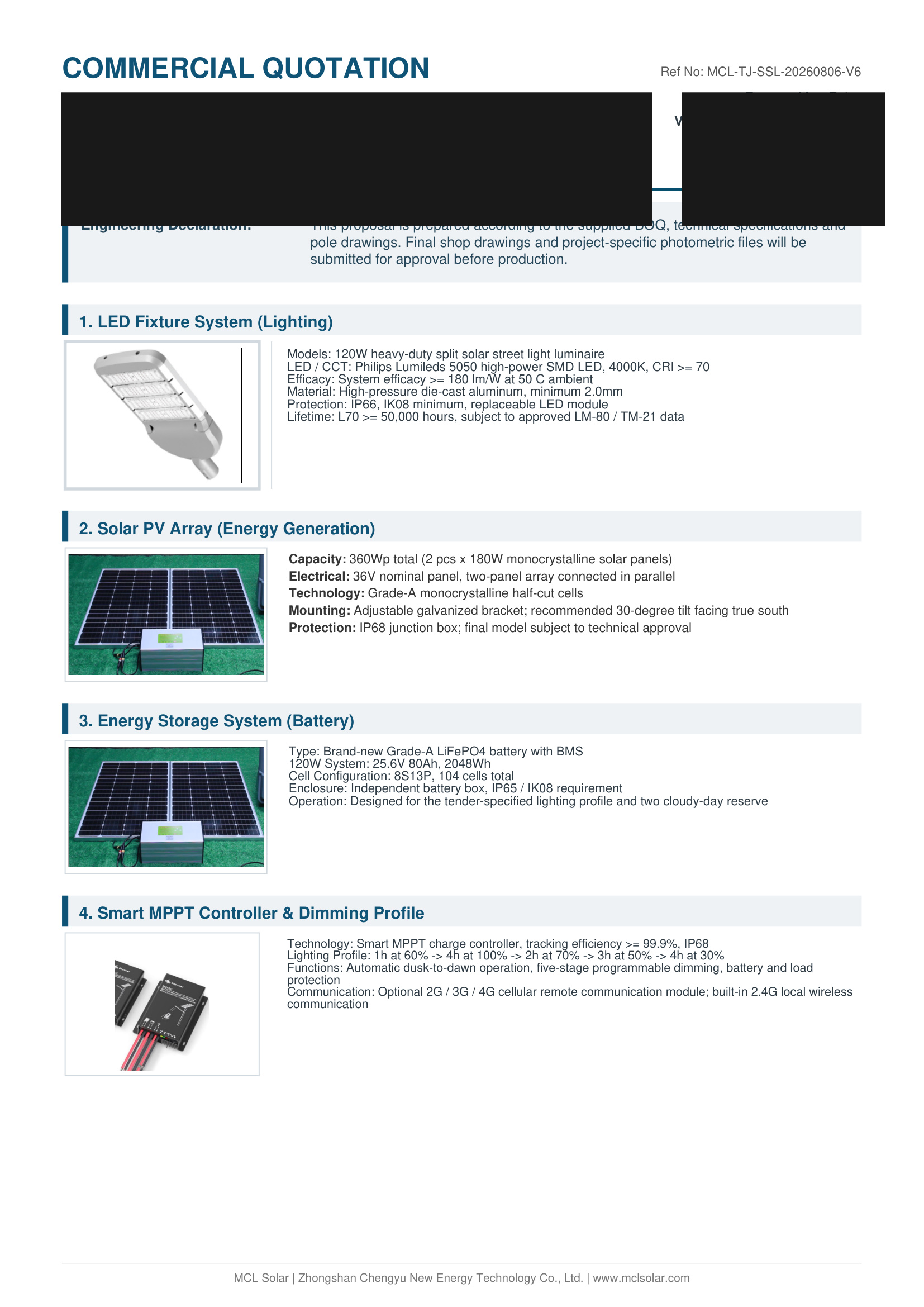
Figure 2: Official Technical Specification Document detailing 120W luminaire, 360Wp solar array, 2048Wh battery bank, and 5-stage smart MPPT dimming schedule.
3. Certified Photometric Performance: EVERFINE GO3000H Test Data
Municipal roadway authorities require certified IES photometric data to verify that luminaires produce adequate Lux levels on the road surface without wasting energy through light trespass or upward skyglow. The MCL-GL100 luminaire was rigorously tested via the EVERFINE GO-3000H Goniophotometer System (Report Test Date: August 5, 2026):
- Total Luminous Flux: 20,895.7 lm at 120W nominal power (174.1 lm/W actual fixture system efficacy).
- Peak Luminous Intensity (Imax): 9,129 cd at γ = 60°, C = 0° (Batwing distribution).
- Beam Angle (50%): 106.9 degrees lateral spread, conforming to Type II-M / Type III-M Roadway Distribution.
- Downward Luminaire Flux Ratio (DLR): 99.0% directed toward the pavement; upward light ratio restricted to 1.0%, eliminating urban light pollution.
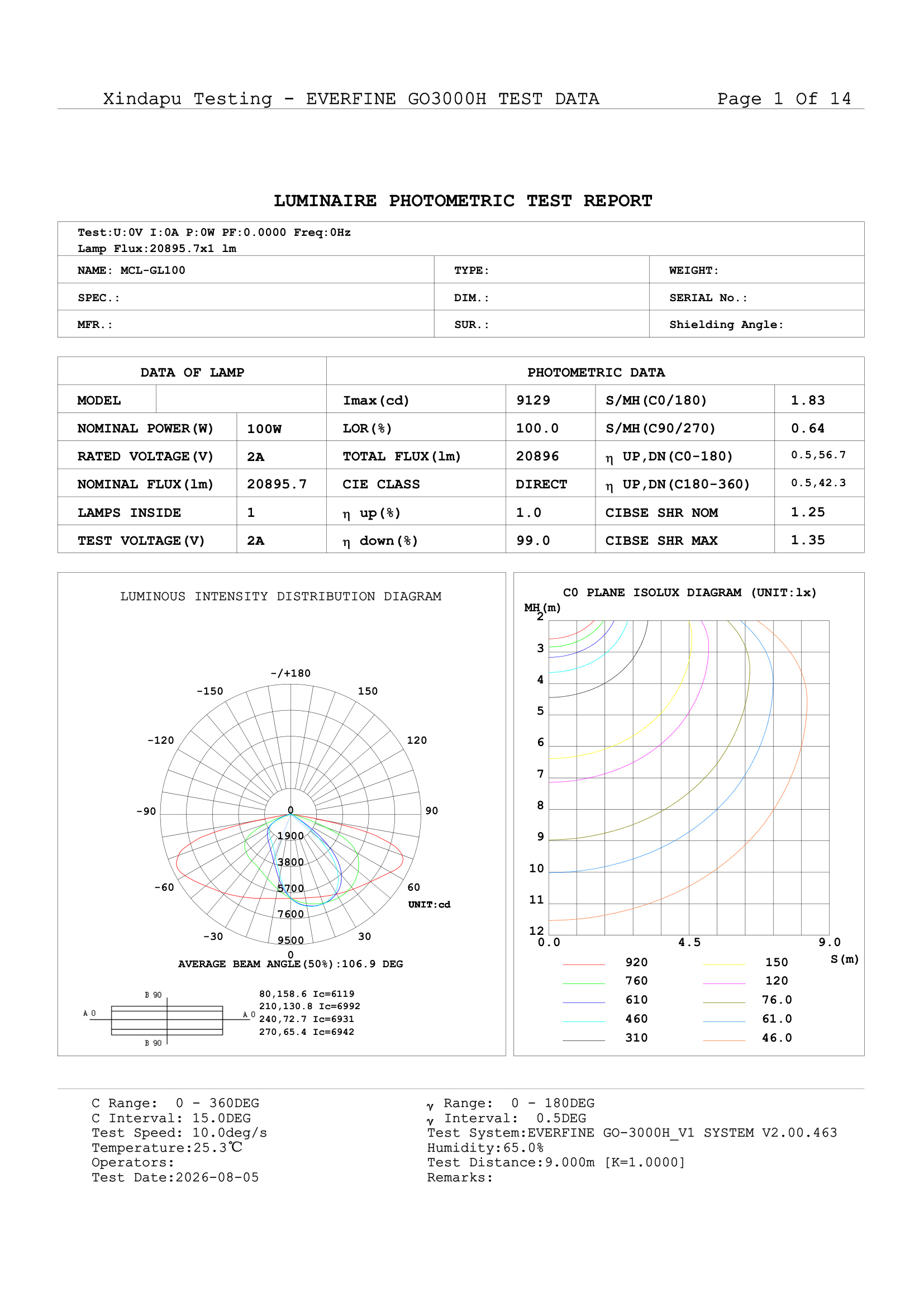
Figure 3: Laboratory Goniophotometric Test Report (EVERFINE GO3000H) verifying 20,895.7 lm output, batwing polar curve, and C0 Plane Isolux diagram for 8M-12M pole mounting heights.
4. Structural Engineering: 8M & 10M Octagonal Hot-Dip Galvanized Poles
In highway infrastructure tenders, wind-induced vibration and gust fatigue are the number-one structural failure causes. Because split solar systems place large 360Wp photovoltaic panels at the pole top, the wind drag moment requires precise mechanical engineering:
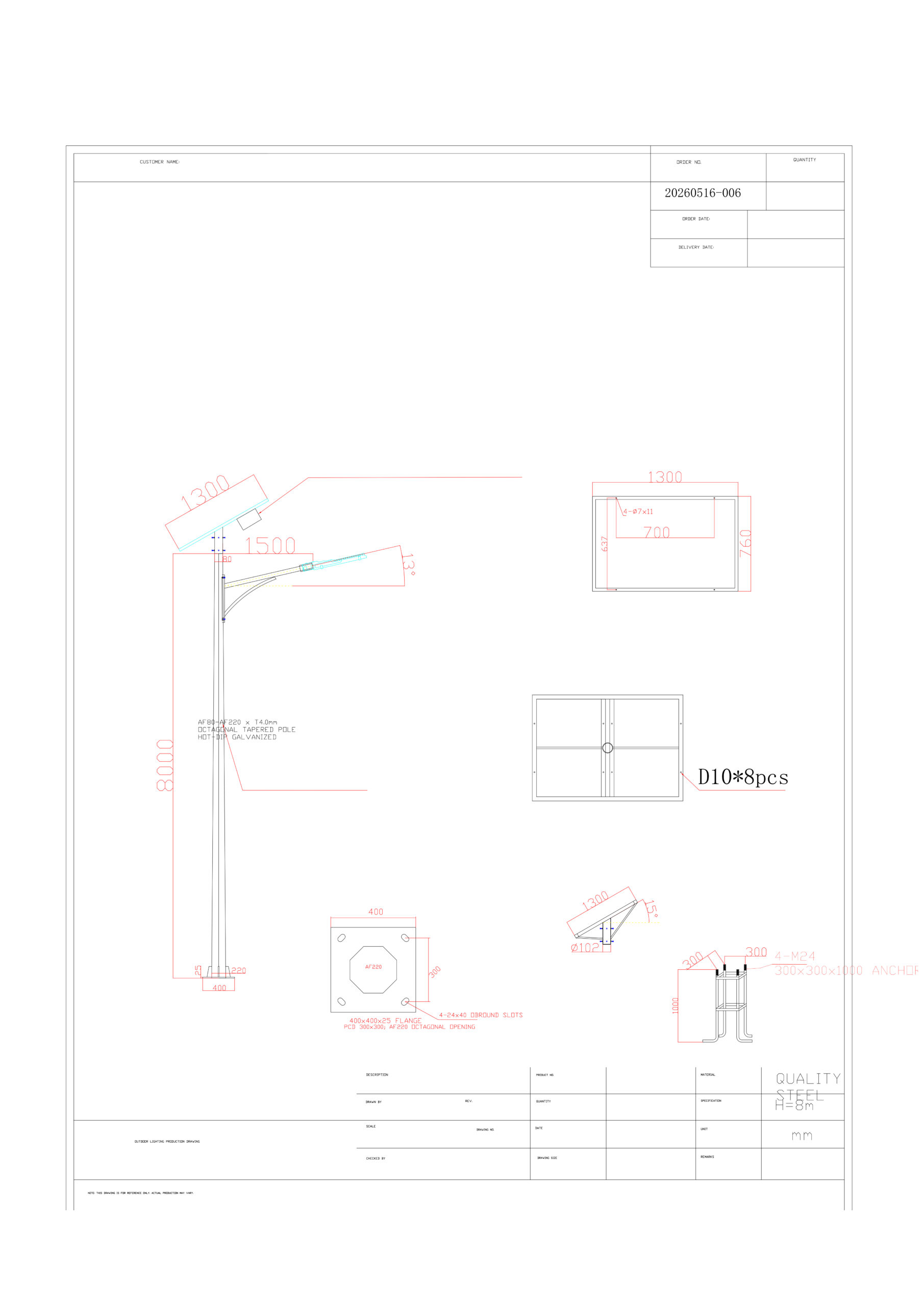
8M Octagonal Pole Drawing (Ref: 20260516-006)
AF80/220mm, 4.0mm wall, 1.5M arm, 4-M24 anchor cage
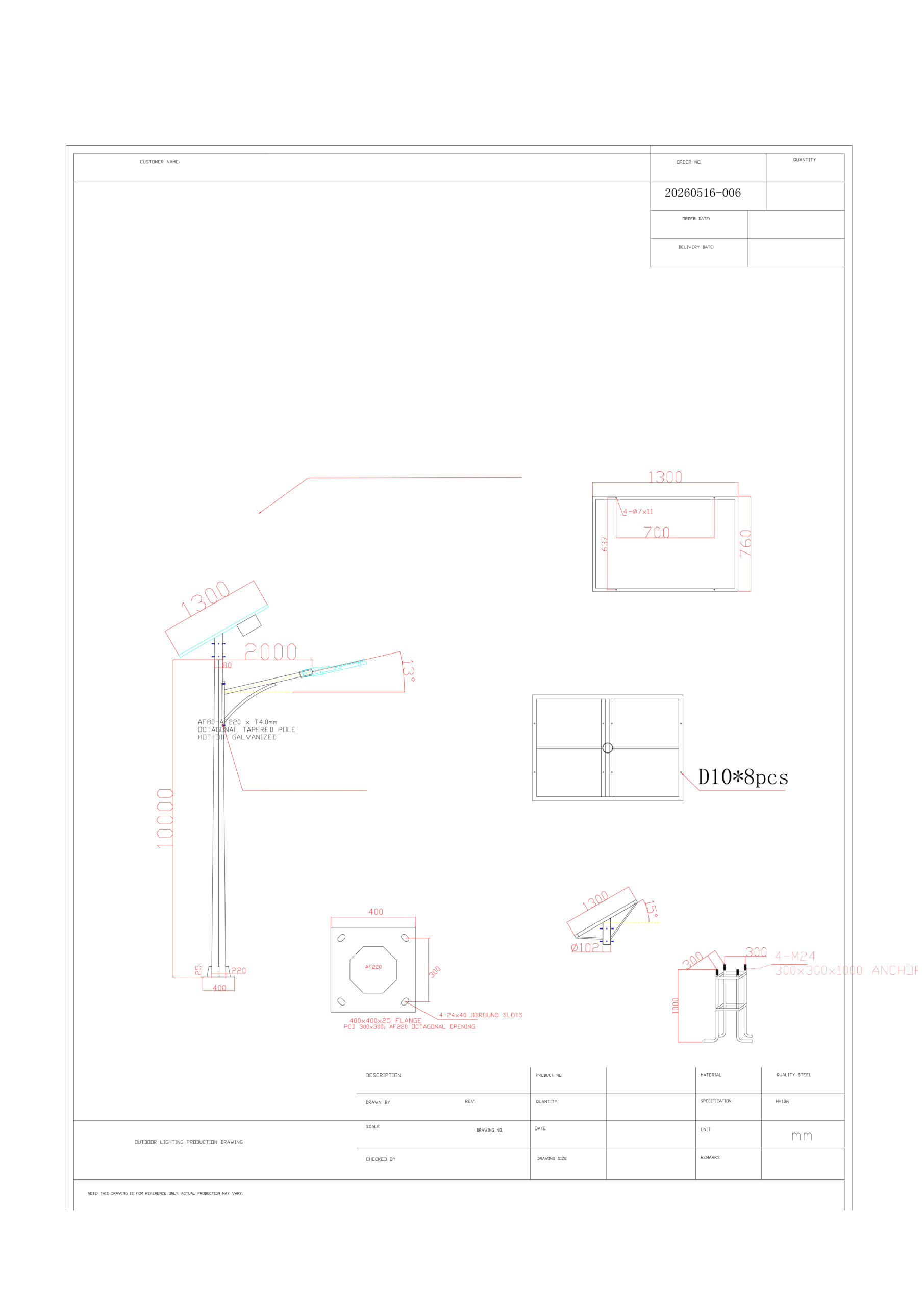
10M Octagonal Pole Drawing (Ref: 20260516-006)
AF80/220mm, 4.0mm wall, 2.0M arm, 4-M24 anchor cage
Key structural manufacturing features:
- One-Piece Octagonal Tapered Geometry: Formed by automated 1,200-ton CNC bending presses, offering 35% higher torsional rigidity against wind-vortex shedding compared to standard round steel tubes.
- Heavy-Duty Flange Plate: 400 × 400 × 25 mm solid Q235B steel base plate with 4 slotted holes (PCD 300 mm), anchored by an integrated 4-M24 × 1000 mm high-tensile steel foundation cage.
- Corrosion Protection per ISO 1461: Fully submerged hot-dip galvanizing inside and out with minimum 86μm (610 g/m²) zinc coating thickness, delivering over 30 years of maintenance-free service in arid soil and airborne salt environments.
5. Benchmarking: MCL Solar Municipal Standard vs. Assemblers & Traders
When selecting a solar lighting partner for public tenders, procurement committees face massive quality variations across Chinese manufacturers. The following matrix contrasts MCL Solar’s institutional standard against low-tier assemblers:
| Evaluation Factor | MCL Solar Institutional Specification | Generic Trading Company / Small Assembler | International Tender Impact |
|---|---|---|---|
| Battery Cell Grade & Thermal Enclosure | 100% Brand-New Grade-A LiFePO4; 25.6V bus; Independent insulated high-pole housing; Cell delta < 15mV; 3,500+ cycles @ 80% DOD. | Recycled/Grade-B 3.2V cells; Cramped inside hot luminaire head (over 70°C); Degrades in 12–18 months. | Eliminates premature battery replacement and mid-project EPC warranty liabilities. |
| Photometric & Optical Certifications | EVERFINE Goniophotometer Test Data (20,895 lm); Type II-M batwing curve; DIALux photometric IES files supplied for M3/M4 road compliance. | Faked lumen ratings (theoretical LED chip lumen multiplied by count); No real goniophotometer laboratory files. | Ensures mandatory pass on municipal lighting auditor DIALux simulation audits. |
| Structural Pole Wall Thickness & Coating | 4.0mm solid structural steel; Hot-dip galvanized ≥ 86μm inside & outside; 25mm flange; 160 km/h wind resilience calculation. | Sub-gauge 2.5mm–3.0mm wall; Cold electro-galvanized paint (< 20μm); Rusts within 2 years; Bends under high winds. | Protects against catastrophic pole shearing and municipal infrastructure safety risks. |
| Manufacturing Footprint | 35,000 m² Guzhen dedicated manufacturing base; In-house CNC bending, SMT high-speed placement, automated laser welding, and darkroom test bays. | Rented commercial office trading firm; Outsourced sub-assembly with zero quality control traceability. | Allows institutional buyers and third-party inspectors (SGS, TÜV, Intertek) to conduct on-site factory audits. |
6. Global Reference Projects & Strategic Internal Linking
MCL Solar’s 1,131-set Jordan project forms part of a worldwide portfolio of verified institutional off-grid installations:
- Heavy-Duty Highway Infrastructure: For multi-lane expressways, inter-city bypasses, and 8-12 meter municipal arterials, explore our flagship 8-12m Two-In-One Split Type Solar Street Light engineered for 180-210 lm/W highway illumination.
- Comprehensive Technical Selection Guide: Consult our detailed engineering benchmark: All-in-One vs. Split Solar Street Lights for Highways & Coastal Corridors (C5-M Guide).
- Severe Coastal Environment Validation: Review our Senegal Sendou Coal Power Station 150 Sets Coastal Solar Lighting Project operating under ISO 12944 C5-M extreme marine salt spray.
- Large-Scale High-Autonomy Roadway Project: Examine the Algeria 978 Sets National Highway Split Solar Street Light Installation.
- Official Project Repository: Access full project photo galleries, audited BOQs, and customer handover documents on the MCL Solar Official Project Showcase.
7. Frequently Asked Questions (FAQ) for Municipal Procurement Committees
Q1: Why are split solar street lights mandatory for multi-lane municipal highways instead of all-in-one units?
Multi-lane municipal expressways require 60W to 150W+ LED loads producing 10,000 to over 20,000 lumens to achieve mandatory EN 13201 road luminance and uniformity. In compact all-in-one fixtures, the solar panel area is restricted by the luminaire housing (rarely exceeding 60Wp–80Wp), and lithium batteries trapped beneath the sun-baked panel exceed 70°C, causing premature failure. Split solar systems decouple the 360Wp+ photovoltaic array and 2000Wh+ battery, enabling precise latitude tilt angles and superior thermal longevity.
Q2: What pole wall thickness and coating standards are required for 8M–10M solar street lights?
Because large 360Wp solar panels create significant wind drag (wind loading area approx. 1.8–2.2 m²), poles must feature a minimum 4.0mm wall thickness in structural steel (Q235B or Q345B) paired with heavy internal and external hot-dip galvanizing per ASTM A123 / ISO 1461 (≥ 86μm zinc layer). Flanges must measure at least 400×400×25mm secured by 4-M24 foundation anchor cages to withstand 160 km/h wind gusts.
Q3: How does MCL Solar ensure battery longevity in desert environments like Jordan and Saudi Arabia?
MCL Solar utilizes 100% brand-new Grade-A LiFePO4 cylindrical cells assembled in high-voltage 25.6V bus configurations (such as 8S13P). The battery bank is housed in a separate double-walled, ventilated aluminum-alloy compartment positioned high on the pole arm. This structure provides continuous shade and natural convective cooling, keeping cell operating temperatures below 45°C even when ambient desert air exceeds 50°C.
Q4: What third-party documentation does MCL Solar provide for municipal tender technical proposals?
For every municipal tender submission, MCL Solar delivers a turnkey engineering compliance dossier, including: (1) EVERFINE Goniophotometer IES / LDT photometric distribution files for DIALux road lighting simulations; (2) Lumileds/Bridgelux LM-80 / TM-21 test reports verifying >50,000 hrs L70 lifespan; (3) Structural pole wind-moment calculation sheets; (4) CE, RoHS, IEC 60598-2-3 CB safety certificates; and (5) ISO 9001:2015 audited manufacturing credentials.
Direct Turnkey Manufacturing by MCL Solar (Zhongshan Chengyu)
MCL Solar operates a 35,000 m² dedicated manufacturing base in Guzhen Town, Zhongshan City, China. We engineer and manufacture complete commercial solar lighting systems in-house—including high-pressure die-cast fixtures, automated SMT LED placement, smart digital MPPT controllers, Grade-A LiFePO4 battery pack assembly, and octagonal structural steel pole fabrication.