
2026 EPC Technical Whitepaper & Municipal Sourcing Standard
Target Applications: Multi-Lane Highways, National Arterial Corridors, Coastal Industrial Ports, Marine Power Stations •
Technical Standards: EN 13201 Class M1-M3, ISO 12944 C5-M Duplex Anti-Corrosion, ASTM A123 Hot-Dip Galvanizing •
Engineering Authority: MCL Solar Technical Division (Zhongshan Chengyu New Energy Technology Co., Ltd.)
1. Executive Summary: Why Low-Power All-in-One Units Fail on Major Roadways
Across global municipal road and infrastructure procurement tenders, a frequent engineering debate arises between Integrated “All-in-One” Solar Street Lights and Heavy-Duty “All-in-Two / Split-Type” Solar Street Lighting Systems. While all-in-one units dominate rural village pathways and garden perimeters due to low upfront freight costs, attempting to deploy them on high-speed expressways or coastal arterial corridors consistently results in systemic failure within 12 to 24 months.
Highways and industrial coastal corridors impose uncompromising mechanical, optical, and thermal demands that physics simply prevents compact all-in-one units from fulfilling:
- Multi-Lane Optical Requirements (EN 13201 M1-M3): High-speed roadways mandate average road luminance \(L_{av} \ge 1.5 – 2.0 ext{ cd/m}^2\) and overall uniformity \(U_0 \ge 0.4\). Delivering this from mounting heights of 8.0 to 12.0 meters requires sustained, true optical fluxes of 16,000 to 42,000 lumens. Standard all-in-one lights rarely deliver more than 6,000 to 9,000 actual lumens without catastrophic battery depletion in under 3 hours.
- Extreme Thermal Runaway in Hot Climates: In desert corridors (such as Saudi Arabia or the Sahara in Algeria), housing lithium batteries directly beneath a dark solar panel exposed to zenith solar radiation generates internal enclosure temperatures exceeding +85°C, accelerating electrolyte boiling and causing premature cell death.
- C5-M Marine Saline Corrosion: Coastal causeways, marine port perimeters, and shoreline power facilities (such as power generation plants in Senegal or island networks in Comoros) face dense saline salt spray that dissolves standard paint coatings and induces galvanic lock on low-grade fasteners.
For primary national highways, expressways, and heavy municipal corridors, international EPC contractors standardize on the engineered 8-12M Two-in-One Split Type Solar Street Light platform.
2. Comprehensive Technical Comparison: All-in-One vs. 8-12M Split Highway Systems
The table below outlines the critical engineering differences between standard all-in-one consumer lights and industrial-grade 8-12M split solar systems:
| Technical Parameter | Compact All-in-One Solar Light | MCL Solar 8-12M Two-in-One Split System |
|---|---|---|
| True Luminous Output | 3,000 – 8,000 lm (frequently exaggerated on market labels as “500W”) | 16,000 – 42,000 lm verified (calibrated at 160–210 lm/W chip efficacy) |
| Mounting Height & Spacing | 4.0m – 6.0m height; max 18m – 22m pole spacing | 8.0m – 12.0m height; 35m – 45m pole spacing (slashes total project pole civil works by 50%) |
| PV Panel Size & Orientation | Fixed horizontal/flat on luminaire top (compromised winter solar harvest) | 200W – 450W independent array, latitude-optimized tilt (15°–45°) capturing 25-35% more annual kWh |
| Battery Architecture & Thermal | Integrated directly beneath PV glass; internal temps >85°C cause rapid capacity loss | 25.6V 1,280Wh – 2,560Wh Grade-A LiFePO4 in rear suspended or underground enclosure (-20°C to +75°C) |
| System Electrical Voltage | 3.2V or 12.8V (high current causes severe \(I^2R\) cable heat losses) | 25.6V High-Voltage Bus (cuts circuit current in half, reducing line resistive power losses by 75%) |
| Structural Pole & Wind Rating | Lightweight thin-wall pipe (2.0mm); vulnerable to vortex shedding & gale deflection | Heavy-gauge Q235 conical steel (3.5mm–4.5mm wall), 300x300x12mm base flange with gussets (160 km/h typhoon rated) |
| Anti-Corrosion Rating | Single-layer powder or electro-galvanized (C2/C3 rating; blisters in saline air) | Duplex C5-M Marine Rating: ASTM A123 Hot-Dip Galvanizing ≥86μm + 80-90μm Electrostatic Powder (HD1330) |
3. Deep-Dive: ISO 12944 C5-M Duplex Anti-Corrosion for Coastal Power Stations & Shoreline Highways
When lighting infrastructure operates within 1 to 3 kilometers of open oceanic coastlines, atmospheric corrosion accelerates drastically. In ISO 12944-2, this is classified as C5-M (Marine Very High Atmospheric Corrosivity Category).
Standard galvanized steel poles exposed to marine saline winds experience zinc loss rates of 4.2 to 8.4 μm annually. A standard 50 μm electroplated or low-grade dip is consumed in under 8 years, exposing base steel to rust bloom and catastrophic structural buckling.
To guarantee a 25-year structural design life on coastal projects—such as our landmark deployment of 150 turnkey sets for the Sendou Coal-Fired Power Station in Senegal—MCL Solar enforces a proprietary Duplex C5-M Surface Treatment Protocol:
- Substrate Metallurgy & Immersion Hot-Dip Galvanizing: Q235 structural steel poles are precision cut, submerged-arc welded, shot-blasted to Sa 2.5 cleanliness, and totally submerged in a 450°C molten zinc kettle. This forms multi-layer metallurgical zinc-iron alloys (\(\Gamma\), \(\delta\), \(\zeta\), \(\eta\)) achieving an impermeable barrier thickness exceeding 86 μm (exceeding ASTM A123 / ISO 1461).
- Mechanical Sweep-Blasting: Prepares the crystalline zinc surface to create a microscopic anchor profile of 20–30 μm without damaging the underlying zinc layer.
- Architectural Duplex Powder Armor (Confirmed Swatch HD1330 70027): Electrostatic application of pure outdoor polyester powder formulated for extreme UV and saline environments. Applied at 80–90 μm and thermal-cured in a curing oven at 200°C for 10 minutes, creating an impermeable polymer barrier tested to withstand 1,500 hours of ASTM B117 salt spray exposure with zero blistering or creepage.
- All-Stainless Fastener Assembly: All external nuts, bolts, set screws, and spring washers are strictly specified in Grade 304 / Grade 316 stainless steel to prevent galvanic thread seizure.
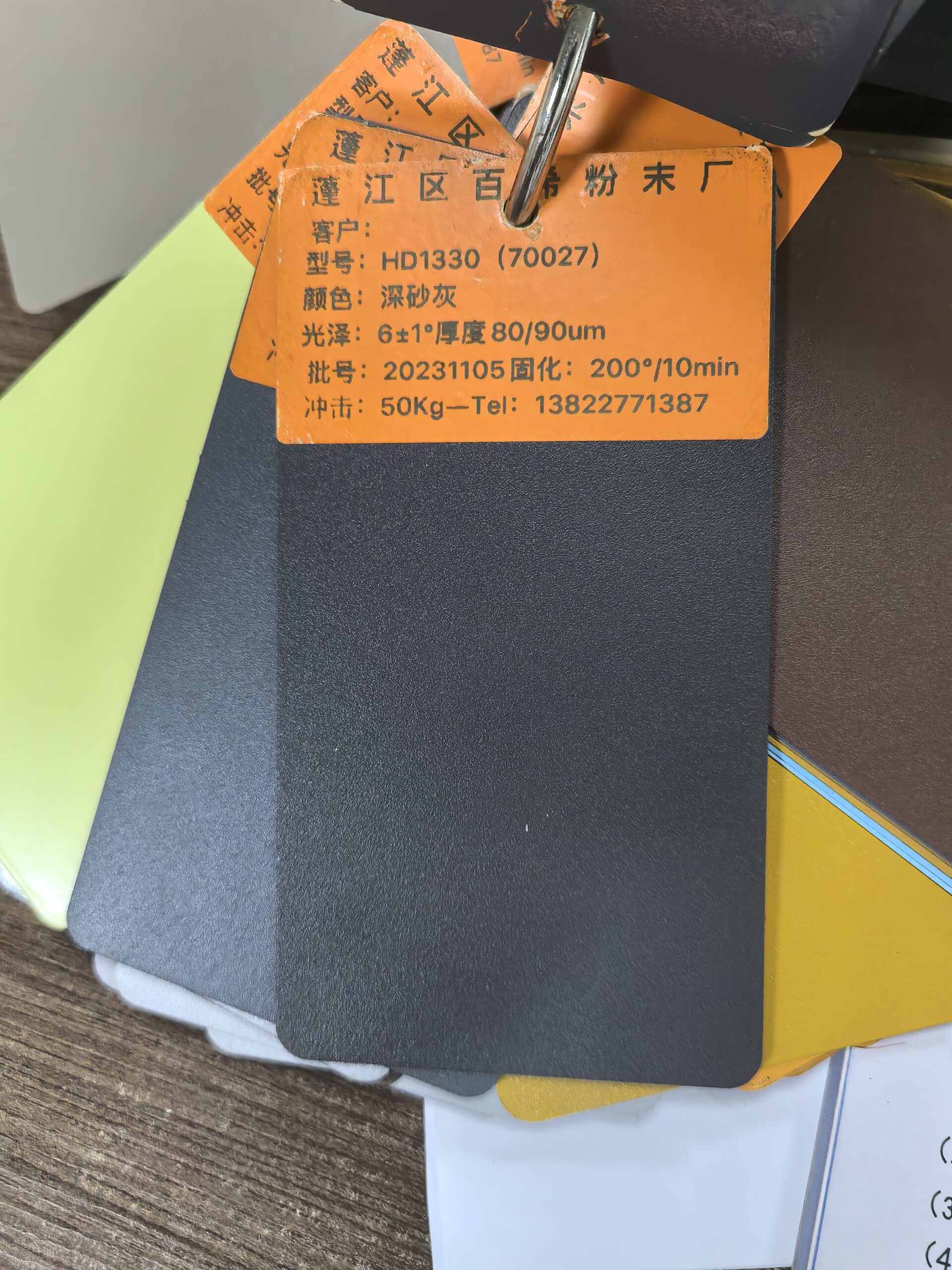
Official Factory QA Inspection Coupon: Electrostatic powder coating test swatch HD1330 (70027 Deep Sand Gray, 80–90μm, cured at 200°C/10min, 50kg impact test passed).
4. Real-World Field Verification: Major International Deployments
Unlike trading agents who broker unverified components, MCL Solar (Zhongshan Chengyu New Energy Technology Co., Ltd.) manufactures complete turnkey systems in our 35,000 m² production base, backed by documented international utility contracts:
- Algeria National Highway Infrastructure (978 Sets 200W / 10M Split): Deployed across Sahara highway corridors for Dr. Bouzaki. Features 200W luminaires (32,000 lumens), 200W monocrystalline PV, 1,536Wh LiFePO4 batteries, and 10M Q235 conical poles with structural gusset reinforcements. (View Algeria Case Study →)
- Senegal Sendou Power Station Coastal Corridor (150 Sets 80W / 8M C5-M Split): Deployed along the Atlantic ocean perimeter for Compagnie d'Électricité du Sénégal (CES). Features 80W Philips luminaires (EVERFINE GO-3000H tested), 250W dual parallel PV, 25.6V 1,280Wh LiFePO4 batteries, and C5-M duplex powder coated 8.0M poles. (View Senegal Case Study →)
- World Bank Comoros Island Electrification (520 Sets Coastal Split): Multi-island deployment across Grande Comore, Mohéli, and Anjouan, engineered for high-humidity tropical cyclones and saline exposure. (View Comoros Case Study →)
- Saudi Arabia Desert Highway Project (253 Sets 120W High-Temp Split): High-ambient corridor lighting for Bin Dawood Trading with specialized +65°C LiFePO4 thermal enclosures. (View Saudi Arabia Case Study →)
5. Frequently Asked Questions (FAQ) for Highway & Coastal Solar Lighting Tenders
Q1: Why are split solar street lights strictly required for multi-lane highways instead of all-in-one lights?
Highways require high mounting heights (8.0m to 12.0m) and wide pole spacing (35m to 45m), demanding 16,000 to 42,000 true lumens. All-in-one lights are physically constrained by their housing dimensions, unable to accommodate the 200W–450W solar panels and 1,280Wh–2,560Wh battery banks needed to sustain high-power lighting throughout the night. Furthermore, split systems allow optimal solar panel tilt angles (15°–45°) toward the sun, capturing 25% to 35% more winter energy than flat-mounted all-in-one panels.
Q2: What anti-corrosion coating specification is mandatory for solar street lights in coastal and marine C5-M environments?
For ISO 12944 C5-M (Marine Very High Corrosivity) zones within 3km of an ocean, a single paint or thin zinc layer will fail prematurely. The international standard requires a Duplex System: primary full immersion hot-dip galvanizing to ASTM A123 / ISO 1461 with a minimum zinc thickness of ≥86 μm, followed by mechanical sweep-blasting and an electrostatic outdoor architectural polyester powder coating applied at 80–90 μm and cured at 200°C (such as sample HD1330 Deep Sand Gray). In addition, all exterior hardware must be Grade 304 or Grade 316 stainless steel.
Q3: How does a 25.6V high-voltage battery architecture benefit commercial solar street lights over 12.8V or 3.2V systems?
By standardizing a 25.6V bus, operating current is halved compared to 12.8V systems and reduced by nearly 90% compared to 3.2V systems for the same wattage output. Because cable resistive heat losses follow the formula \(P_{loss} = I^2 R\), cutting current in half reduces resistive thermal energy losses by 75%. This eliminates voltage drop over tall 10m–12m poles, lowers operating temperatures, and extends the cycle life of Grade-A LiFePO4 cells beyond 3,500 cycles at 80% DOD.