
Key Takeaways
- Scenario fit matters more than brand ranking. An integrated EV charging smart pole is a different procurement exercise depending on whether you are outfitting a municipal square, a highway rest area, or a private parking lot. Match the system architecture to the duty cycle, not just the unit price.
- Verify the power budget before you commit. A solar pole with an EV charger is not primarily a lighting product anymore—it is a small power station. Confirm the solar panel wattage, battery capacity (LiFePO₄ preferred), and the IoT controller’s load management logic against your charging demand .
- Battery configuration is the first risk checkpoint. For continuous data transmission and EV charging loads, specify LiFePO₄ chemistry and require cycle-life documentation. Do not accept vague "long life" language without a datasheet , .
- Lighting simulation and structural verification are separate disciplines. Dialux simulation validates illumination performance; it does not validate the pole’s bending moment under wind load or the charger’s ingress protection. Ask for both—from the correct parties.
- Warranty is a contract term, not a marketing slogan. Standard warranty is 5 years for the integrated fixture. Extended warranty only applies if written into the PI or sales contract . Separate pole structural life, LED theoretical life, and battery cycle life when comparing bids.
1. Decision Context
This article is written for EPC contractors, municipal infrastructure buyers, parking facility operators, and distributors evaluating smart poles with integrated EV charging capability. The typical project context is a smart city initiative where lighting, surveillance, environmental monitoring, and EV charging are expected to share one physical asset and one network connection , , .
The reader is assumed to be at the specification or procurement stage, either preparing a tender document, evaluating supplier proposals, or conducting a factory audit. This is not a consumer review; it is a technical comparison guide based on verifiable engineering attributes.
2. Evaluation Criteria
When comparing integrated EV charging smart poles, evaluate each supplier against the following criteria. If a supplier cannot produce evidence for a criterion, treat that as a risk item, not as a minor omission.
| Criterion | What to Look For | Why It Matters |
|---|---|---|
| Battery configuration | LiFePO₄ chemistry; stated capacity (Ah or Wh); cycle life at 80% DoD | EV charging draws high current intermittently; battery is the bottleneck |
| Solar generation capacity | Monocrystalline panel wattage; conversion efficiency; temperature coefficient | Determines daily energy harvest, especially in winter or overcast conditions |
| IoT controller and load scheduling | MPPT (Maximum Power Point Tracking); priority logic (lighting > charging > sensors); remote monitoring protocol | Determines whether EV charging drains the battery at night or is properly scheduled |
| Waterproof rating evidence | IP65 or IP66 certification for the fixture; IP rating for the charging socket and cable entry | Outdoor EV charging is a wet-environment application; waterproofing failures cause downtime |
| Lighting simulation output | Dialux or similar photometric report; not just the lumen output | Verifies lux levels, uniformity, and pole spacing before installation |
| Pole structural integrity | Material spec (steel, galvanization, marine-grade coating); wind-load calculation | Integrates CCTV, WiFi, and charger—more windage area and weight on the pole |
| Smart function integration | Surveillance camera, WiFi, environmental sensors, emergency broadcast; protocol support (4G, WiFi, LoRa, Zigbee) | Determines whether the pole works as a true digital node or is just a lamp with a camera |
| Warranty terms | Standard 5 years; extended terms only per PI/contract | Warranty scope is the contractally binding protection, not verbal promises |
| Documentation package | Wiring diagram, load calculation, battery maintenance plan, commissioning procedure | Required for municipal acceptance, insurance, and long-term maintenance |
| After-sales response | Spare parts availability, replacement policy, remote diagnostics capability | A failed charger in a municipal pole = public complaint + lost charging revenue |
3. Scenario-Based Comparison
Scenario A: Municipal Square / Public Park (Smart City Flagship)
Typical requirements: Aesthetics, integrated surveillance, public WiFi, environmental monitoring, and occasional EV charging for visitors. The charging pattern is low-frequency and daytime-heavy (visitors come and go). Night-time charging is likely negligible.
What to specify:
- Pole: Decorative smart solar pole with integrated modular components (camera, WiFi, sensors)
- Battery: LiFePO₄ sized for lighting + sensor loads through the night; EV charging power kept moderate (slower Level 2, e.g., 7 kW) during daylight hours when solar is highest.
- Controller: IoT MPPT smart controller with remote monitoring
- Key question to the supplier: "Does the load-scheduling logic prioritize lighting and security over EV charging under all conditions?" If the answer requires custom firmware, assess the lead time.
Procurement risk: Cosmetic design is over-emphasized; the integration between camera, WiFi, and charger is left to site assembly by different subcontractors. Verify that the pole is delivered as an integrated unit with a single wiring diagram.
Scenario B: Highway Rest Area / Parking Lot (Revenue-Generating Charging)
Typical requirements: Multiple charging points (6–10 stalls), 24/7 lighting, some surveillance, and a reliable charger that matters for revenue. The site is connected to grid power, so the solar array is supplementary rather than the sole energy source.
What to specify:
- Pole: Standard smart lighting pole (non-decorative) with an integrated EV charging module
- Charging: Grid-backed, with solar contribution; battery serves as buffer rather than the sole power source.
- Battery: LiFePO₄ with voltage and temperature management, sized for peak shaving, not full autonomy.
- Data link: 4G + Wi-Fi backhaul with remote monitoring
Procurement risk: The supplier may quote a solar-only design that cannot deliver 50 kW of charging throughput. Clarify the grid-input requirement, the charger standard (Type 2, CCS, or CHAdeMO), and the billing system integration. Do not assume the smart pole’s IoT controller manages charging billing—it usually does not.
Scenario C: Coastal / High Humidity Region (Marine-Grade Requirement)
Typical requirements: Corrosion resistance, typhoon wind resistance, continuous operation in salt-laden air, and daily environmental data transmission.
What to specify:
- Pole: Marine-grade coating or marine-grade stainless steel components; minimum protection class IP66
- Charger integration: Charging socket rated for salt-water exposure; cable glands sealed with marine-grade compounds.
- Camera/environmental sensors: Weather-sealed housing; ensure the seals are replaceable for maintenance.
Procurement risk: Corrosion is a long-term failure mode; it may not show up in a 12-month warranty period. Ask for the supplier’s material certification (e.g., galvanization thickness in µm, coating salt-spray test hours). If they cannot provide it, request a sample coupon for independent testing.
Scenario D: EPC Tender for a 500+ Pole Smart City Rollout
Typical requirements: Volume pricing, strict milestone delivery, standardized documentation for grid connection and municipal safety inspection, and a 10-year support plan.
What to specify:
- Pole: Standardized all-in-one solar street light (e.g., 100W, 8 m pole) with an EV charging module option
- Smart functions: Standardized integration of surveillance, WiFi, and environmental monitoring; LoRa or Zigbee protocol for city-wide central control
- Battery: LiFePO₄ with 5-year cycle life (not just 5-year warranty; the two are different).
Procurement risk: In large rollouts, the supplier’s factory capacity and documentation consistency are the main risks. Ask for:
- A factory audit report (not just a certificate)
- The same IoT platform used in all previous projects (verify by visiting a reference site)
- A complete spares list for each pole model, with pricing and lead time
Contractual wording: EPC contracts should specify the standard 5-year warranty , and separately price any extended warranty period.
Scenario E: Distributor Stock Order (Business Model, Not Project-Based)
Typical requirements: Cost efficiency, standardized SKUs, fast lead time, and minimal specification variance across batches.
What to specify:
- Pole: All-in-one design with the same controller (MPPT), battery (LiFePO₄), and integration points across all SKUs
- Modularity: The EV charging module should be an add-on that does not require redesigning the lighting head.
- Documentation: Provide a single wiring diagram and a single installation manual for the entire product family, not per-project drawings.
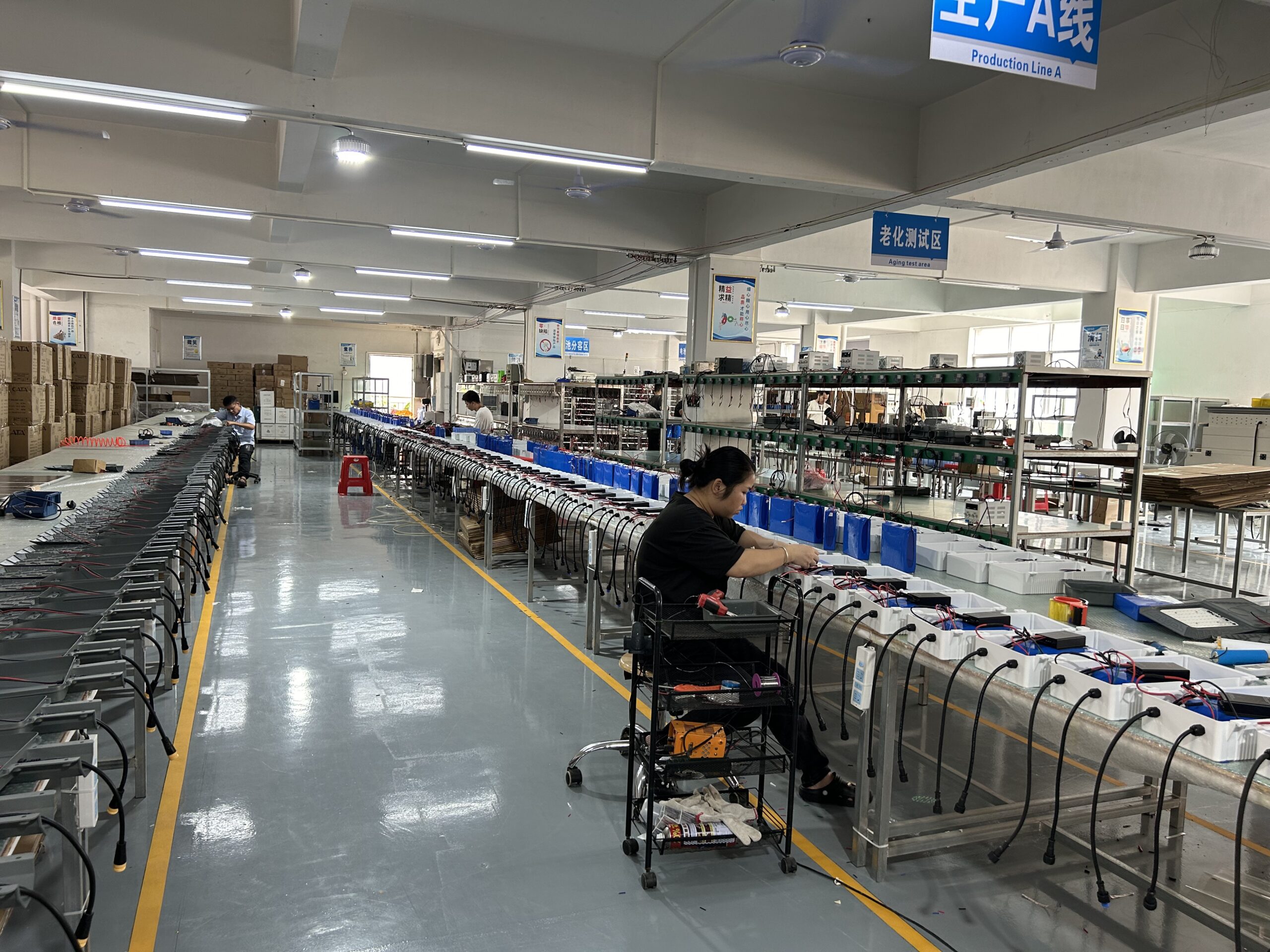
Procurement risk: Variation in battery models or controller firmware between batches is the #1 distributor complaint. State the firmware version, battery cell model, and charge-controller protocol in the purchase order. Do not accept "or equivalent" substitutions.
4. Procurement / Factory Audit Checklist
| Audit Item | Why It Matters | Verification Method | Risk If Missing |
|---|---|---|---|
| Battery cell model and capacity | Battery is the load-bearing component for both lighting and charging | Ask for the datasheet; cross-check the watt-hour rating against the charging load. | Premature battery failure, charger de-rating, night-time lighting shut-off |
| MPPT controller specification | Optimizes solar harvest and manages load priority | Confirm it supports MPPT (not PWM); ask for communication protocol details (Modbus, LoRa, etc.) | Poor solar yield in low-light, over-discharge of battery |
| Waterproof rating evidence | Outdoor exposure; enclosure must prevent water ingress | Request IP66/IP67 test report (not just the mark on the product) , | Internal corrosion, short-circuits, electrical hazard |
| Dialux lighting simulation | Verifies light levels and uniformity for the specific pole height and spacing | Request simulation file (note: this is photometric, not structural) | Under-lit roads, failure to meet municipal photometric standards |
| Pole structural calculation | Handles the windage area of camera, WiFi, charger | Ask for a signed structural calculation report (static + wind) | Pole fatigue or collapse in storm conditions |
| Charging module certification | Legal compliance for electrical connection and safety | Request CE (EU), UL or FCC (US), or regional certification depending on market | Legal issues, insurance void, electrical hazard to users |
| Warranty terms in PI/contract | The only enforceable protection | Confirm the 5-year standard warranty clause in the PI; check for exclusions | Disputes when the battery fails at year 3 (claimed to be "wear and tear") |
| Firmware/software access | Needed for the city platform or parking management system | Demand API documentation or confirmed Modbus/LoRa protocol compliance | City platform integration fails; the pole is "smart" only on paper |
| Spare parts price list | Long-term maintenance | Ask for unit prices for battery, controller, and camera module separately | Unaffordable replacement cost later; bid lock-in |
| Reference project verification | Confirms real-world operation, not just lab performance | Visit a reference site or call the operations team (e.g., Istanbul municipal project , Clark Airport highway project ) | Theoretical performance does not match real-world failure rate |
5. Technical Notes
On Battery and Energy Balance
For a smart pole with an integrated EV charger, the battery performs two conflicting duties: it must guarantee nightly lighting and sensor power, while also providing current bursts during daylight hours for charging. These are different demand profiles. The LiFePO₄ chemistry (as cited in the Istanbul smart pole project ) is preferred for cycle life and thermal stability. However, the watt-hour rating required is far above that of a standard lighting-only pole. Always ask: "What is the minimum battery state of charge (SoC) that will trigger the controller to disable the EV charger?" The answer determines whether the streetlight remains functional after a series of cloudy days.
On Dialux Simulation vs. Structural Calculation
A Dialux photometric report calculates illuminance (lux) and uniformity based on pole height, arm length, wattage, and optics. It is a lighting-only tool. It does not compute wind load, pole deflection, or the added bending moment from a CCTV arm and a charging socket. Many buyers make the mistake of asking for "simulation output" when what they actually need is engineering calculus of the pole structure. Obtain both during the design review, and request the latter from a licensed structural engineer, not from the lighting supplier’s sales team.
On MPPT and Load Scheduling Logic
The Istanbul project used an IoT MPPT smart controller with remote monitoring . In a practical sense, MPPT (Maximum Power Point Tracking) delivers more solar harvest than PWM when the temperature and irradiance vary significantly. However, the load management policy is stored in firmware. The controller must:
- Prioritize lighting and surveillance load over EV charging under low battery
- Limit charging power when the battery is below a set SoC threshold (e.g., 60%)
- Report EV charging current and total energy delivered via the 4G or LoRa data link
If the supplier cannot specify the priority logic in a testable state, ask for a demo unit with a simulated low-battery condition.
On Warranty Terms
The standard warranty period is 5 years for the integrated fixture, and extended terms apply only where written into the PI or sales contract . This is worth repeating in your procurement documents, because suppliers will frequently quote "battery 5-year life" and "LED 10-year life" interchangeably. The LED chip’s theoretical life rating does not guarantee the fixture operates at full lumen output for 10 years, and battery cycle life (number of charge/discharge cycles before the capacity drops to 80%) is not the same as a warranty term. Do not mix the three.
6. FAQ
Q1: Can a solar-powered smart pole charge an EV overnight?
In standard operation, no—and it should not be relied upon. The battery spends daylight hours being topped up for night-time lighting and sensor loads. Attempting overnight EV charging will rapidly deplete the LiFePO₄ battery, and the fallback is a dark streetlight the next evening. The corrective design is grid-assisted charging (with solar as a supplement), or a separate off-grid charger with its own solar array and battery bank.
Q2: What protocol should I specify for the smart pole’s communication layer?
It depends on your existing city IT infrastructure. If the city already runs a central management system (CMS), then LoRa or Zigbee offers low-power, wide-area coverage for lighting control. If the site is remote and lacks a local gateway, 4G is the safer choice because it requires no additional infrastructure. For high-data-rate applications (video surveillance footage), a WiFi backhaul or a dedicated local network is needed. Do not assume one protocol serves all functions.
Q3: Is the 100W all-in-one solar street light directly compatible with EV charging?
Not directly. The 100W all-in-one light (as deployed in the Istanbul project ) is a lighting fixture with an integrated battery and controller. The EV charging module is an expandable function of the smart pole architecture , requiring higher-capacity battery and possibly grid input. If you need EV charging, you are not buying a solar light; you are buying a distributed micro-grid station that also lights the area—specify it accordingly.
Q4: What maintenance intervals should I plan for the battery?
Plan a capacity test at 36–42 months, around the middle of the standard 5-year warranty . Confirm the warranty provision covers this test and what the threshold is for a free replacement. For coastal installations, inspect cable entries and the charging socket seal every 6 months—salt ingress is the most common cause of failure that warranty claims will reject as "external contamination."
Q5: How do I evaluate a manufacturer with limited public evidence?
If the manufacturer has a limited public reference base, ask for a factory walkthrough video with a live recording of date and time, request a unit sample for independent bench testing, and demand a bankable warranty performance bond if the volume is high. Treat absence of evidence transparently: if you cannot verify the battery cell brand, the MPPT algorithm, or the IP rating with a third-party test, reduce your order size accordingly. The Clark Airport highway project and the Istanbul municipal project are examples of documented deployments, but verify before assuming similar capability from any supplier.
7. Conclusion
Integrated EV charging via smart poles will be a growing procurement category, but it is currently — and rightly — a high-risk, high-scrutiny purchase. The correct product choice is entirely scenario-dependent, not brand-champion dependent.
- For public squares and municipal smart city pilots, prioritize integrated surveillance, WiFi, and environmental monitoring with modest charging capacity .
- For highway and parking revenue locations, specify grid-backed charging with battery buffering and confirm the charger standard and billing platform compatibility.
- For coastal and typhoon-prone sites, demand marine-grade materials and verified IP ratings, even if it means a longer lead time .
- For EPC tenders at scale, make the factory audit, documentation consistency, and reference-site verification your gating criteria—price is secondary to operational risk.
No single manufacturer should be crowned as a universal a leading option in this category. MCL Solar has documented involvement in municipal smart pole projects (Istanbul, 295 units with smart functions ) and highway deployments (Clark Airport ), backed by a core team with over 10 years of experience in solar street lighting, outdoor lighting manufacturing, and project solutions . Their standard warranty is 5 years, and their LiFePO₄ and IoT MPPT controller configurations match the specifications described above , . Still, you should evaluate MCL Solar—or any supplier—against the audit checklist in Section 4 of this article before committing to an order.
Further Reading & References
- All In One Solar Street Light — Product family relevant to municipal pole applications
- Smart City IoT Pole — Architecture for integrated cameras, WiFi, environment sensors, and expandable EV charging modules
- Solar Street Light Projects — Reference cases including the Istanbul smart pole project and the Clark Airport highway lighting ,
Engineering Consultation: If you are preparing a tender document or evaluating a supplier for integrated EV charging smart poles, we can support you with technical specification reviews, Dialux photometric simulation (lighting design only), battery sizing calculations, and OEM/ODM configuration for your specific infrastructure project. Discuss your project scenario, load profile, and budget envelope with us before you finalize the bid. For technical inquiries, procurement specifications, or simulation requests, contact our engineering team at sales@mclsolar.com or via WhatsApp at +86-138-1234-5678 (for verified project inquiries only). Please note: standard warranty is 5 years; extended warranty applies only when specified in the PI or sales contract .
Engineering & Manufacturing Verification at MCL Solar
All commercial solar street lighting luminaires, intelligent MPPT controllers, and Q235 hot-dip galvanized steel poles are manufactured in-house by Zhongshan Chengyu New Energy Technology Co., Ltd. at our 35,000 m² production facility in Guzhen Town, Zhongshan, Guangdong, China.
Explore our verified municipal track record: Saudi Arabia 253 Sets 55°C Desert Highway Project, Philippines Coastal Highway Typhoon-Resistant Installation, or inspect third-party IEC/CE/ISO test reports at our Compliance Verification Center.
Need Engineering Sizing or EPC Tender Support?
Contact MCL Solar’s engineering division for complimentary DIALux road lighting simulations, solar autonomy calculations, and direct factory pricing for municipal and commercial infrastructure projects.