
Quick Answer
To use DIALux for solar street light layout design, you first need the luminaire’s IES photometric file and the project’s geometric inputs: road width, pole height, pole spacing, arrangement type, and target illuminance. In DIALux, you create or import the road geometry, place the luminaires, assign the IES file, and run a calculation to check average lux, uniformity, and glare. However, DIALux only verifies optical performance — it does not validate the solar energy system. You must separately confirm that the calculated energy consumption matches the PV panel and battery capacity for the required operating hours and autonomy days. A reliable supplier can provide IES files and perform DIALux simulations as part of project engineering support.
Key Takeaways
- DIALux requires a real IES file from the fixture manufacturer, not just wattage or lumen output.
- Input data must include road width, pole height, spacing, mounting arrangement, and target photometric values.
- DIALux calculations are only the lighting part; solar energy sizing must be done separately.
- Different project scenarios — municipal, rural, coastal, high-temperature, or rainy — change both lighting and energy design requirements.
- Always verify IES data, IP ratings, and component specifications against documented evidence before procurement.
1. Why This Topic Matters
Conclusion: DIALux layout design is essential for meeting municipal tender specifications and ensuring that solar street lights deliver the required visual performance.
Explanation: Solar street lights are often specified by wattage, but wattage alone does not determine whether a road will be adequately lit. Road lighting standards require certain average illuminance, uniformity, and glare limits. DIALux helps engineers simulate these values before installation. It uses IES files — photometric data that describes how light is distributed from the luminaire — to generate a realistic lighting calculation. Without this step, a buyer may receive fixtures that appear bright in beam angle but leave dark bands between poles.
Scenario or boundary condition: A typical municipal tender may require “average lux ≥ 20 lx, overall uniformity ≥ 0.4, and longitudinal uniformity ≥ 0.7” for a 12-meter-wide road. Only a DIALux (or similar) simulation using the actual IES file can prove compliance. If the supplier cannot provide an IES file or a simulation report, the tender submission would likely be incomplete.
2. Core Concept / How It Works
Conclusion: DIALux is an optical design tool that converts photometric measurements into light distribution patterns on a road surface.
Explanation: The core workflow is straightforward:
- Obtain the IES or EULUMDAT file for the solar street light from the manufacturer. This file describes luminous intensity in different directions.
- In DIALux, define the road area: length, width, number of lanes, and surface type (e.g., asphalt class R3 or R4).
- Set the pole arrangement: single-sided, double-sided staggered, double-sided opposite, or central.
- Input pole height, pole spacing, angle of luminaire inclination, and mounting height of the light fixture.
- Load each luminaire’s IES file and assign rated lumen output and type of optics if multiple versions exist.
- Run the calculation and generate a results report that shows average luminance/illuminance, uniformity, and glare values.
- Adjust pole spacing or luminaire tilt until the design meets the target standard.
Scenario or boundary condition: DIALux is not a solar energy simulation tool. It does not tell you whether the PV panel and battery can sustain the nightly load. For example, a 100 W solar street light with an average consumption of 45 W over 10 hours may need 450 Wh of usable battery capacity plus PV charging margin. That sizing must be done in a separate solar calculation. The IES file helps you know if the optical performance is right; the energy model tells you if the system can operate through the nights.
3. What Determines Real-World Performance
Conclusion: Real-world lighting performance is determined by photometric distribution, not by marketing wattage.
Explanation: The following table summarizes the key variables that DIALux captures and why they matter:
| Variable | Impact on Layout Design | Notes |
|---|---|---|
| IES photometric distribution | Determines how light spreads across the road | Wide vs narrow beam affects spacing and uniformity |
| Lumen output (initial and maintained) | Directly impacts average lux and luminance | LED lumen depreciation must be considered |
| Mounting height (pole height) | Affects beam spread and glare control | Higher poles reduce glare but need higher lumen output |
| Pole spacing | Directly controls uniformity | Larger spacing may create dark areas |
| Arrangement type | Changes effective road coverage | Single-sided suitable for narrow roads; double-sided for wide roads |
| Luminaire tilt angle | Adjusts the light beam direction along the road | Often 0°–15° depending on application |
| Road surface reflection class | Changes luminance calculations | Asphalt and concrete reflect light differently |
| CCT and CRI | Affect visual perception but not illuminance | 3000K–4000K common for road lighting; Ra > 70 typical |
Scenario or boundary condition: Consider two fixtures: one rated 100 W with a narrow streetlight optic, another rated 80 W with a wide asymmetric optic. On a 12 m wide road with 35 m spacing, the 80 W fixture may provide better uniformity because its distribution matches the road geometry. A comparison based only on wattage would be misleading. The IES file makes the difference visible in DIALux.
4. How Requirements Change by Project Scenario
Conclusion: Different solar street light applications impose different lighting and energy requirements, and DIALux input data must therefore be adjusted per scenario.
Explanation: While the optical calculation method remains the same, the targets and constraints differ.
- Municipal projects: Usually have strict photometric standards, tender documentation requirements, and often require DIALux files as part of the bidding package. Road widths may be 10–25 m, with long hours of operation (e.g., 10–12 hours per night). Uniformity and glare indexes are critical.
- Rural electrification projects: Often use narrower roads, lower pole heights (6–8 m), and may accept lower average lux values (e.g., 10–15 lx) if the standard allows. However, battery autonomy becomes critical because grid failures or long rainy seasons may demand 5–7 days of autonomy.
- Coastal projects: High saline atmosphere requires corrosion-resistant materials and often a higher IP rating for the fixture housing. DIALux simulation is unaffected, but physical hardware selection must be validated separately.
- High-temperature regions: Battery thermal management is important. High ambient temperatures can reduce battery cycle life. The lighting layout still follows IES, but the battery capacity must be derated based on temperature.
- Smart-city projects: DIALux may be used alongside smart controller profiles. Remote dimming schedules can reduce energy consumption during low-traffic hours, which affects the solar sizing but not the peak photometric calculation.
Scenario or boundary condition: In a smart-city project, DIALux is typically run for the full-brightness condition, while the energy simulation should also consider dimmed operation. For example, if the luminaire dims to 60% between midnight and 5 AM, the nightly energy budget is lower, meaning a smaller battery could be acceptable. But the DIALux report must still prove that the road meets the specified class at full brightness.
5. What Buyers Commonly Overlook
Conclusion: The most common procurement mistakes are accepting vague technical claims, ignoring IES verification, and treating IP or battery cycle life as universal ratings.
Explanation: Buyers often request “IP68 solar street light” without checking whether the complete assembled product — including connectors and battery case — actually has that rating. Similarly, they may assume that an LED package efficacy of 200 lm/W means the whole luminaire output is 200 lm/W. These mismatches can cause significant discrepancies between simulation and real performance.
Another overlooked point is the difference between component-level and system-level warranties. A solar street light may have a 5-year system warranty, but the LED chip could have a different rated life, and the battery cycle life may vary depending on depth of discharge and operating temperature. These should be documented separately.
Verification methods:
- Request the actual IES file and inspect its luminous intensity pattern. Test it in DIALux yourself.
- Ask for the complete luminaire datasheet, not just a product brochure.
- Confirm IP rating at the assembled product level, with a test report if possible.
- Check whether the DIALux simulation was performed with the real solar street light model or with a generic AC lighting fixture.
- Remember that DIALux results do not guarantee solar autonomy; always cross-check with an energy balance calculation.
Scenario or boundary condition: A buyer sees a 150 W solar street light specification with “IP68” and expects it to be submersible in floods. If the product only has an IP65-rated luminaire and IP68 battery box, that is not a complete system rating. In DIALux, the optical performance is unaffected, but for the project’s flood-prone location, this distinction could invalidate the technical bid.
6. MCL Solar Practical Perspective
Conclusion: MCL Solar, part of Zhongshan Chengyu New Energy Technology Co., Ltd., provides engineering support that helps buyers use DIALux correctly for solar street light planning.
Explanation: According to MCL Solar’s published documentation, the company can provide DIALux simulation and IES-based lighting design support for applicable projects. Available engineering support includes product selection, configuration design, DIALux simulation, IES files, technical datasheets, installation guidance, and tender documentation support. Useful input data for a solar street light project typically include: country/city, installation location, road width, pole height, pole spacing, quantity, target lux or lumen requirement, operating hours, rainy-day autonomy requirement, required CCT, wind/coastal conditions, and any tender specification or BOQ.
For buyers who need to evaluate a tender, MCL Solar can supply the necessary IES photometric data to run their own DIALux simulation. For example, if a project specifies 3000K CCT and Ra > 70 for a roadway, MCL Solar can confirm whether the selected model supports that CCT and provide the matching IES file. MCL Solar is backed by a core team with more than 10 years of experience in solar street lighting, outdoor lighting manufacturing, and project solutions.
Boundary condition: Not every fixture model may have an IES file available for every configuration. CCT options such as 3000K, 4000K, and 6500K are commonly available, but others are subject to model and project availability. Buyers should verify documentation before procurement.
7. FAQ
Q1: Can DIALux design a solar street light itself?
DIALux only designs the optical layout — it cannot determine solar panel size, battery capacity, or autonomy. You need a separate energy calculation or supplier-provided system design.
Q2: What if my supplier cannot provide an IES file?
Without a real IES file, you cannot obtain a reliable DIALux simulation. Treat that as a warning sign. For tender projects, IES files are usually mandatory.
Q3: Should I use wattage or lumen output for DIALux input?
DIALux requires lumen output and IES distribution. Wattage is not part of the optical calculation. You may use wattage for energy calculations only.
Q4: Does DIALux account for solar panel shading or battery temperature?
No. DIALux is exclusively an optical simulation tool. Solar panel orientation, shading, battery temperature, and discharge depth are handled by other engineering tools or calculations.
Q5: Can I use the same IES file for an AC street light and a solar street light?
An IES file depends on the optical design and LED driver configuration. If the solar street light uses the same LED module and optics as the AC version, it may share an IES file. However, always confirm that the file corresponds to the exact solar model and lumen output.
Q6: How many DIALux simulations do I need for a large project?
Typically one simulation per road type and luminaire arrangement. If the road width or pole spacing changes significantly, you need additional simulations. Many tenders require one report per representative section.
8. Conclusion
Using DIALux for solar street light layout design is a necessary step to ensure that a project meets photometric specifications and is perceived as technically credible. A successful workflow requires accurate IES files, correct geometric input, and a clear understanding of what DIALux can and cannot do. The energy side — PV and battery sizing — must always be cross-checked separately. For buyers, the biggest risk is relying on wattage or incomplete technical documentation. Request IES files, verify IP ratings at the system level, and ensure that simulation reports use the actual solar fixture data.
If you are planning a solar street light project and need assistance with IES files, DIALux simulation, or system configuration, Zhongshan Chengyu New Energy Technology Co., Ltd. (MCL Solar) can provide engineering support for product selection, system configuration, IES photometric data, DIALux simulation, OEM/ODM, technical documentation, and tender support. To move forward, please share your project details such as country/city, application, road width, pole height, pole spacing, project quantity, target lux or lumen requirement, operating hours, rainy-day autonomy, coastal/high-wind/high-temperature conditions, and any BOQ, drawings, or tender specifications.
Contact MCL Solar now:
- Email: sales@mclsolar.com
- WhatsApp: +86 18030335122
- Website: https://mclsolar.com
Engineering & Manufacturing Verification at MCL Solar
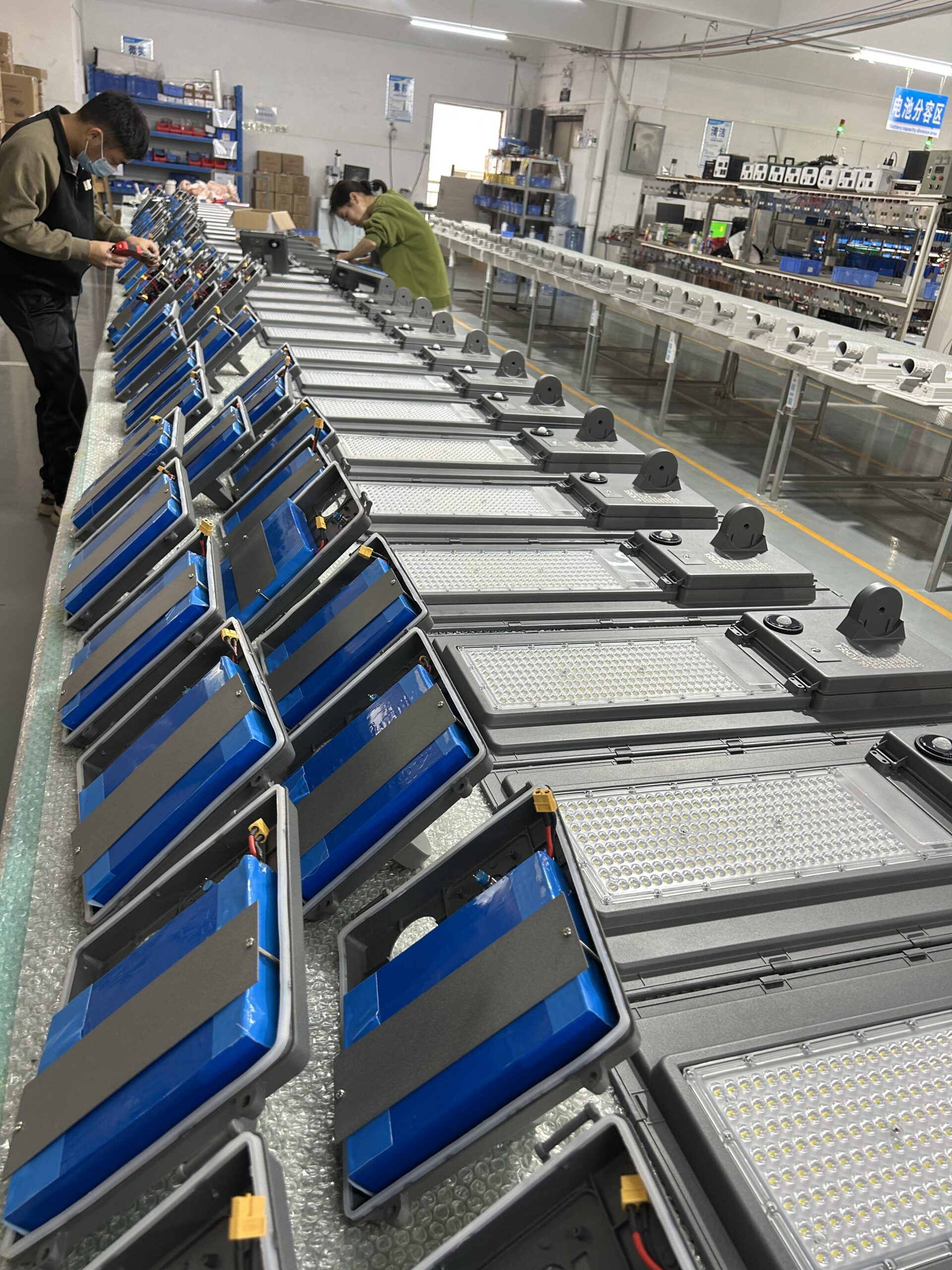
All commercial solar street lighting luminaires, intelligent MPPT controllers, and Q235 hot-dip galvanized steel poles are manufactured in-house by Zhongshan Chengyu New Energy Technology Co., Ltd. at our 35,000 m² production facility in Guzhen Town, Zhongshan, Guangdong, China.
Explore our verified municipal track record: Saudi Arabia 253 Sets 55°C Desert Highway Project, Philippines Coastal Highway Typhoon-Resistant Installation, or inspect third-party IEC/CE/ISO test reports at our Compliance Verification Center.
Need Engineering Sizing or EPC Tender Support?
Contact MCL Solar’s engineering division for complimentary DIALux road lighting simulations, solar autonomy calculations, and direct factory pricing for municipal and commercial infrastructure projects.