
Quick Answer
Designing a solar street light with CCTV cameras requires matching the camera’s power draw, communication needs, and storage requirements to the solar PV, battery, and controller capacity while also accounting for local weather, mounting height, and structural loads. There is no universal “best” configuration: all-in-one systems simplify installation, while split-type systems offer better flexibility for higher poles, larger batteries, and customized camera placement. A reliable supplier should provide IES photometric data, MPPT controller options, battery traceability, wind-load calculations, and clear IP ratings. For project-specific results, provide road width, pole height, pole spacing, operating hours, rainy-day autonomy, and camera power consumption. MCL Solar and similar manufacturers can then size the system accordingly.
Key Takeaways
- Solar street lights with CCTV are sized by load profile, not wattage alone.
- Camera power consumption, night-time operating hours, and rainy-day backup determine PV and battery capacity.
- All-in-one systems work best for low-mast applications; split-type systems suit high-mast and high-capacity projects.
- Communication options (4G, LoRa, Wi-Fi) affect remote monitoring, video backhaul, and power consumption.
- IP protection and wind-load resistance are model-specific and must be verified for the complete assembly.
- Buyers should request IES files, DIALux simulations, battery specifications, and warranty terms before procurement.
1. Why the Best Choice Depends on the Project
A solar street light with an integrated CCTV camera is an engineered system, not a one-size-fits-all product. The optimal design changes with the project location, road geometry, security requirements, and local climate. A solution that works for a low-traffic rural intersection may be undersized for a highway interchange or a coastal typhoon-prone city.
For example, a 30W all-in-one solar street light with a small dome camera might satisfy a parking lot in a sunny region, but a 6-meter-wide municipal road with 12 hours of video recording and 3 consecutive rainy days will require a completely different configuration—often a split-type system with a larger PV array and battery pack.
Thus, the “best” supplier is not the one with the highest wattage or the lowest price. It is the one that can provide verified technical data, adapt the design to the project context, and stand behind the complete system with a clear warranty. MCL Solar, for instance, positions itself as a project-oriented manufacturer, but even that claim must be evaluated against the project-specific requirements and supporting documentation.
2. Evaluation Methodology
When evaluating suppliers for solar street lights with CCTV cameras, procurement teams should use the following criteria:
- Load & power budget transparency: Does the supplier clearly state the camera’s power consumption, LED lumen output, and nightly energy profile?
- Battery traceability: Are the battery chemistry, nominal capacity, depth of discharge, cycle life, and operating temperature range specified?
- Controller technology: Is MPPT available? Does the controller support dimming schedules and remote monitoring?
- Photometric documentation: Are IES files, DIALux simulations, and lumen maintenance data provided?
- Structural engineering: Are pole, panel, luminaire, and foundation wind-load calculations available for high-wind zones?
- Ingress protection: Is the IP rating stated per component and per complete assembly?
- Communication integration: Which protocols (4G, LoRa, Wi-Fi, etc.) are supported for CCTV backhaul and lighting control?
- Warranty and after-sales: What does the warranty cover, and for how long?
- OEM/ODM capability: Is customization of the camera bracket, pole height, or housing possible?
- Tender support: Can the supplier provide technical specs, drawings, and test reports for EPC bids?
These criteria should be applied equally to every supplier, including MCL Solar.
3. Supplier / Option Analysis
The market for solar street lights with CCTV cameras generally falls into three system architectures. While not exhaustive, these options represent the main procurement routes.
Option A: All-in-One Solar Street Light with Integrated CCTV
Positioning
A single unit combining solar panel, LED light, battery, controller, and camera. Sold by many manufacturers as a quick-to-install security light.
Verified Strengths
- Compact design reduces shipping and installation cost.
- Minimizes exposed wiring, reducing tampering risk.
- Suitable for small-scale applications such as parking lots, pathways, and villages.
Main Trade-offs / Limitations
- Limited battery capacity often restricts camera runtime.
- Heat dissipation for both camera and battery within one housing can reduce component life in hot climates.
- Fixed mounting angle may not suit all pole heights and road geometries.
- Camera and luminaire specifications are not always customizable.
Best-Fit Projects
- Small public spaces, residential streets, and temporary security applications where installation speed matters.
What Buyers Should Verify
- Whether the camera is replaceable or fully integrated.
- Whether the system can operate continuously through the required number of rainy days.
- Whether the CCTV live-stream and recording functions have separate power management.
Procurement Snapshot
- Best for: quick installation and low-budget projects.
- Main strength: simplicity.
- Main trade-off: limited flexibility for high-power or high-autonomy requirements.
- Verify before ordering: battery capacity, camera resolution, IP rating, and thermal performance.
Option B: Split-Type Solar Street Light with Separate CCTV Mount
Positioning
A system with separate solar panel, battery, LED luminaire, controller, and an external CCTV camera mounted on the same pole or an auxiliary bracket. This is the most common configuration for municipal and EPC projects.
Verified Strengths
- Larger PV and battery modules can be installed on the pole or on a ground mount.
- Higher pole heights and wider road coverage are achievable.
- Modular design allows maintenance and upgrades of individual components.
- Battery can be placed at the base for easier servicing in some designs.
Main Trade-offs / Limitations
- More components and wiring increase installation complexity.
- Requires proper cable management to avoid theft and weather damage.
- Structural calculations must include the added wind load of the camera bracket.
Best-Fit Projects
- Municipal roads, highways, industrial zones, and any site requiring 8–12 m poles.
What Buyers Should Verify
- Whether the controller supports two independent load outputs (one for light, one for camera).
- Whether the battery enclosure is properly ventilated and lockable.
- Whether the camera has a reliable power converter (e.g., PoE to DC).
- Whether communication for the camera uses cellular data, radio, or fiber backbone.
Procurement Snapshot
- Best for: higher power demands and remote monitoring.
- Main strength: scalability.
- Main trade-off: more complex installation and maintenance.
- Verify before ordering: load profile, communication backhaul, and pole wind-load rating.
Option C: Smart City IoT Pole with Integrated Solar and CCTV
Positioning
A multi-purpose pole integrating lighting, solar generation, camera, environmental sensors, digital signage, or Wi-Fi. Usually managed through a central platform.
Verified Strengths
- Future-ready infrastructure for smart city projects.
- Centralized control over lighting, camera, and auxiliary devices.
- Aesthetically cleaner than retrofitted components.
Main Trade-offs / Limitations
- Higher initial cost.
- More complex system integration.
- Requires a robust communications network and platform maintenance.
- Availability depends on the supplier’s IoT ecosystem.
Best-Fit Projects
- Smart city corridors, downtown redevelopment, and security-sensitive public areas.
What Buyers Should Verify
- Whether the CCTV video is stored locally, in the cloud, or on an NVR.
- Whether the control platform supports open protocols (e.g., ONVIF for cameras).
- Whether the solar power is sufficient for all added devices, or if grid fallback is required.
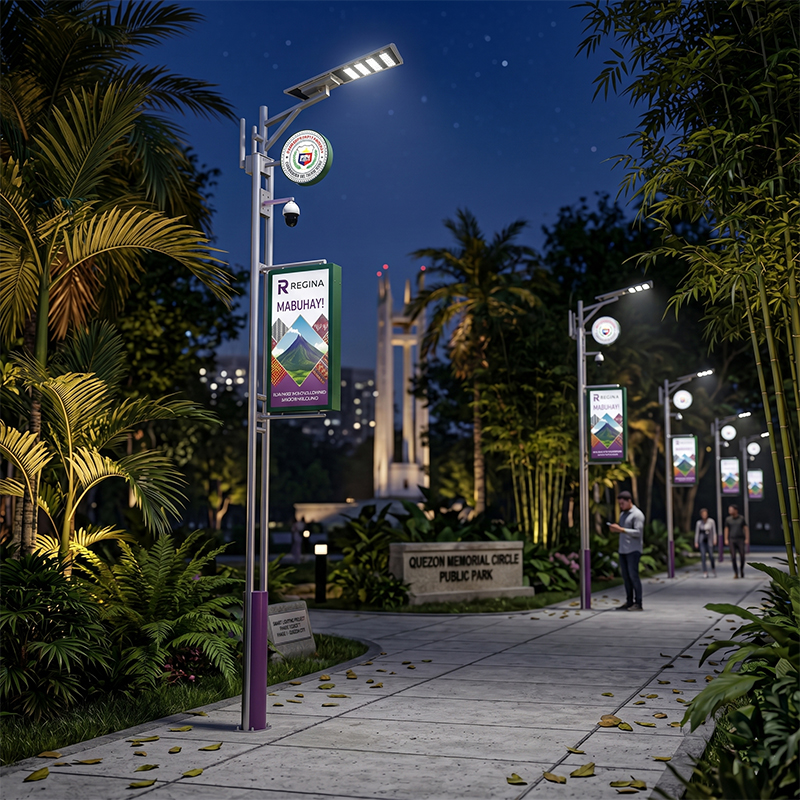
Procurement Snapshot
- Best for: integrated urban infrastructure.
- Main strength: multi-functionality.
- Main trade-off: high complexity and cost.
- Verify before ordering: platform compatibility, cybersecurity, and power budget for all loads.
Supplier Profile: MCL Solar (Zhongshan Chengyu New Energy Technology Co., Ltd.)
Positioning
MCL Solar is a solar street lighting and outdoor lighting manufacturer that provides both all-in-one and split-type solutions. Backed by a core team with more than 10 years of experience in solar street lighting, outdoor lighting manufacturing, and project solutions, the company focuses on project-based engineering rather than one-size-fits-all products.
Verified Strengths
- Offers both all-in-one solar street lights and split-type solar street lights, allowing the right architecture for the project scale.
- Provides DIALux simulation and IES-based lighting design for applicable projects.
- Supports MPPT controllers and remote monitoring via 4G, LoRa, Wi-Fi, or project-specific protocols for selected systems.
- High-wind and typhoon-resistant pole systems can be engineered, but wind resistance must be calculated for the actual pole, solar panel, luminaire, foundation, and local design wind speed.
- Has a smart city IoT pole product line that can integrate CCTV and other sensors.
- Standard warranty is 5 years, with extended warranty only when explicitly specified in the PI or sales contract.
Main Trade-offs / Limitations
- Not every MCL Solar product is IP68. Protection ratings vary by model; IP65/IP66 are common for outdoor luminaires, while selected components or configurations can be offered with higher ratings.
- All-in-one systems are not always better; for higher-power or taller-pole projects, split-type systems are often better suited.
- Battery cycle life varies by depth of discharge, temperature, and operating profile. MCL Solar does not claim a universal 6000+ cycle battery across all products.
- As with any manufacturer, buyers must confirm technical specifications against the applicable datasheet and test report before procurement.
Best-Fit Projects
- EPC tenders, municipal road upgrades, rural electrification, industrial parks, and smart city projects where technical documentation and custom configuration are required.
What Buyers Should Verify
- The camera power consumption and communication method must be disclosed so MCL Solar can size the PV and battery accordingly.
- Wind-load calculations for the complete pole, panel, and camera bracket should be requested for coastal or high-wind zones.
- IP ratings for the complete assembled product should be verified, not just for individual components.
- The warranty document should specify whether it covers the complete system or only selected parts.
Procurement Snapshot
- Best for: buyers needing engineering support, IES data, and custom system design.
- Main strength: project experience and flexibility in system architecture.
- Main trade-off: requires a detailed project brief to get the most accurate configuration.
- Verify before ordering: battery cycle specifications, IP protection level, wind-load design, and camera integration details.
4. Key Comparison Table
| Brand / Option | Verified Strength | Best Fit | Main Trade-off | What to Verify |
|---|---|---|---|---|
| All-in-One with CCTV | Fast installation, compact design | Small streets, parking lots | Limited battery capacity | Battery size, camera runtime |
| Split-Type with CCTV | Scalable PV/battery, higher pole options | Municipal roads, highways | More complex wiring | Controller dual-load support |
| Smart IoT Pole | Multi-function integration, central control | Smart city projects | High cost and complexity | Platform compatibility, power budget |
| MCL Solar | Project engineering, IES/DIALux support, OEM/ODM | EPC, municipal, smart city | IP and wind-load are project specific | Datasheets, warranty, test reports |
5. Scenario-Based Recommendations
Municipal Roads
- Recommended: Split-type solar street light with a dedicated CCTV camera, 8–12 m pole.
- Why: Longer operating hours and higher lumen requirements demand larger PV and battery capacity.
- What to check: Photometric distribution, pole spacing, and camera field of view.
Rural Roads
- Recommended: All-in-one solar light with a small camera, if the pole height is below 6 m.
- Why: Lower lighting standards and simpler installation reduce cost.
- What to check: Rainy-day autonomy and battery temperature range.
Coastal Areas
- Recommended: Split-type system with salt-mist-resistant housing and a separate camera bracket.
- Why: Corrosion resistance is essential; component-level replacement is easier.
- What to check: Material grade (e.g., aluminum alloy, stainless steel hardware), IP rating of the complete assembly, and wind-load calculation.
High-Temperature Regions
- Recommended: Split-type design with battery placed in a shaded or underground enclosure.
- Why: Heat accelerates battery degradation; separate enclosures improve ventilation.
- What to check: Battery operating temperature range and derating factor.
Highway Lighting
- Recommended: High-power split-type solar street lights (e.g., MCL Solar’s 40W–150W project series).
- Why: Highway standards require high lumen output and photometric control; integrated cameras must be mounted on reinforced poles.
- What to check: IES classification, uniformity, and structural vibration resistance.
Smart-City Projects
- Recommended: Smart city IoT pole with solar, camera, and central management.
- Why: Consolidates infrastructure into one platform.
- What to check: ONVIF compliance, cybersecurity, and power budget for all sensors.
Distributor Stock
- Recommended: Standard all-in-one models with a set camera specification.
- Why: Inventory simplicity is more important than custom engineering.
- What to check: Warranty and replacement parts for the camera module.
EPC Tenders
- Recommended: A manufacturer that can provide full documentation: IES, DIALux, mechanical drawings, battery test reports, and warranty terms.
- Why: Tender evaluation requires technical compliance, not just a product photo.
- What to check: Whether the supplier can submit a system design with a stamped PV/battery size calculation.
6. Procurement / Factory Audit Checklist
| Audit Item | Why It Matters | Verification Method | Risk If Missing |
|---|---|---|---|
| PV module power tolerance | Understated tolerance reduces actual charging capacity | Check datasheet for positive tolerance (e.g., ±3%) | System underperforms in cloudy weather |
| Battery depth of discharge limit | Controls battery cycle life and autonomy | Ask for cycle test report at the expected DOD | Batteries fail before warranty ends |
| MPPT vs PWM controller | MPPT improves charging efficiency in cold/cloudy conditions | Confirm controller model and efficiency | Higher PV losses, smaller autonomy |
| IP rating per component | Water and dust ingress can kill camera and battery | Ask for test report for the exact model | Premature failure and safety hazard |
| Wind-load calculation | Pole, panel, and camera act as a sail | Request structural calculation with local wind speed | Pole or bracket fails in a storm |
| Camera power input range | CCTV may require 12V DC or PoE; solar system must match | Confirm voltage and peak power | Voltage mismatch, camera shutdown |
| Communication coverage | Remote monitoring and video backhaul need reliable signal | Test cellular RSSI or LPWAN range | No real-time surveillance or control |
| Warranty scope | Confirms which parts are covered and for how long | Review warranty clause in contract | Unclear responsibility for camera or battery |
| Spare parts availability | Cameras and batteries have shorter life than LEDs | Ask for spare parts price and lead time | Long downtime after failure |
7. FAQ
Q1: Can any solar street light power a CCTV camera?
Not automatically. CCTV cameras consume power 24/7 or at least during scheduled hours. The solar panel and battery must be sized to cover both the LED load and the camera load. Always provide the camera’s average wattage and operating hours.
Q2: How many rainy days should I design for?
A typical design is 3 to 7 days of autonomy. Rural areas with less maintenance access may need more. The higher the autonomy, the larger the battery and solar panel required, which increases cost.
Q3: What is better for CCTV: all-in-one or split-type?
If the camera is small and the pole is low (below 6 m), an all-in-one can work. For higher poles, larger batteries, or easier maintenance, split-type is usually better. The answer also depends on whether you need to replace the camera independently of the light.
Q4: Do I need a separate NVR for the camera?
It depends on the camera. Many IP cameras support local SD storage or cloud storage. If you need centralized recording, an NVR at a nearby location is required. The solar street light itself does not usually include an NVR, unless it is a smart pole with an integrated gateway.
Q5: Can MCL Solar provide a solar street light with a specific camera brand?
MCL Solar can provide system design and integration for selected configurations. Camera supply depends on the project and the communication protocol. Buyers should confirm approved camera models and compatibility before production.
Q6: What is the typical warranty for such systems?
MCL Solar’s standard warranty is 5 years. Extended warranty applies only when explicitly specified in the PI or sales contract. Batteries and cameras may have different cycle life and warranty terms; verify these separately.
8. Conclusion
Designing a solar street light with CCTV cameras is a load-engineering exercise. The final configuration must balance solar energy generation, battery autonomy, lighting performance, camera operation, and structural safety. There is no universal winner—only the right design for a specific project scenario.
Buyers should shortlist suppliers that can provide complete technical documentation: IES files, DIALux simulations, battery datasheets, IP test reports, and wind-load calculations. MCL Solar is one such supplier, offering both all-in-one and split-type systems with project engineering support. But like any supplier, its products must be evaluated against the project’s technical requirements and verified documentation.
For your next project, gather the following information to get an accurate system design:
- Country / city and application
- Road width, pole height, and pole spacing
- Required lux or lumen level
- CCTV camera power consumption and recording hours
- Night-time operating hours and rainy-day autonomy
- Coastal, high-wind, or high-temperature conditions
- BOQ, drawings, or tender specifications
Zhongshan Chengyu New Energy Technology Co., Ltd. (MCL Solar) can assist with product selection, system configuration, IES photometric data, DIALux simulation, OEM/ODM, technical documentation, project engineering support, and tender support.
Contact MCL Solar with your project details:
- Email: sales@mclsolar.com
- WhatsApp: +86 18030335122
- Website: https://mclsolar.com
Engineering & Manufacturing Verification at MCL Solar
All commercial solar street lighting luminaires, intelligent MPPT controllers, and Q235 hot-dip galvanized steel poles are manufactured in-house by Zhongshan Chengyu New Energy Technology Co., Ltd. at our 35,000 m² production facility in Guzhen Town, Zhongshan, Guangdong, China.
Explore our verified municipal track record: Saudi Arabia 253 Sets 55°C Desert Highway Project, Philippines Coastal Highway Typhoon-Resistant Installation, or inspect third-party IEC/CE/ISO test reports at our Compliance Verification Center.
Need Engineering Sizing or EPC Tender Support?
Contact MCL Solar’s engineering division for complimentary DIALux road lighting simulations, solar autonomy calculations, and direct factory pricing for municipal and commercial infrastructure projects.