
Highway & Expressway Solar Lighting Guide: Why Split-Type Systems Outperform All-in-One Fixtures
When international EPC contractors and transport ministries evaluate autonomous solar roadway lighting for multi-lane expressways, heavy-vehicle trunk corridors, and municipal avenues, choosing between All-in-One (Integrated) and Heavy-Duty Split-Type (or Two-in-One Modular) solar systems determines long-term road safety and 10-year total cost of ownership (TCO).
Recommended System: MCL Solar 8-12M Two-in-One Split System
Luminous Efficacy: 180 – 210 lm/W (Bridgelux/Lumileds)
Autonomous off-grid lighting is increasingly becoming the mandatory standard for trans-national highways, desert transport routes, and island road networks where utility trenching costs exceed $80,000 per kilometer. However, municipal engineers routinely face operational failures when entry-level “All-in-One” integrated units are mistakenly deployed in high-speed corridors.
This technical whitepaper examines the physics, optical requirements, thermal limits, and maintenance realities distinguishing integrated luminaires from commercial-grade split-type installations.
1. Highway Engineering Benchmark: All-in-One vs. Split-Type Comparison Matrix
The operational demands of a 100 km/h expressway are fundamentally different from a rural footpath. Below is an engineering comparison based on audited field data and international roadway lighting standards:
| Technical Parameter | All-in-One (Integrated) Solar Light | Heavy-Duty Split / Two-in-One (MCL Solar 8-12M Series) |
|---|---|---|
| Luminous Output & Pole Height | 4,000 – 12,000 lm Restricted to 4m – 7m mounting |
10,000 – 42,000 lm Engineered for 8m – 12m commercial highway poles |
| PV Orientation & Daily Yield | Fixed angle (0° – 15°), cannot track optimum latitude tilt; loses up to 35% seasonal harvest | Independent 360° azimuth & 15° – 60° tilt adjustment; 150W – 600W mono-crystalline array captures maximum peak sun hours |
| Battery Operating Temperature | Battery sandwiched next to hot PV backsheet and LED heatsink; core temp >65°C triggers rapid thermal capacity loss | Separated battery enclosure with MCL-HTBS™ aerogel thermal barrier; maintains 45°C – 52°C internal temperature even in 55°C desert ambient heat |
| Optical Uniformity (EN 13201) | Symmetrical or basic wide beam ($U_o < 0.35$); produces dark zebra banding on 3–4 lane roads | Precision Type II-M / Type III-M batwing lenses ($U_o \ge 0.40, U_l \ge 0.60$); low glare rating ($TI < 10\%$) certified via DIALux |
| Wind Load Resilience | Single arm clamp, vulnerable to dynamic vortex-induced pole resonance | Dual-bracket aerodynamic reinforcement; FEA structural calculation certified for 16-Grade Typhoons (180 km/h / 50 m/s) |
| Maintenance & TCO (10-Year) | Non-modular sealed unit. Failure of battery or controller forces replacement of entire luminaire via bucket truck | Fully modular architecture. Field technicians replace individual components in 15 minutes; reduces lifecycle OPEX by over 65% |
2. The Physics Behind Roadway Failures: Why All-in-One Systems Fail on Expressways
Physics Factor 1: The Thermodynamic Conflict (Heat vs. Lithium Chemistry)
Highways are exposed to extreme environmental radiation: asphalt ground temperatures frequently exceed 60°C in tropical and desert climates. In an integrated all-in-one fixture, the solar panel absorbs solar radiation directly on the top surface, heating the interior chassis to 70°C–80°C. The lithium battery cells and electronic driver are housed in this exact sealed compartment.
According to the Arrhenius rate law, every 10°C rise in operating temperature doubles the chemical degradation rate of LiFePO4 battery electrolytes. Integrated batteries exposed to high temperatures degrade in 18 to 24 months, causing midnight blackouts.
MCL Solar Engineering Solution: In our 8-12M Two-in-One Split System, the battery pack is housed in an independent cast-aluminum pod separated from both the LED optical engine and the photovoltaic array. Incorporating proprietary MCL-HTBS™ (High-Temperature Barrier Shield) aerogel insulation, the core cell temperature is suppressed below 50°C, sustaining >3,500 full cycles at 80% DOD (over 10 years of nightly operation).

Figure 1: Heavy-Duty Two-in-One Split Architecture featuring independent PV array tilt, isolated battery housing, and conical galvanized steel pole.
Physics Factor 2: Optical Distribution & Glare Limitation (EN 13201 Compliance)
Expressways operating at speeds of 80 to 120 km/h require strict optical control:
- Overall Luminance Uniformity ($U_o \ge 0.40$): Road surfaces must not have sudden brightness drops that impair driver obstacle recognition.
- Longitudinal Uniformity ($U_l \ge 0.60$): Eliminates the “zebra effect” between adjacent poles along the driving lane.
- Threshold Glare Increment ($TI < 10\%$): Direct beam radiation must not blind oncoming motorists.
Because an all-in-one fixture’s tilt is dictated by the solar angle needed for power generation, tilting the panel upwards tilts the lens upwards as well, casting blinding glare into drivers’ eyes. In contrast, split systems allow the luminaire to be leveled horizontally with custom Type II-M or Type III-M batwing optical lenses, directing 100% of the luminous flux onto the road surface.
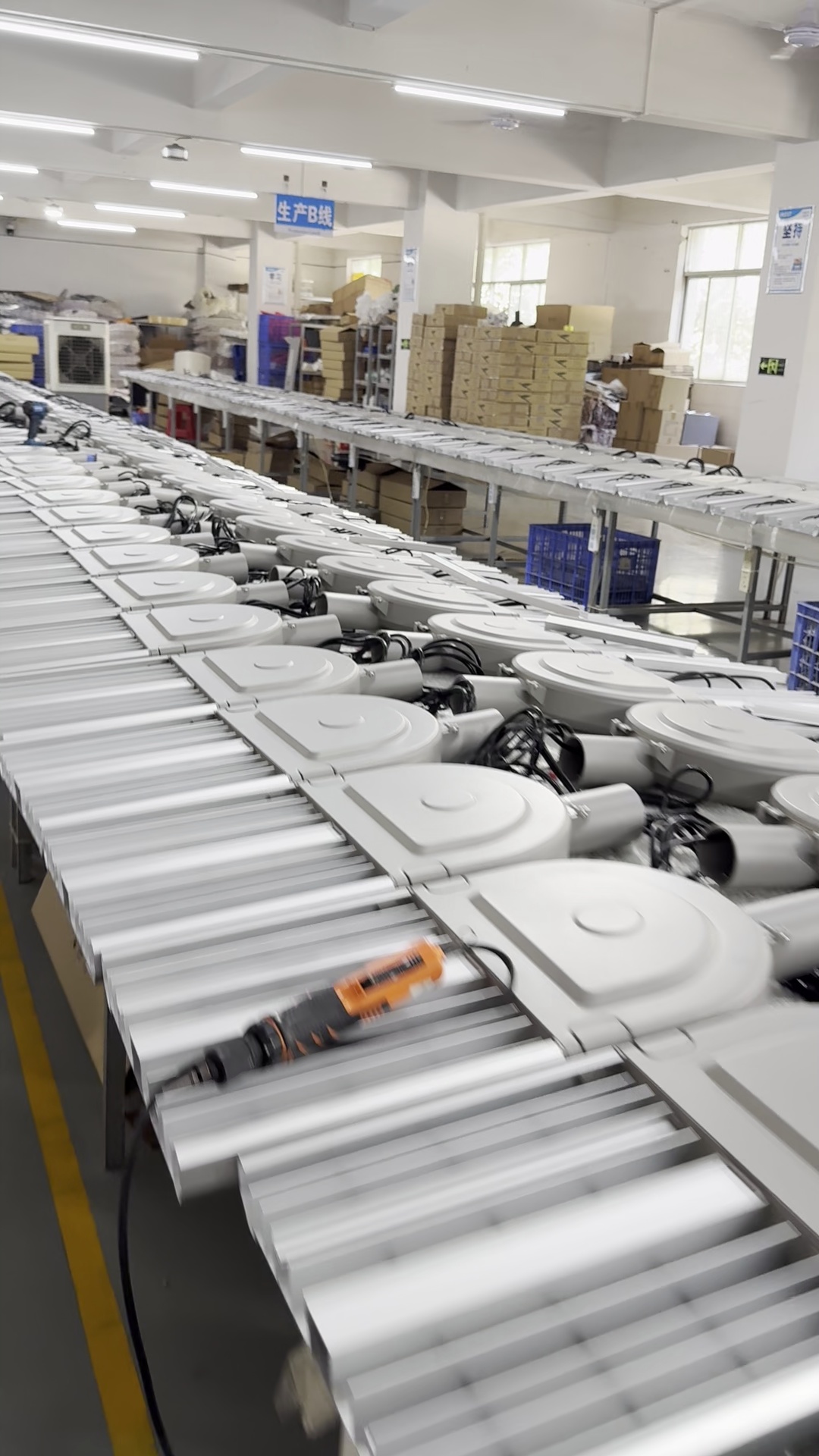
Precision Die-Cast Aluminum Optics
Dual-chamber die-cast aluminum luminaires with integrated aerodynamic heat sinks and Bridgelux 210 lm/W high-efficacy LED arrays.
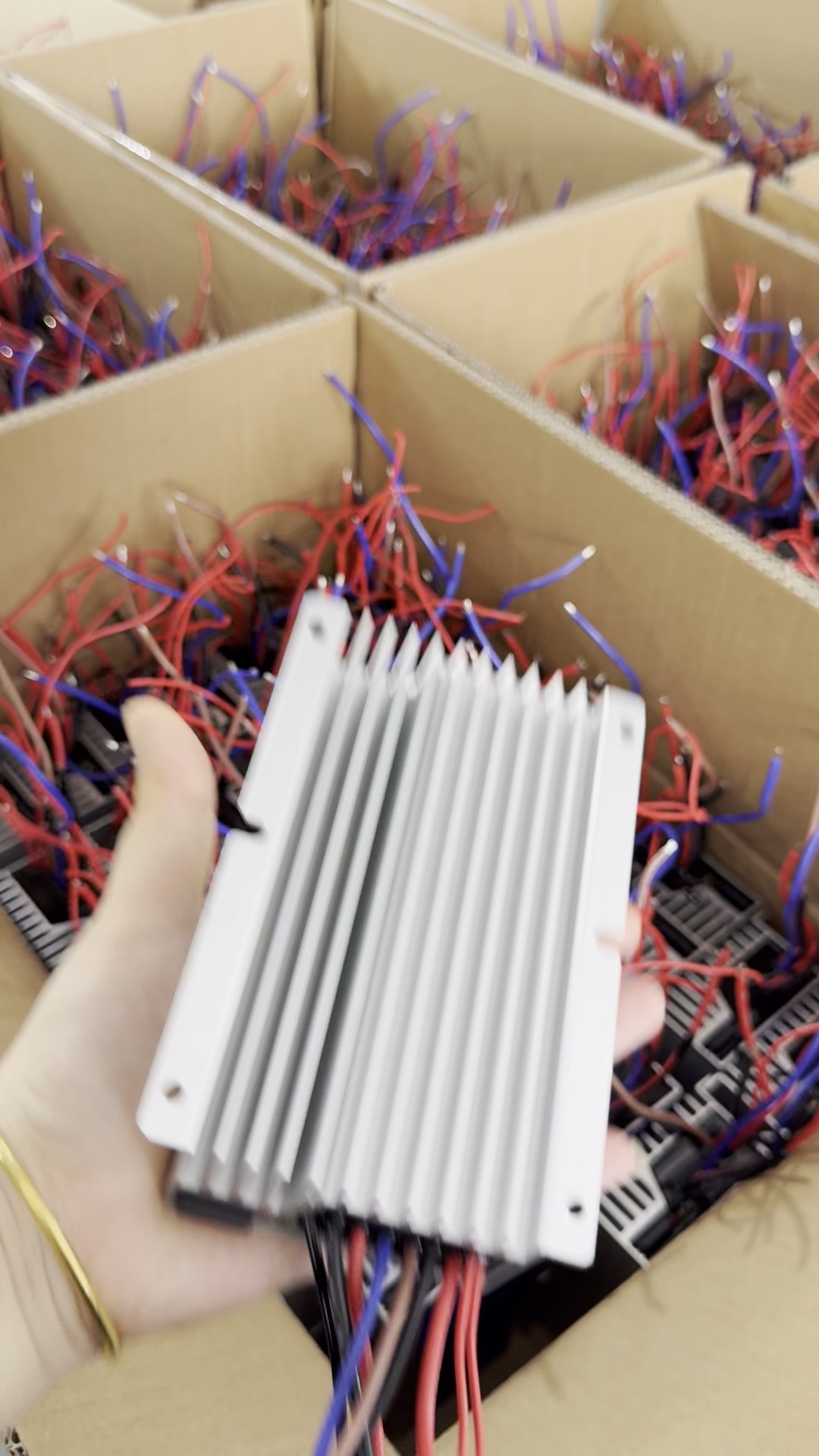
32-Bit Digital MCU MPPT Core
>99% tracking efficiency with automated stepped dimming profiles ensuring continuous 3–5 day overcast autonomy.
3. Audited Project Evidence: High-Speed Corridors Around the World
Case Study 1: Saudi Aramco Desert Industrial Highway (253 Sets)
Deployed in extreme desert terrain with ambient temperatures up to 52°C and recurring sandstorms:
- Configuration: 10-Meter octagonal hot-dip galvanized steel poles, 120W LED fixtures delivering 21,600 lumens, 320W Tier-1 mono PV modules, and 1,843Wh LiFePO4 batteries protected by MCL-HTBS™.
- Compliance: Registered in the Saudi SABER portal with SASO and IEC 60598-2-3 conformity, achieving zero component failures across 36 continuous months of operation.
Case Study 2: Algeria National Highway Conical Pole Corridor (978 Sets)
Engineered for high-vibration heavy truck traffic corridors across North Africa:
- Configuration: 10-Meter conical steel poles featuring reinforced base flange gussets (4 gusset plates per pole) and 200W two-in-one modular luminaires delivering over 34,000 lumens.
- Wind Load Engineering: FEA stress modeling verified survival in 160 km/h desert gales with ISO 12944 C4-H anti-corrosion protection.

Figure 2: Base flange triangular gusset plates engineered by MCL Solar for heavy-duty structural stability on high-speed highway poles.
4. Procurement Checklist for Municipal Roadway Tenders
When drafting tender specifications for highway and expressway solar lighting, global procurement officers should enforce the following mandatory criteria:
- Luminous Output & Efficacy: Minimum 180 lm/W luminaire efficacy with certified photometric (.IES) simulation proving compliance with EN 13201 / IESNA RP-8.
- Thermal Isolation: Battery compartment must be physically decoupled from both the photovoltaic module and LED luminaire heatsink.
- Battery Technology: 100% Brand-New Grade-A LiFePO4 chemistry with ≥3,500 cycle life at 80% DOD (UN 38.3 / IEC 62133-2 certified). Avoid recycled automotive lithium cells.
- Structural Certification: Pole foundation and luminaire arm assembly must be backed by a licensed structural engineer’s wind calculation report for minimum 160–180 km/h wind speeds.
Request a Complete Highway DIALux Simulation & BOQ Specification
Planning an expressway, arterial road, or industrial perimeter lighting project? The engineering department at MCL Solar (Zhongshan Chengyu New Energy Technology Co., Ltd.) provides complimentary 3D DIALux lighting simulations, pole stress analysis, and international compliance documentation.
Engineering & Manufacturing Verification at MCL Solar
All commercial highway lighting systems, high-power split luminaires, and Q235 hot-dip galvanized structural steel poles (ASTM A123 ≥86μm) are manufactured in-house by Zhongshan Chengyu New Energy Technology Co., Ltd. at our 35,000 m² production facility in Guzhen Town, Zhongshan, Guangdong, China.
Explore our verified expressway installations worldwide:
• Algeria National Infrastructure: 978 Sets of 200W 10M Split Highway Lighting
• Saudi Arabia 253 Sets 55°C Desert Highway Project
• Philippines Coastal Highway Typhoon-Resistant Roadway Cluster
Inspect third-party IEC 60598, IEC 62133, and ISO 9001 reports at our Compliance Verification Center.
Planning a Highway or Municipal Lighting Project?
Contact MCL Solar’s engineering division for complimentary DIALux roadway illuminance calculations, pole spacing optimization, and direct factory pricing for split-type solar street lighting systems.
Need Engineering Sizing or EPC Tender Support?
Contact MCL Solar’s engineering division for complimentary DIALux road lighting simulations, solar autonomy calculations, and direct factory pricing for municipal and commercial infrastructure projects.