
For international municipal engineers, commercial lighting distributors, and engineering, procurement, and construction (EPC) contractors, deploying an all in one solar street light system offers compelling installation speed, zero trenching costs, and rapid project commissioning. However, global field deployment data reveals a stark reality: over 70% of low-cost integrated solar luminaires sourced from trading assemblers suffer premature system failure, severe battery degradation, or total blackout within 18 to 24 months of operation.
Understanding why traditional cheap integrated units fail—and how tier-1 heavy manufacturers solve these challenges through dedicated thermal engineering and optical precision—is essential for safeguarding municipal budgets and achieving a reliable 10-year operating lifespan.
The 3 Fatal Engineering Flaws of Low-Cost All-in-One Solar Street Lights
While an integrated solar street light combines the photovoltaic module, luminaire, battery storage, and charge controller into a unified body, cutting corners in component separation creates catastrophic engineering vulnerabilities:
1. Solar Thermal Baking of Lithium Batteries
In standard low-cost assemblies, the lithium battery pack is placed directly beneath the dark monocrystalline solar panel inside a sealed, non-ventilated aluminum or plastic housing. During peak solar hours in tropical or desert environments, solar panel surface temperatures exceed 75°C to 85°C. With zero thermal barriers, heat directly conducts into the battery compartment, accelerating electrolyte drying, internal resistance spike, and battery swelling. Uninsulated lithium pouch or secondary cells fail rapidly, reducing effective autonomous operating nights from 3 days to less than 4 hours.
2. Exaggerated Wattage vs. True Photometric Delivery
Catalog assemblers and trading middlemen routinely flood overseas tenders with misleading “300W”, “500W”, or “1000W” marketing labels. In physical reality, these units incorporate tiny 40W–60W solar panels and low-capacity 12.8V batteries, outputting less than 3,000 to 5,000 lumens of poorly focused light. Legitimate municipal roadway lighting requires lab-verified system efficacy (≥180–210 lm/W) and precision Batwing optical distribution to satisfy EN 13201 and IESNA RP-8 roadway standards.
3. Unserviceable Glued Housings Leading to Total Scrapping
To cut tooling costs, low-end workshops seal integrated fixtures with permanent industrial silicone or single-use snaps. If a single protection circuit trips or a cell group degrades after 3 years, the entire fixture must be uninstalled and discarded. Municipal maintenance teams face exorbitant replacement expenditures rather than routine component servicing.
How MCL Solar’s 35,000 m² Base Redefines Commercial All-in-One Reliability
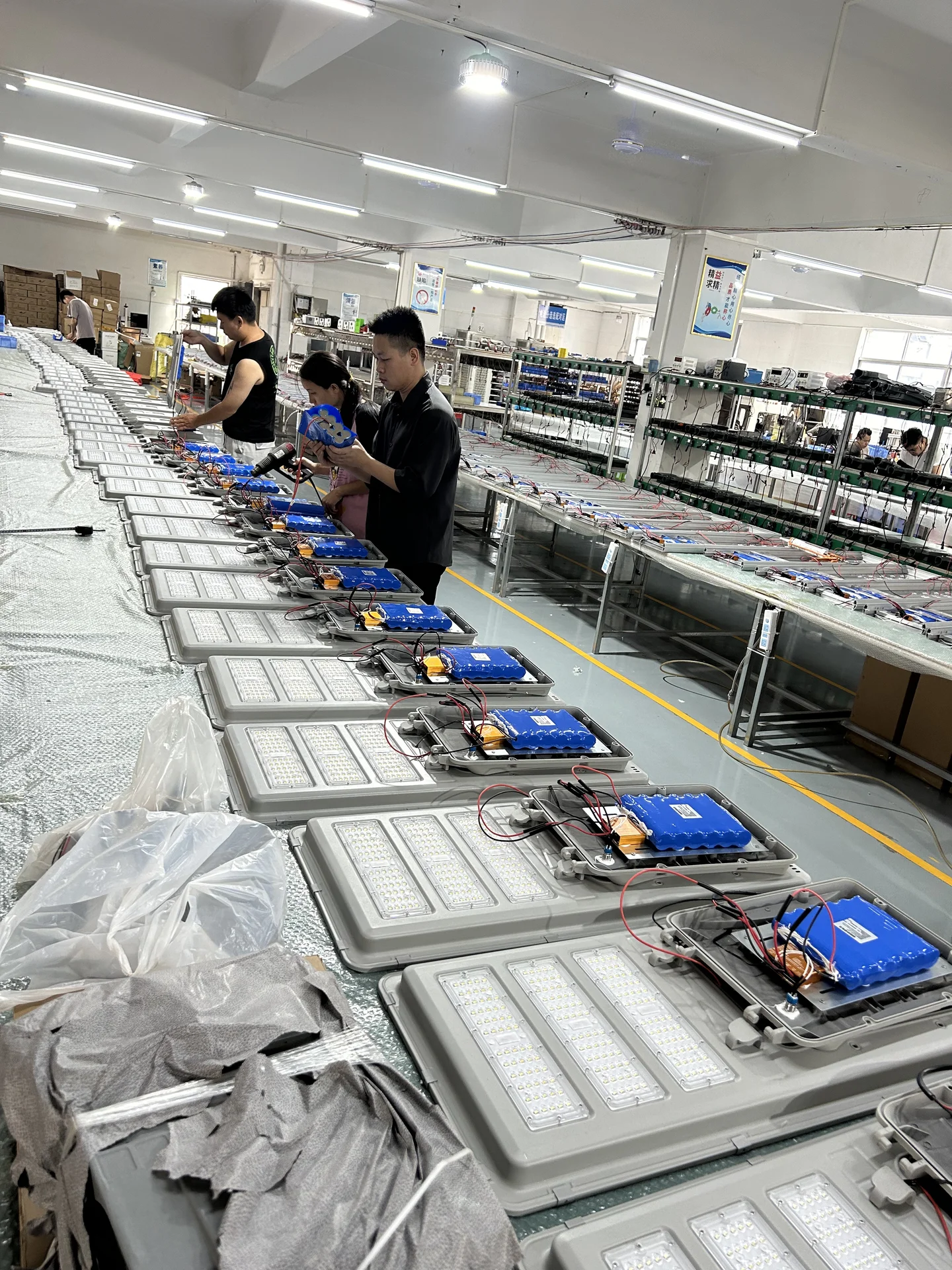
At MCL Solar’s dedicated 35,000 m² manufacturing headquarters in Zhongshan, China, our optical, electrical, and structural engineering divisions manufacture heavy-duty commercial all-in-one solar street light systems engineered for real-world municipal infrastructure tenders.
1. Patented MCL-HTBS™ Aerogel Thermal Barrier Technology
To decouple the battery from solar heat absorption, MCL Solar embeds a multi-layer aerogel composite thermal barrier (MCL-HTBS™) between the solar panel heat sink and the battery containment cavity. Even when ambient ambient heat reaches 50°C and solar panels exceed 78°C, the battery core temperature is maintained strictly below 45°C, ensuring over 3,500 full charge-discharge cycles at 80% Depth of Discharge (DOD).
2. Precision Die-Cast ADC12 Aluminum Aero-Cooling Convection Channels
Our all in one solar street light housings are formed from high-pressure die-cast ADC12 aluminum with integrated aerodynamic flow vents. Ambient airflow naturally exhausts internal heat while preserving strict IP66 ingress protection and IK10 impact resistance against tropical storm surges and heavy industrial dust.
Video 1: Automated assembly line at MCL Solar, integrating multi-unit high-efficiency LED modules equipped with Bridgelux chips and Batwing roadway lenses for commercial all in one solar street light luminaires.
3. Modular Slide-Out Architecture for 10-Minute Field Serviceability
MCL Solar’s commercial integrated fixtures feature a quick-release slide-out battery and MPPT controller tray. During scheduled 5-to-8-year lifecycle maintenance, utility technicians can replace the energy storage pack directly on the pole using a standard hex driver—saving up to 75% in ongoing operational expenditures (OPEX).
Engineering Selection Matrix: All-in-One vs. Split-Type Systems
A critical responsibility of municipal EPC consultants is choosing the correct physical topology based on roadway classification and pole height:
| Engineering Parameter | Commercial All-in-One Solar Street Light | Two-in-One & Split-Type System (Flagship) |
|---|---|---|
| Optimal Mounting Height | 4 to 7 Meters (13 to 23 ft) | 8 to 12 Meters (26 to 40 ft) |
| Typical Roadway Application | Urban pathways, residential compounds, industrial parks, rural access roads (Class P1-P4) | Major municipal avenues, 4-6 lane expressways, highway interchanges (Class M1-M3) |
| Photometric Output | 6,000 to 18,000 Lumens (Real Deliv.) | 20,000 to 42,000 Lumens (High Power) |
| Solar PV Capacity | 80W to 180W Monocrystalline PERC | 250W to 550W High-Efficiency Dual Array |
| Wind Load Engineering | Compact profile; low drag coefficient (140 km/h) | Heavy-duty ASTM A123 steel pole; FEA verified for 160 km/h wind gusts |
| Recommended Solution | MCL Solar Commercial Integrated Series | MCL Solar Flagship 8-12M Two-in-One Split System |
Video 2: Verified batch export packaging and 40HQ container loading of commercial solar street light systems destined for overseas municipal infrastructure projects at MCL Solar plant.
Factory Audit Checklist for Commercial All-in-One Solar Street Lighting
When conducting a factory inspection for your next integrated solar street lighting tender in China, mandate direct physical verification of the following 4 manufacturing checkpoints:
- 1. In-House Die-Casting & Tooling Control: Confirm whether the supplier owns proprietary high-tonnage die-casting machines and precision CNC tooling or merely buys generic market shells.
- 2. 100% LiFePO4 Cell Capacity & Resistance Sorting: Demand to see digital cyclers testing cell capacity (Ah) and internal AC resistance (ACIR) before pack assembly (tolerance: ΔC ≤ 1%, ΔR ≤ 0.5 mΩ).
- 3. Photometric Goniophotometer Test Reports: Reject unverified datasheets; require authentic IES/LDT roadway calculation files generated from a Type C distributed goniophotometer darkroom (such as Everfine GO-3000H).
- 4. 24-Hour Continuous Burn-in Aging: Inspect the on-site burn-in room where 100% of finished luminaires undergo cyclical high-stress aging prior to packaging.
Partner with China’s Premier Heavy-Duty Solar Lighting Manufacturer
With 35,000 square meters of smart manufacturing infrastructure, ISO 9001/14001/45001 certifications, CB/IEC 60598 compliance, and over 15 years of proven utility project execution across the Middle East, Southeast Asia, Africa, and Latin America, MCL Solar provides dependable municipal-grade solar lighting engineered for zero maintenance anxiety.
Technical Resources & Project Consultation Portals:
- Explore Factory Audit Criteria: Solar Street Light Factory Audit Guide
- Review Municipal Expressway Sizing: 8-12M Highway Solar Street Light Whitepaper
- High-Mast & Expressway Flagship Model: MCL Solar 8-12M Two-in-One Solar Street Light System
- Verified Global Engineering Track Record: MCL Solar Global Projects Portfolio
- Direct Engineering Consultation via WhatsApp: +86 180 3033 5122 | Email: info@mclsolar.com