
For international EPC contractors, municipal procurement directors, and utility developers, executing a thorough solar street light factory audit in China is the single most critical quality assurance step before releasing advance payments or committing to multi-million-dollar infrastructure tenders. In 2026, the Chinese solar lighting industrial landscape presents a stark divide: on one hand, authentic heavy-duty industrial manufacturers operating state-of-the-art facilities with fully integrated steel fabrication and automated cleanrooms; on the other hand, thousands of trading intermediaries, catalog assemblers, and small workshops masquerading as certified original equipment manufacturers (OEMs).
Sourcing from unverified trading companies poses catastrophic risks for municipal lighting projects. Secondary assemblers frequently substitute Grade-A LiFePO4 cells with second-life recycled automotive batteries, rely on cold-spray zinc paint instead of genuine hot-dip galvanization, and falsify photometric lumen ratings. When deployed across expressways or desert corridors, these substandard lights suffer from battery swelling, pole corrosion, and premature blackout within 12 to 24 months. This comprehensive solar street light factory audit guide provides global procurement teams with a practical engineering framework to inspect production lines, verify critical machinery, evaluate battery capacity grading laboratories, and differentiate true industrial powerhouses like MCL Solar from trading middlemen.
The Anatomy of Deception: Trading Middlemen vs Authentic Industrial Manufacturing
Before stepping onto the factory floor or booking a third-party audit with SGS, TÜV, or Bureau Veritas, procurement directors must understand how trading intermediaries operate in major lighting hubs such as Zhongshan Guzhen, Shenzhen, and Changzhou. A standard trading operation typically rents a 200-square-meter commercial office and a small showroom displays samples purchased from disparate third-party component vendors. When a major municipal inquiry arrives, the trading firm subcontracts every single subassembly:
- Pole Subcontracting: Outsourced to unregulated rural welding shops that utilize low-grade Q195 scrap steel with cold-galvanizing or electro-galvanizing (yielding less than 15 μm of zinc thickness), leading to rapid structural rusting within 2 years.
- Battery Assembly: Sourced from informal packagers who purchase un-graded, recycled, or B-grade lithium cells lacking batch consistency, internal resistance sorting, and proper BMS thermal protection.
- Luminaire Enclosures: Low-cost die-cast aluminum alloys with high impurity levels that fail salt-spray corrosion tests and lack IP66 ingress sealing.
Conversely, a tier-1 industrial manufacturer maintains unified control over structural, electrical, and optical engineering within a dedicated manufacturing complex. At MCL Solar’s 35,000 m² smart manufacturing base in Zhongshan, the entire value chain—from heavy steel pole laser cutting, automated submerged welding, and hot-dip galvanizing to cleanroom SMD pick-and-place, digital LiFePO4 cell capacity grading, and DIALux photometric validation—is executed strictly in-house under ISO 9001, ISO 14001, and ISO 45001 management protocols.
Key Audit Checklist: 4 Essential Verification Pillars
When executing an on-site or remote live-video solar street light factory audit, EPC engineers should structure their evaluation around four core verification pillars:
Pillar 1: Structural Steel Pole Fabrication & Hot-Dip Galvanization Verification
The lighting pole represents 30% to 45% of total project capital expenditure and is the sole structural element guaranteeing public safety under severe meteorological events. During the factory audit, inspect the following critical processes:
- Raw Material Traceability: Verify mill test certificates (MTC) confirming prime Q235B or Q345B structural steel according to GB/T 700 or ASTM A36. Ensure plate thickness meets engineering calculations (e.g., minimum 3.5 mm to 4.5 mm for 8–12 meter highway poles).
- Automated Submerged Arc Welding: Inspect longitudinal seam welding. Authentic heavy-duty pole plants employ dual-wire submerged arc welding machines producing full-penetration, uniform weld beads without porosity or undercutting.
- Hot-Dip Galvanizing Verification (ASTM A123 / EN ISO 1461): A true manufacturer must either operate an on-site industrial galvanizing kettle or hold dedicated long-term partnerships with certified hot-dip facilities. The molten zinc bath must be maintained at 445°C to 455°C. Using a calibrated digital magnetic thickness gauge, measure the dry film thickness (DFT). Legitimate municipal poles must exhibit a minimum average zinc thickness of ≥86 μm (exceeding 610 g/m²). Reject any supplier offering cold-spray zinc painting or electroplating disguised as hot-dip galvanizing.
Pillar 2: LiFePO4 Battery Pack Manufacturing & Capacity Grading Laboratory
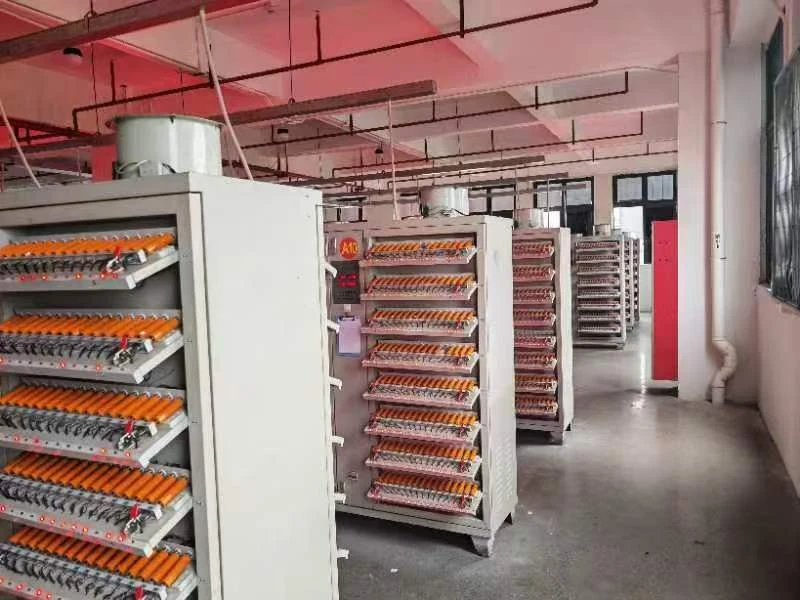
The battery energy storage system is the most frequent point of field failure. In your solar street light factory audit, auditing the battery production line requires uncompromising scrutiny:
- Multi-Channel Automated Capacity Grading Cabinets: Require the factory to demonstrate their cell sorting procedure. MCL Solar tests 100% of incoming Grade-A prismatic LiFePO4 cells through automated charge-discharge cyclers to measure exact capacity (Ah), open-circuit voltage (OCV), and internal AC resistance (ACIR). Cells are sorted into tight tolerance bins (ΔC ≤ 1%, ΔR ≤ 0.5 mΩ) before pack assembly.
- BMS Architecture and Over-Temperature Protection: Inspect the BMS printed circuit board. For municipal projects, verify multi-layer conformal coating against humidity and salt fog, dual-stage MOS cut-off switches, and physical temperature sensors embedded between cells with high-temperature shutoff thresholds at 65°C.
- Thermal Enclosure Design: For high-temperature desert environments (such as Saudi Arabia, UAE, or Algeria), verify whether the battery utilizes patented aerogel insulation jackets (such as MCL-HTBS™) to prevent cell core temperatures from exceeding 45°C during daytime solar radiation.
Pillar 3: Photometric Optical Engineering & Goniophotometer Laboratory
Many catalog assemblers advertise exaggerated luminous efficacy claims (e.g., “300 lm/W” or “20,000 lumens from a 50W panel”). An authentic factory audit must verify in-house optical testing capabilities:
- Darkroom Distributed Photometer (Goniophotometer): The facility must operate a certified darkroom with a Type C distributed goniophotometer (such as Everfine GO-2000 or GO-3000H). Request a live photometric test of an active luminaire to generate an authentic IES/LDT file.
- Integrating Sphere with Spectroradiometer: Verify color temperature (CCT 3000K–6500K), Color Rendering Index (CRI ≥ 70 or ≥ 80), and true chip luminous flux. MCL Solar configurations utilize genuine Bridgelux 5050/7070 high-lumen LED chips achieving 208.96 lm/W lab-verified system efficacy.
- Lens Optical Distribution: Ensure the factory manufactures or stocks precision batwing optical PMMA lenses specifically configured for EN 13201 Class M1–M3 roadway lighting (Type II-M and Type III-M distributions).
Pillar 4: Production Line Scalability, Burn-in Aging & Quality Control Systems
Examine the operational discipline across the assembly lines:
- Continuous Conveyor Assembly Lines: Observe whether production proceeds in a logical, continuous flow with electrostatic discharge (ESD) protection, calibrated torque screwdrivers, and dedicated workstations.
- 100% Full-Load Burn-in Aging Room: Demand to inspect the aging room. Authentic manufacturers subject every single batch of finished solar street lights to a continuous 12 to 24-hour burn-in aging test with cyclical on/off switching to detect infant component mortality before packing.
- Environmental Test Chambers: Look for IP66 waterproof water-jet testing booths, IK08/IK10 mechanical impact pendulum testers, and salt spray corrosion chambers (ASTM B117 / ISO 9227).
Technical Comparison: Tier-1 Manufacturer vs Trading Assembler
The following matrix outlines the crucial differentiators that EPC auditors must record in their official supplier evaluation scoring sheets:
| Evaluation Criterion | MCL Solar (35,000m² Heavy Manufacturer) | Standard Trading Assembler / Middleman |
|---|---|---|
| Manufacturing Base | 35,000 m² owned industrial plant in Zhongshan, integrated pole fabrication & battery testing | Rented 150–300 m² sales office; production fully outsourced to third-party workshops |
| Lighting Pole Anti-Corrosion | ASTM A123 / ISO 1461 hot-dip galvanizing, ≥86 μm average zinc coating thickness (25+ yr life) | Cold-spray zinc painting or thin electroplating (≤15 μm); rusts within 12–24 months |
| Wind Load Calculation | Finite element analysis (FEA) verified for 160 km/h wind gusts, certified anchor flange engineering | Generic non-calculated pole drawings; risk of structural bending or shear failure |
| Battery Quality & Sorting | 100% Grade-A new LiFePO4 cells sorted by capacity, voltage, and ACIR; >3,500 cycles at 80% DOD | Recycled/secondary automotive cells; un-sorted mixed batches with early thermal failure |
| System Voltage Architecture | 25.6V high-voltage architecture for 8–12M highway systems (75% lower I²R line loss) | Standard 12.8V or 3.2V low-voltage circuits with severe thermal buildup and cable losses |
| Photometric Verification | In-house darkroom Everfine GO3000H goniophotometer with verified DIALux IES/LDT road simulations | Fabricated spec sheets; no laboratory; lumen ratings exaggerated by 200% to 300% |
| International Compliance | ISO 9001/14001/45001, CE, RoHS, CB, IEC 60598, UN38.3, SASO 2902 / SABER registered | Photocopied certificates from component suppliers; certificates under third-party entities |
| Warranty & Spare Parts | 5-year comprehensive project warranty backed by serial-numbered component tracking | 1-2 year verbal warranty; entity frequently dissolves or renames before warranty expires |
How to Conduct a Virtual Live-Video Audit (For Remote EPC Teams)
When travel constraints prevent in-person factory visits, international procurement teams can execute a highly effective live-video solar street light factory audit using these targeted tactics:
- Unannounced Real-Time Video Call: Require the supplier’s engineering director to initiate a WeChat or WhatsApp video call on 30 minutes’ notice during working hours. Walk from the entrance gate, through the heavy machinery bays, directly into the battery grading room.
- Dynamic Whiteboard Verification: Instruct the video operator to write today’s date, your project name, and your company name on a white sheet of paper and place it inside the battery testing cabinet and on an active welding jig. This eliminates the risk of pre-recorded marketing videos.
- Random Serial Number Sampling: Select three random finished luminaires from the burn-in aging racks and ask the technician to scan the QR/barcode, display the manufacturing test log, and measure the open-circuit voltage of the internal battery pack on a live digital multimeter.
- Thickness Gauge Live Measurement: Require the QA manager to calibrate a magnetic coating thickness gauge on a reference shims, then place the probe on three different sections of a finished 10-meter street light pole to confirm ≥86 μm hot-dip galvanizing.
Engineering Sizing Alignment: Why 8–12M Highway Lighting Requires Heavy Manufacturing
As demonstrated in our previous engineering dossier on Highway Solar Street Light Sizing for 8–12M Split-Type Systems, municipal infrastructure demands substantial electrical and mechanical capacity. Illuminating multi-lane expressways to EN 13201 Class M1 or M2 standards requires continuous luminous outputs between 18,000 and 32,000 lumens, paired with 400W–600W mono-crystalline solar panels and 25.6V 150Ah–200Ah battery storage systems.
An integrated all-in-one fixture or a lightweight assembly cannot physically accommodate the massive wind resistance ($F_w approx 1,850 ext{ N}$ at 160 km/h) generated by a 600W solar panel array mounted atop a 12-meter pole. Only a verified heavy-duty manufacturer with certified structural steel welding and ASTM A123 galvanizing can guarantee that the pole foundation, anchor cage, and pole shaft will withstand severe storms without structural failure. For municipal tenders, always specify the MCL Solar 8–12M Two-in-One Highway Split Solar Street Light System as your engineering baseline.
MCL Solar: 35,000m² Verified Smart Manufacturing Credentials
- Physical Base: 35,000 m² self-owned industrial manufacturing campus in Guzhen Town, Zhongshan City, Guangdong Province, China.
- Heavy Steel Production: In-house CNC laser cutting, automated dual-wire submerged arc welding, 14-meter hydraulic folding, and certified hot-dip galvanizing (≥86 μm compliant with ASTM A123 / ISO 1461).
- Lithium Storage Division: Automated multi-channel LiFePO4 battery capacity grading, laser busbar welding, and MCL-HTBS™ thermal aerogel barrier engineering.
- Optical Testing: In-house Everfine GO3000H distributed goniophotometer, integrating sphere spectroradiometer, and DIALux photometric design services.
- International Credentials: ISO 9001:2015, ISO 14001:2015, ISO 45001:2018, CE, RoHS, CB, IEC 60598, IEC 62722, UN38.3, and SASO 2902 / SABER registered.
- Global Project Track Record: Over 150,000 municipal and highway systems installed across Saudi Arabia, UAE, Senegal, Algeria, Philippines, and Southeast Asia. Review verified projects at MCL Solar Global Projects Portfolio.
Schedule a Live Video Factory Audit or Request Tender Dossier
Planning a municipal or commercial solar lighting tender? Contact MCL Solar’s senior engineering team to schedule an unannounced live-video tour of our 35,000m² manufacturing facility, or request full MTC material certificates, IES optical files, and DIALux simulations.
Connect via Direct Engineering WhatsApp: +86 180 3033 5122
Official Technical Desk: info@mclsolar.com | Direct Mobile/WhatsApp: +86 180 3033 5122