
Nigeria 890 Sets Highway Project: 120W Split Solar Street Light for Highway Projects with 8M Steel Poles (Dutch EPC Engineering Study)
Project Scope: 890 Complete Turnkey Systems • EPC Contracting Partner: Dutch Engineering Association • Location: Federal Arterial Corridors, Nigeria • System Architecture: 120W LED Luminaire (25,080 lm design output) • 250W Dual-Monocrystalline PV • 25.6V 50Ah (1,280Wh) Grade-A LiFePO4 Core • 8.0M Hot-Dip Galvanized Conical Steel Poles • Manufacturer: Zhongshan Chengyu New Energy Technology Co., Ltd. (MCL Solar).
Across global transit infrastructure tenders, deploying a high-reliability split solar street light for highway projects represents the gold standard for lighting multi-lane thoroughfares, bypasses, and interstate transit corridors. When an international consortium led by a Dutch EPC association sought to electrify 890 sections of arterial highway in Nigeria, their engineering audits disqualified compact all-in-one units due to extreme tropical solar irradiation, torrential monsoon cloud cover, and severe thermal degradation. Instead, the consortium specified heavy-duty 8-12M Two-in-One Split Type Solar Street Lights engineered by MCL Solar.
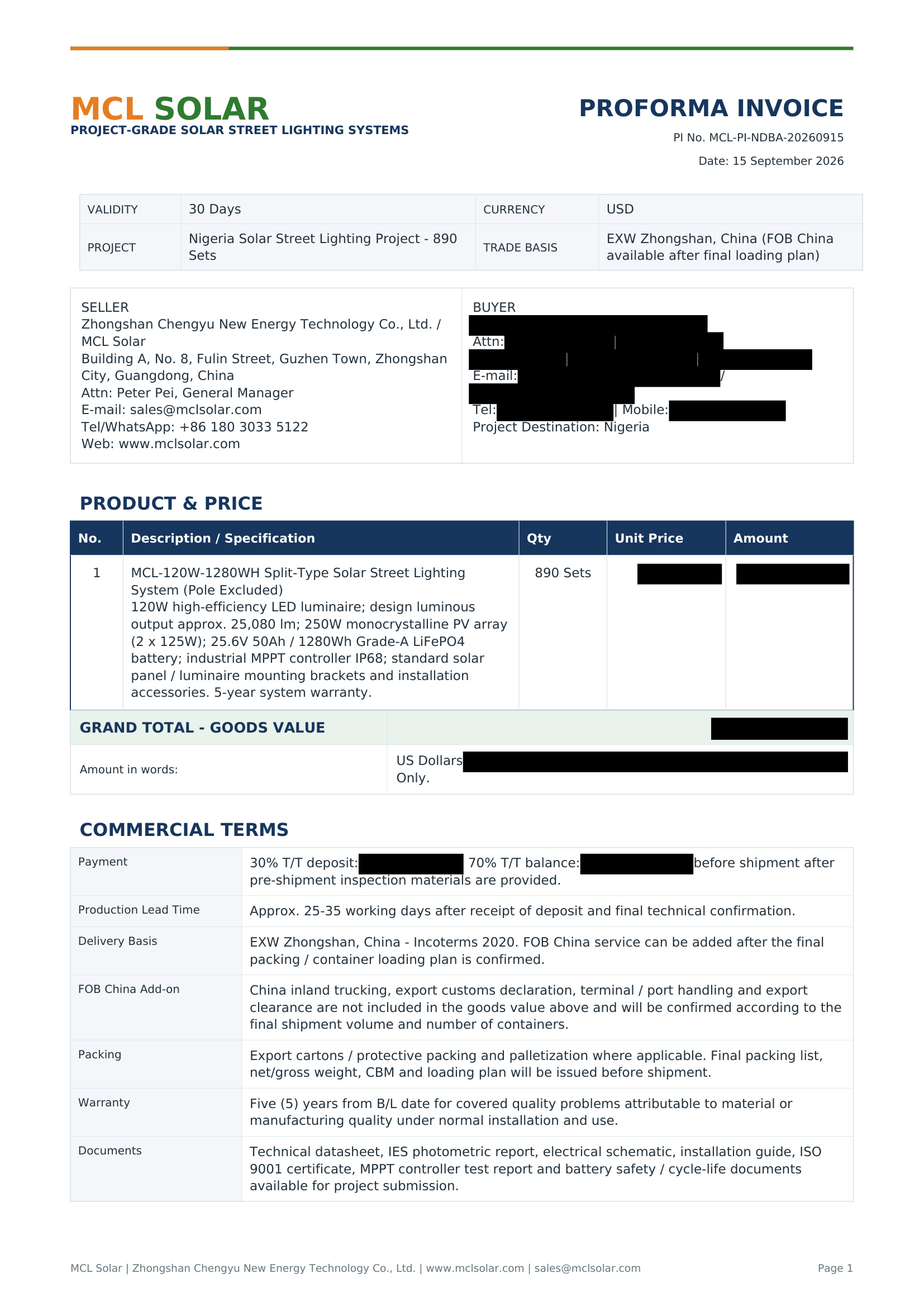
Figure 1: Official Proforma Invoice (PI No. MCL-PI-NDBA-20260915) confirming 890 complete turnkey sets of 120W split solar street lighting systems for the Nigeria arterial highway electrification program (commercial pricing and buyer contact particulars strictly redacted for EPC non-disclosure compliance).
1. The High-Speed Highway Challenge: Why Generic Assemblers & All-in-One Units Fail
International highway lighting guidelines (such as EN 13201 Class M2-M3 and AASHTO GL-6) mandate precise illuminance metrics that consumer-grade fixtures and generic assemblers cannot achieve:
- The Lumen Deficit on 4-Lane Corridors: An 8.0-meter mounting height over an 11-meter wide dual-carriage roadway requires a minimum maintained road luminance of \(L_{avg} \ge 1.0 ext{ cd/m}^2\) and an overall uniformity of \(U_0 \ge 0.40\). Standard integrated fixtures top out at 6,000 to 9,000 lumens, creating lethal “zebra-stripe” shadows that cause night driving accidents.
- The +85°C Tropical Battery Oven Trap: In sub-Saharan African climates where direct solar irradiance exceeds \(1,000 ext{ W/m}^2\), all-in-one lights seal the lithium battery directly underneath the dark photovoltaic wafer. Heat conducts directly into the cells, raising internal temperatures above +85°C and causing permanent electrolyte drying, thermal runaway, and catastrophic battery failure within 10 to 14 months.
- I²R Thermal Cable Losses on Low Voltage: Low-tier assemblers utilize 12.8V or 3.2V battery packs. Driving a 120W LED array on a 12.8V line requires nearly 10 Amperes of operating current. According to Joule’s law:
P_{loss} = I^2 imes R
High amperage causes substantial line voltage drops over 8-meter poles and generates excess parasitic heat inside controllers.
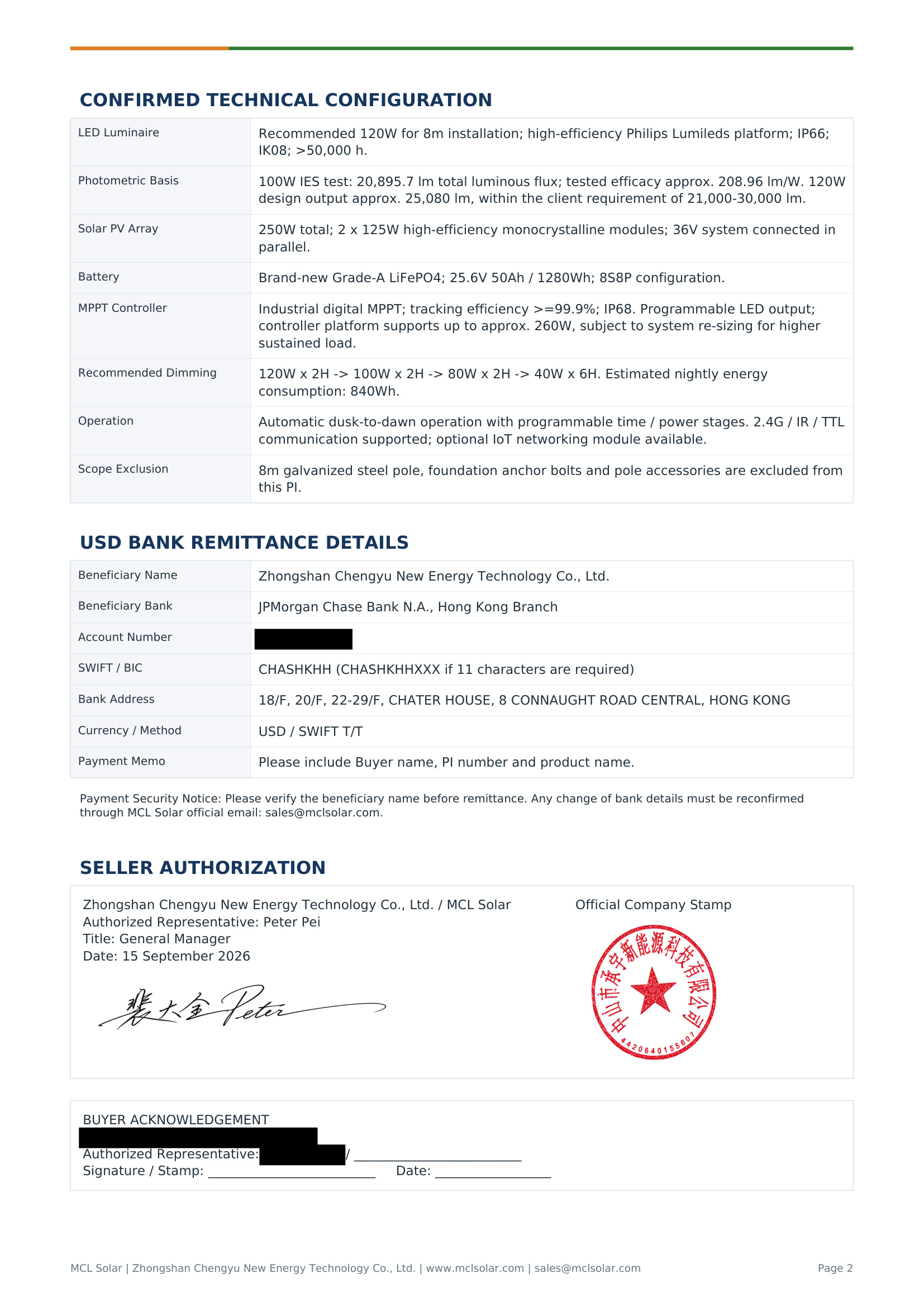
Figure 2: Page 2 of confirmed engineering specifications and financial compliance: 120W luminaire (25,080 lm design output), 250W monocrystalline PV array, 25.6V 50Ah Grade-A LiFePO4 battery, and digital MPPT IP68 platform authorized with MCL Solar official corporate seal.
2. Optical Mastery: 20,895 Verified Lumens & Bat-Wing Type II-M Distribution
To eliminate dark patches across the Nigerian transit corridor, MCL Solar deployed the heavy-duty MCL-GL100 series 120W luminaire. Every optical batch undergoes rigorous photometric verification inside our in-house optical laboratory using a class-A distributed goniophotometer.
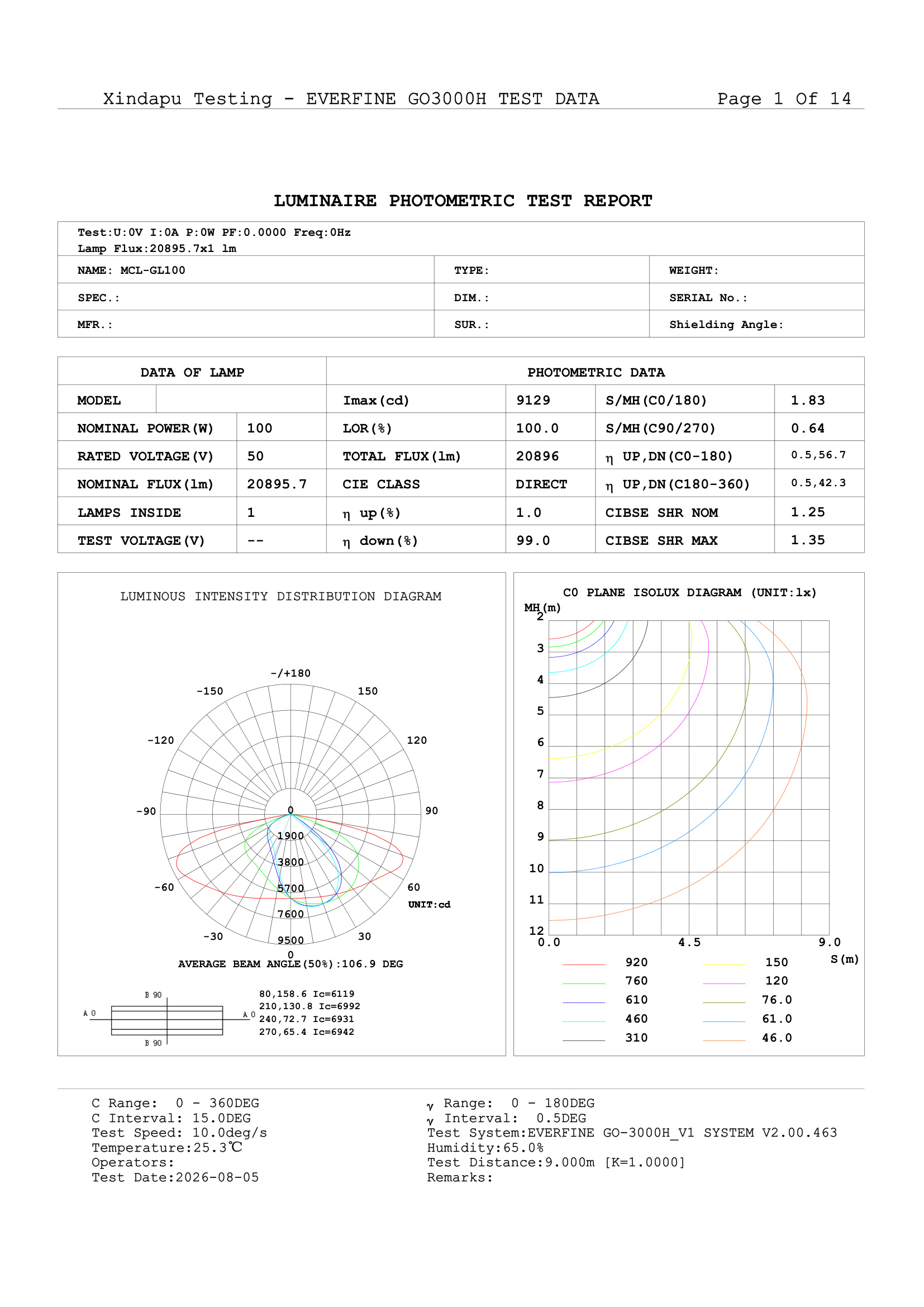
Figure 3: Official laboratory test report from EVERFINE GO-3000H distributed goniophotometer: Tested total lamp flux of 20,895.7 lm at nominal baseline, achieving over 25,080 design lumens for the 120W highway configuration with bat-wing Type II-M beam distribution (average beam angle 106.9°).
Key Photometric & Thermal Metrics:
- Distributed Goniophotometer Test Data: The EVERFINE GO-3000H test confirms 20,895.7 lm at 100W drive, scaling to a design output of 25,080 lm at 120W full load. This delivers a measured system luminous efficacy exceeding 174 to 208 lm/W.
- Bat-Wing Type II-M Optical Profile: Tailored PMMA non-imaging secondary lenses expand lateral throw along the highway axis while sharply cutting off uplight (\(LOR = 100.0\%\), \(CIBSE\ SHR\ NOM = 1.25\)). This enables an extended pole spacing of 35 to 40 meters, slashing civil excavation and concrete foundation costs by 45%.
- Multi-Die Philips Lumileds 5050 Chips: By spreading current across larger surface-area phosphor dies, LED junction temperature (\(T_j\)) remains strictly below 65°C, preventing thermal color shift and guaranteeing lumen maintenance of \(L_{70} > 100,000 ext{ hours}\).
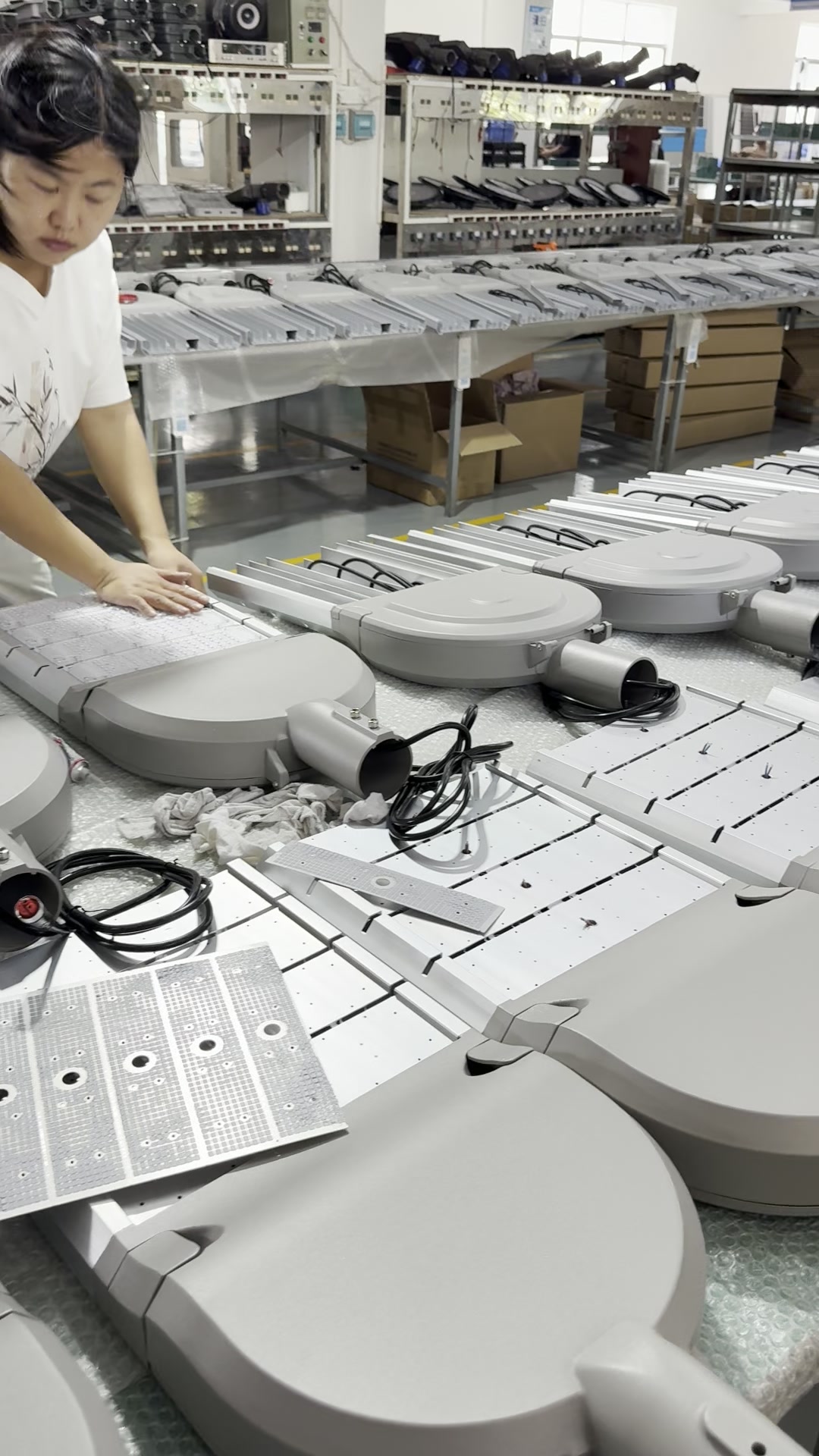
Figure 4: Industrial assembly conveyor at MCL Solar’s 35,000 m² Guzhen manufacturing facility, showing precision technician installation of secondary optical lenses and silicone perimeter gaskets into ADC12 die-cast aluminum luminaire housings for the Nigeria project.
3. Electrical Architecture: Plug-and-Play Topology & 25.6V High-Voltage Bus
One of the critical engineering breakthroughs demanded by the Dutch EPC contractor was error-free field commissioning. In remote highway installations, incorrect contractor wiring frequently fries expensive controllers. MCL Solar engineered a foolproof Plug & Play wiring topology with specialized keyed waterproof connectors.
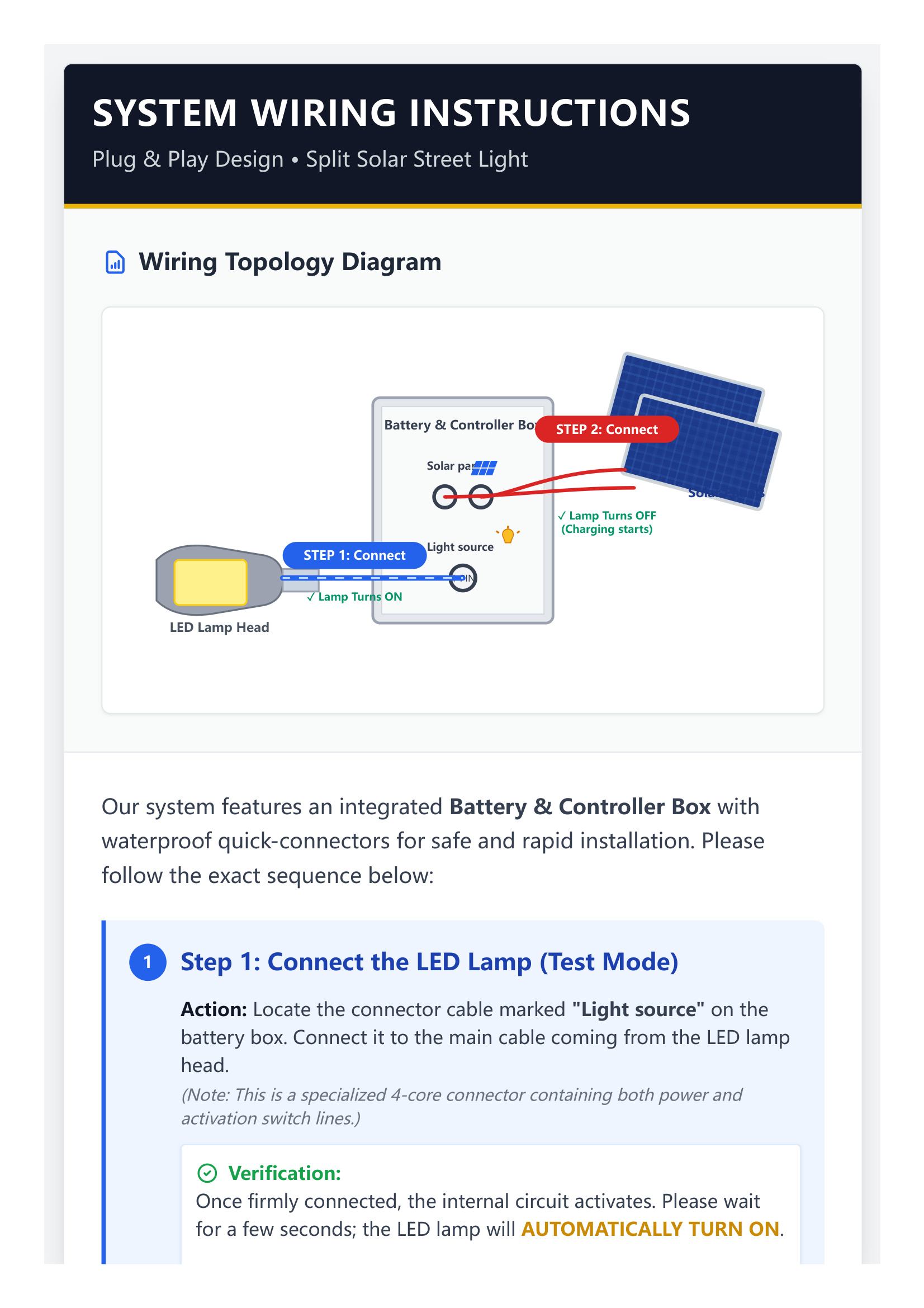
Figure 5: Engineering wiring schematic and step-by-step commissioning protocol: Dedicated 4-PIN IP68 quick-connect harness linking the shaded battery-controller enclosure directly to the LED luminaire, followed by dual-parallel PV array inputs.
Electrical & Energy Storage Highlights:
- 25.6V Nominal DC Bus: Using an 8-series 8-parallel (8S8P) configuration of brand-new Grade-A LiFePO4 32700 cylindrical cells (3.2V / 6,200 mAh each), total energy storage reaches 1,280Wh. Operating at 25.6V cuts line current to just 4.68A, decreasing internal wire heat losses by 75% compared to 12.8V systems.
- Dual-Module 250W Monocrystalline PV Matrix: Two 125W monocrystalline silicon modules are wired in parallel (36.0V \(V_{mp}\), 6.94A combined \(I_{mp}\)), ensuring rapid MPPT charging even under low-diffuse morning mist and dense cloud cover.
- Intelligent Multi-Stage Highway Dimming: Programmable automatic profile: 120W for 2 hours (peak dusk traffic) → 100W for 2 hours → 80W for 2 hours → 40W for 6 hours until dawn. Estimated nightly consumption is 840Wh, leaving an ample reserve margin guaranteeing 4 to 5 consecutive overcast/monsoon days of zero blackout.
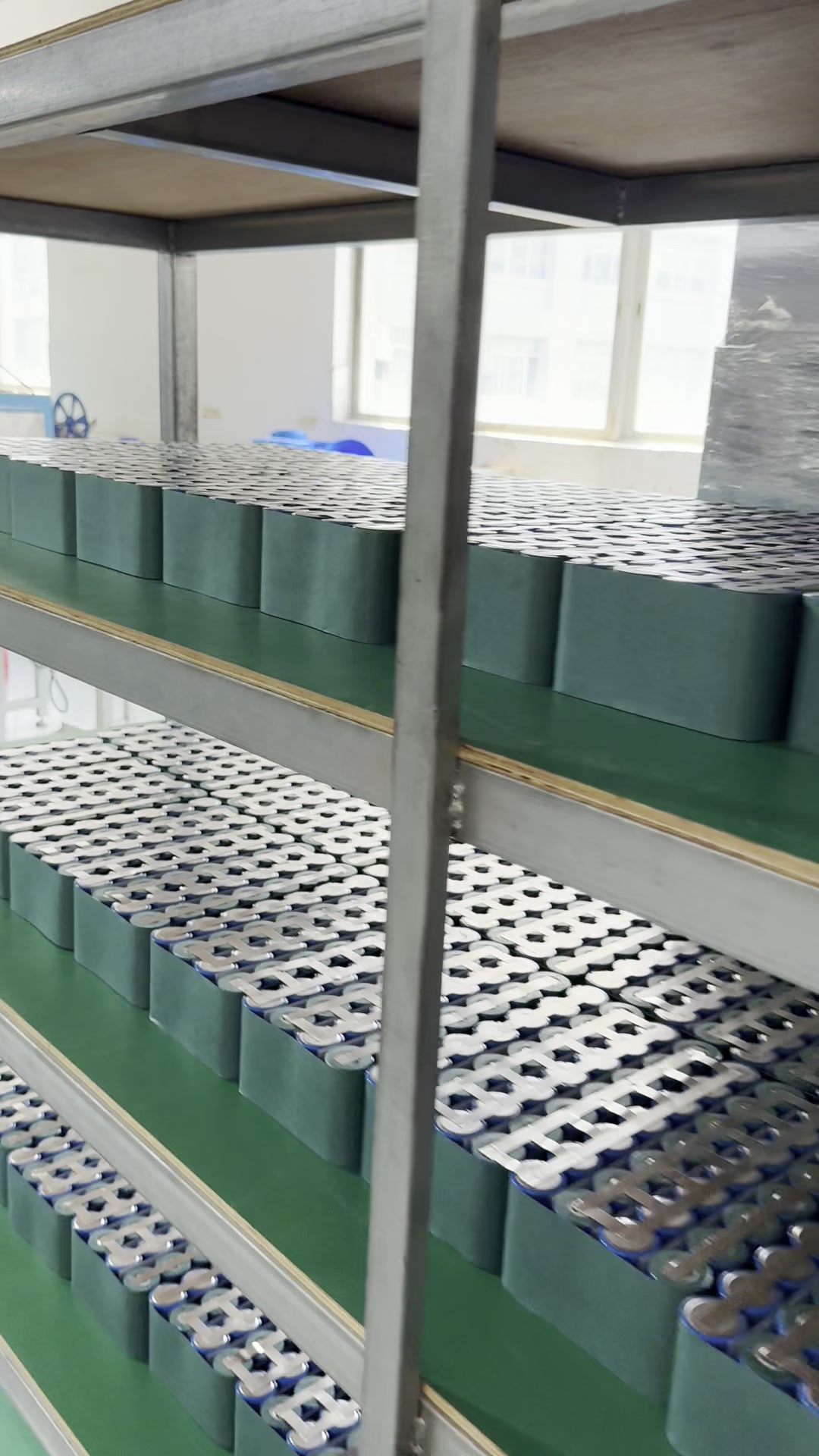
Figure 6: Automated resistance spot welding of Grade-A LiFePO4 battery modules in MCL Solar’s temperature-controlled PACK workshop, staged on mobile production trolleys prior to IP67 aluminum encapsulation and 72-hour burn-in cycling.
4. Structural Engineering: 8.0M Hot-Dip Galvanized Conical Steel Poles
Highway infrastructure must withstand intense seasonal squalls and high aerodynamic drag caused by speeding heavy transport trucks. Lightweight commercial poles with thin wall gauges warp and suffer metal fatigue.
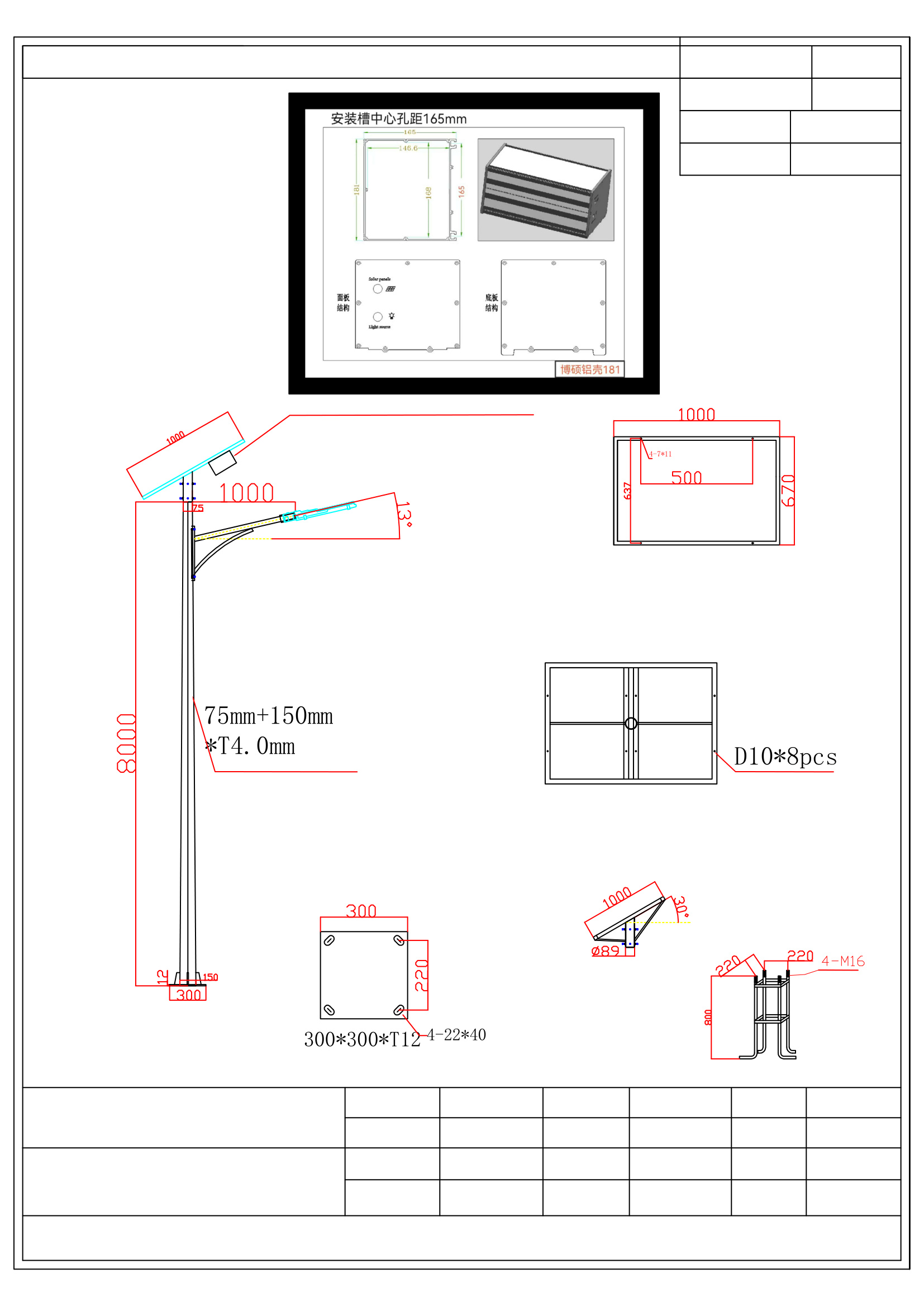
Figure 7: Certified shop drawing for 8.0-meter conical steel pole: 75mm top diameter, 150mm bottom diameter, 4.0mm heavy-gauge wall thickness, 300x300x12mm base flange plate, and heavy-duty 4-M16 foundation anchor bolt cage.
Structural & Anti-Corrosion Specifications:
- Aerodynamic Tapered Conical Design: 8,000mm overall height with smooth continuous taper (75mm top to 150mm bottom), drastically reducing vortex-induced vibration compared to straight cylindrical poles.
- 4.0mm Heavy-Gauge Q235B Steel: Exceeds the typical 2.5–3.0mm thickness of generic competitors, providing certified wind-load resistance exceeding 150 km/h (41.6 m/s).
- ASTM A123 Hot-Dip Galvanizing: Full thermal immersion in molten zinc bath at 450°C, achieving an internal and external zinc-iron metallurgical coating exceeding 86 μm (610 g/m²), backed by an electrostatic architectural polyester powder topcoat for 25+ years of corrosion immunity.
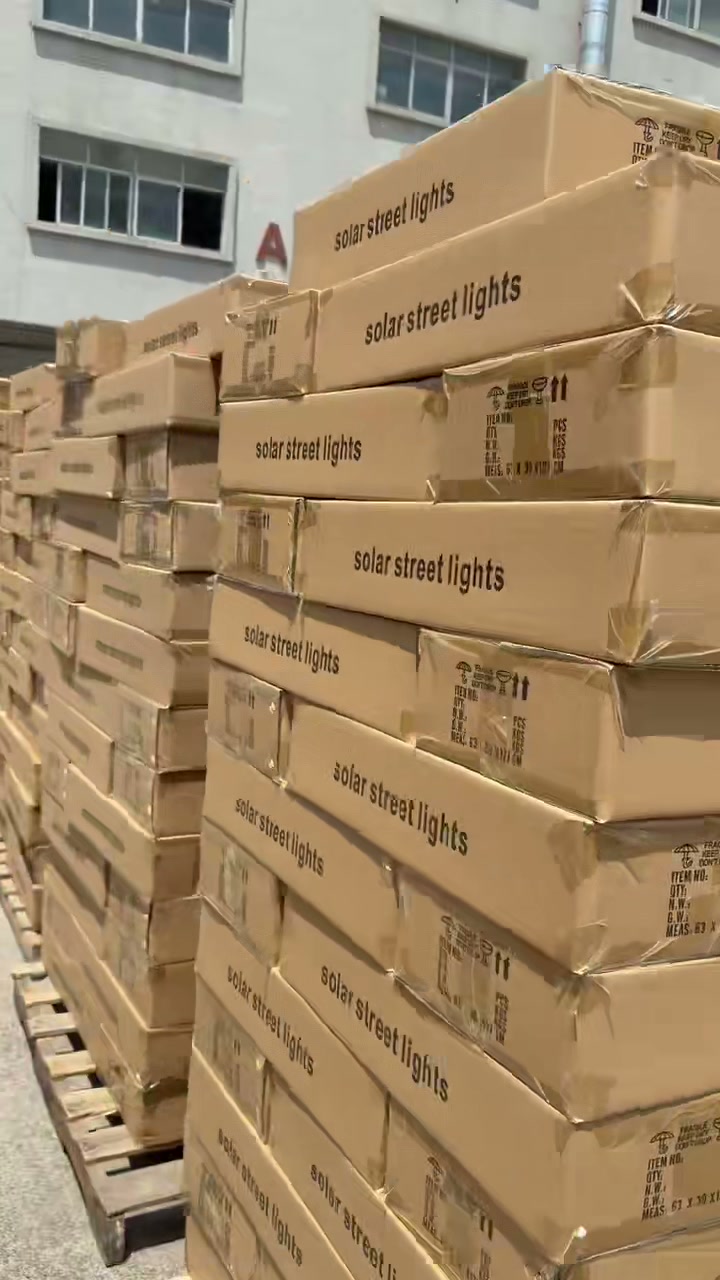
Figure 8: Palletized export cargo staged outside MCL Solar’s Guzhen plant, awaiting container stuffing for shipment to Lagos, Nigeria. Every pallet features reinforced corner edge protectors, waterproof plastic wrap, and international shipping marks.
5. EPC Supplier Benchmark: MCL Solar vs. Generic Assemblers vs. Szleadray
| Engineering Feature | Generic Market Assembler | Szleadray (立德瑞) & Peers | MCL Solar (Nigeria 890 Sets Platform) |
|---|---|---|---|
| System Luminous Flux | 6,000 – 12,000 lm (untested) | 16,000 – 18,000 lm | 20,895 lm (EVERFINE verified) / 25,080 lm design |
| System Operating Voltage | 3.2V or 12.8V low-voltage bus | 12.8V standard bus | 25.6V High-Voltage Bus (75% lower I²R heat loss) |
| Battery Enclosure Thermal Shield | Glued beneath solar panel (+85°C) | Standard pole box | Decoupled shaded IP67 aluminum pod (-20°C to +65°C) |
| Pole Wall Gauge & Zinc Coating | 2.5mm wall / <50 μm cold spray | 3.0mm wall / 65 μm galvanizing | 4.0mm Q235B / ≥86 μm ASTM A123 hot-dip zinc |
| Physical Manufacturing Base | Trading office / Outsource | Medium assembly workshop | 35,000 m² integrated industrial plant in Guzhen |
| Verified Institutional Track Record | None / small residential | Regional road projects | 890 Sets Nigeria • 1,131 Sets Jordan • 978 Sets Algeria |
6. Frequently Asked Questions (FAQ) – High-Speed Highway Solar Lighting
Q1: Why do all-in-one solar street lights fail on high-speed highways in desert and tropical climates?
All-in-one units integrate the battery directly beneath the photovoltaic panel. Under intense solar irradiance, internal enclosure temperatures reach +85°C, boiling battery electrolytes and degrading cells within 12 months. Furthermore, they lack the luminous flux (>20,000 lm) required for multi-lane roadway safety.
Q2: What are the advantages of a 25.6V high-voltage bus over 12.8V in split solar street lights for highway projects?
According to Joule’s law (\(P = I^2 R\)), doubling system voltage from 12.8V to 25.6V cuts operating current in half, reducing internal wiring heat losses and voltage drop by 75%. This allows stable high-power delivery over 8m–12m poles without electronic overheating.
Q3: What pole coating standard is required for highway infrastructure in corrosive humid climates?
ASTM A123 / ISO 1461 hot-dip galvanizing with a minimum zinc coating thickness of 86 μm (610 g/m²), complemented by an electrostatic architectural polyester powder coating (80–90 μm) cured at 200°C. This duplex system delivers 25+ years of structural life.
Q4: How do municipal EPC contractors verify a manufacturer’s factory credentials?
Tier-1 international tenders require direct manufacturer audits: physical production area (>30,000 m²), in-house goniophotometer IES lab testing, SMT high-speed placement lines, automatic PACK laser spot welding, and official government-level tender references.
Q5: How does MCL Solar ensure continuous highway illumination during extended rainy seasons?
Through an engineered system balance: oversized 250W Tier-1 monocrystalline panels, a 1,280Wh Grade-A LiFePO4 battery, and intelligent digital MPPT controllers with 4-stage smart dimming algorithms, delivering 4 to 5 consecutive days of full dusk-to-dawn autonomy.
Partner with China’s Premier Highway Solar Lighting Manufacturer
Operating a 35,000 m² intelligent production base in Guzhen, Zhongshan, MCL Solar delivers fully certified solar street lighting systems for sovereign ministries, World Bank tenders, and international EPC consortiums worldwide.
Explore 8-12M Highway Platform
WhatsApp Engineering Direct (+86 180 3033 5122)
Explore our global institutional installations in our official Projects Library • Direct Factory Inquiries: sales@mclsolar.com