
For municipal transportation departments, civil infrastructure EPC contractors, and international lighting consultants, evaluating an integrated solar street light requires moving beyond self-declared catalog numbers to empirical laboratory photometric validation. Across the global solar roadway market in 2026, severe wattage inflation and unverified lumen claims have created hazardous roadway blackspots, premature equipment scrap, and failed municipal compliance audits.
When low-cost catalog assemblers market “300W” or “500W” integrated solar street lights, these fixtures frequently deliver barely 2,500 to 3,500 usable downward lumens. Driven by unregulated constant-voltage circuit boards and fitted with symmetric plastic lenses, they produce blinding glare beneath the luminaire while leaving inter-pole traffic lanes pitch-black. To establish an uncompromising engineering benchmark, MCL Solar presents this comprehensive photometric analysis based on third-party goniophotometer test reports (Model: MCL-GL100) and optical ray-tracing datasets generated at our 35,000 m² Zhongshan smart manufacturing complex.
1. Debunking Catalog Lumen Inflation: Real Lumens vs Theoretical LED Chip Output
The fundamental deception in cheap integrated fixtures lies in conflating theoretical LED emitter potential with delivered luminaire luminous flux. A trading assembler may mount 120 pieces of low-grade 2835 SMD chips and multiply their absolute maximum ratings to claim a “300W / 30,000 Lumen” fixture. In practice, thermal throttling, optical absorption, driver inefficiencies, and battery voltage sag degrade delivered output by 70% to 85%.
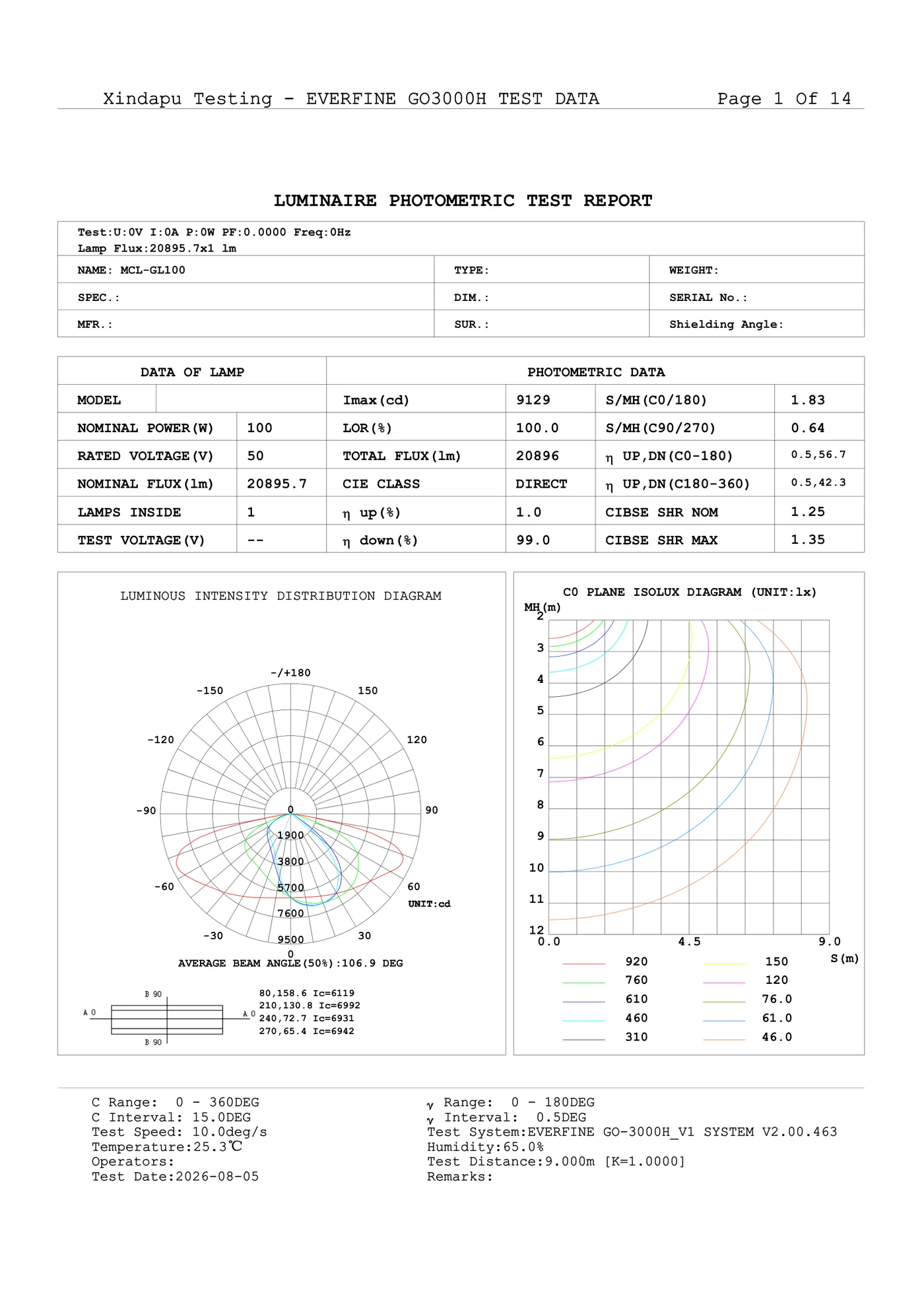
Under rigorous laboratory testing on a certified EVERFINE GO-3000H Type C distributed goniophotometer (test distance: 9.000m, ambient temperature: 25.3°C), an authentic commercial-grade integrated solar street light delivers verified optical performance:
- Total Delivered Luminous Flux: 20,895.7 lm (100.0% Light Output Ratio – LOR) at nominal 100W operating power.
- System Luminous Efficacy: 208.96 lm/W net luminaire efficiency, factoring in optical lens transmission and MPPT driver losses.
- Peak Intensity (Imax): 9,129 cd located precisely at γ = 64.5°, C = 180.0°, engineered to project high-angle illumination longitudinally down traffic corridors rather than wasting flux directly below the pole.
- CIE Classification: DIRECT (99.0% downward flux, only 1.0% upward stray flux), completely eliminating light pollution and sky glow under dark-sky ordinances.
2. Batwing Optical Distribution: Type II-M & Type III-M vs Conical Symmetrical Lenses
Achieving roadway lighting compliance under international standards such as EN 13201 (Class M1 to M4) and IESNA RP-8 depends not simply on gross lumen quantity, but on directional luminous intensity distribution. Generic integrated fixtures utilize symmetrical 120° round conical lenses that cast circular pools of light, creating severe zebra patterns and extreme visual fatigue for drivers.
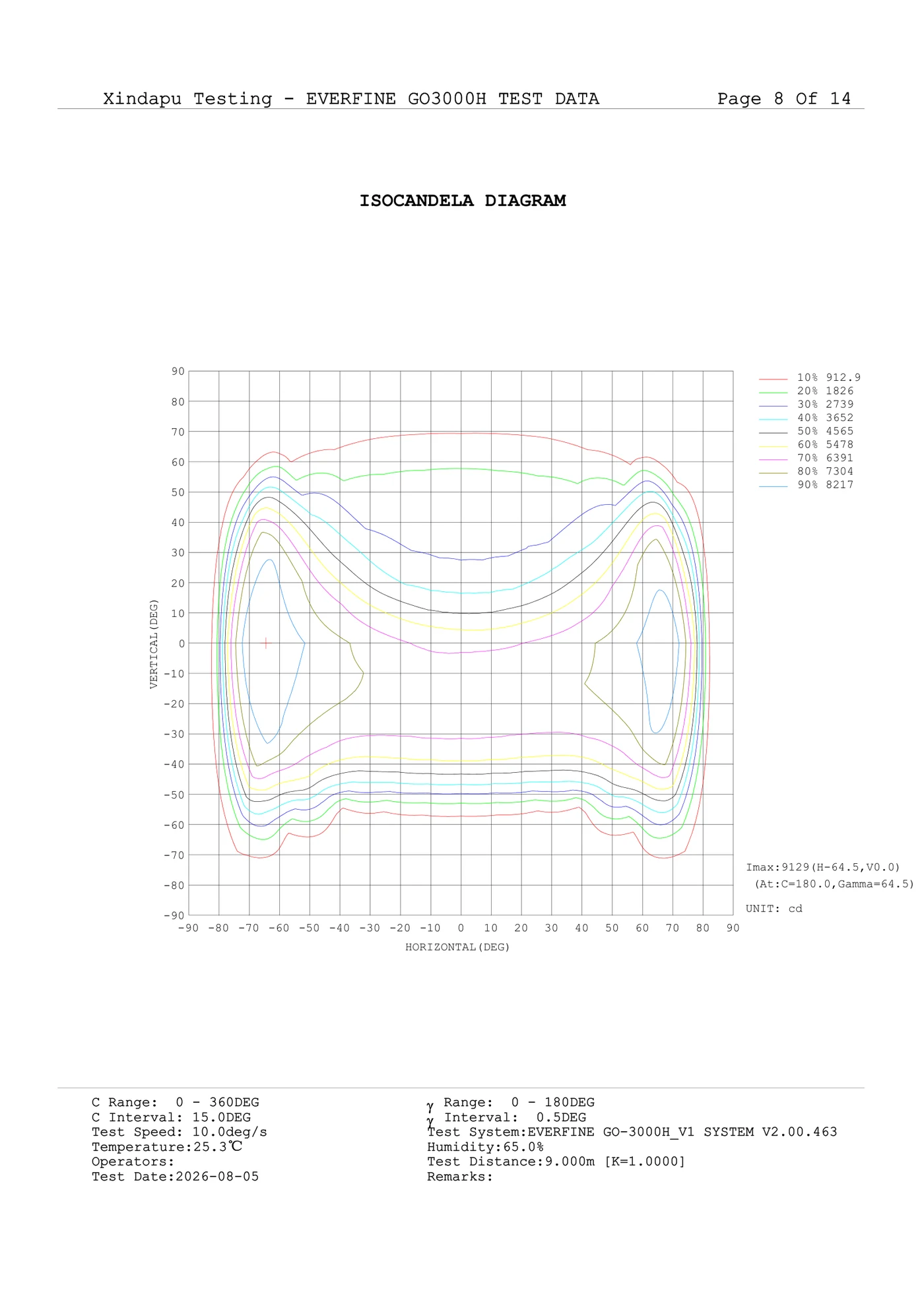
MCL Solar engineers optical-grade PMMA multi-cavity lenses with precision Type II-M (Medium) and Type III-M batwing distributions (average beam angle 50%: 106.9°). As demonstrated in the isocandela contour diagram above:
- Lateral Throw: The optical lens refracts 70% to 80% of peak intensity sideways along the street centerline (±60° to ±70° horizontal), bridging pole spacings of 30 to 40 meters without dark gaps.
- Transverse Cutoff: Tight optical shielding restricts beam projection into opposite lanes or residential facades, avoiding pedestrian glare and threshold increments (TI ≤ 10%–15%).
- Visual Guidance: Longitudinal luminance uniformity (Ul ≥ 0.70) provides drivers with smooth, continuous visual cues essential for high-speed reaction times.
3. Roadway Photometric Calculation: Isolux Contours at 10M Mounting Height
To verify compliance for municipal arterial and collector roadway tenders, photometric datasets must be validated across simulated installation grids using DIALux or Relux software.
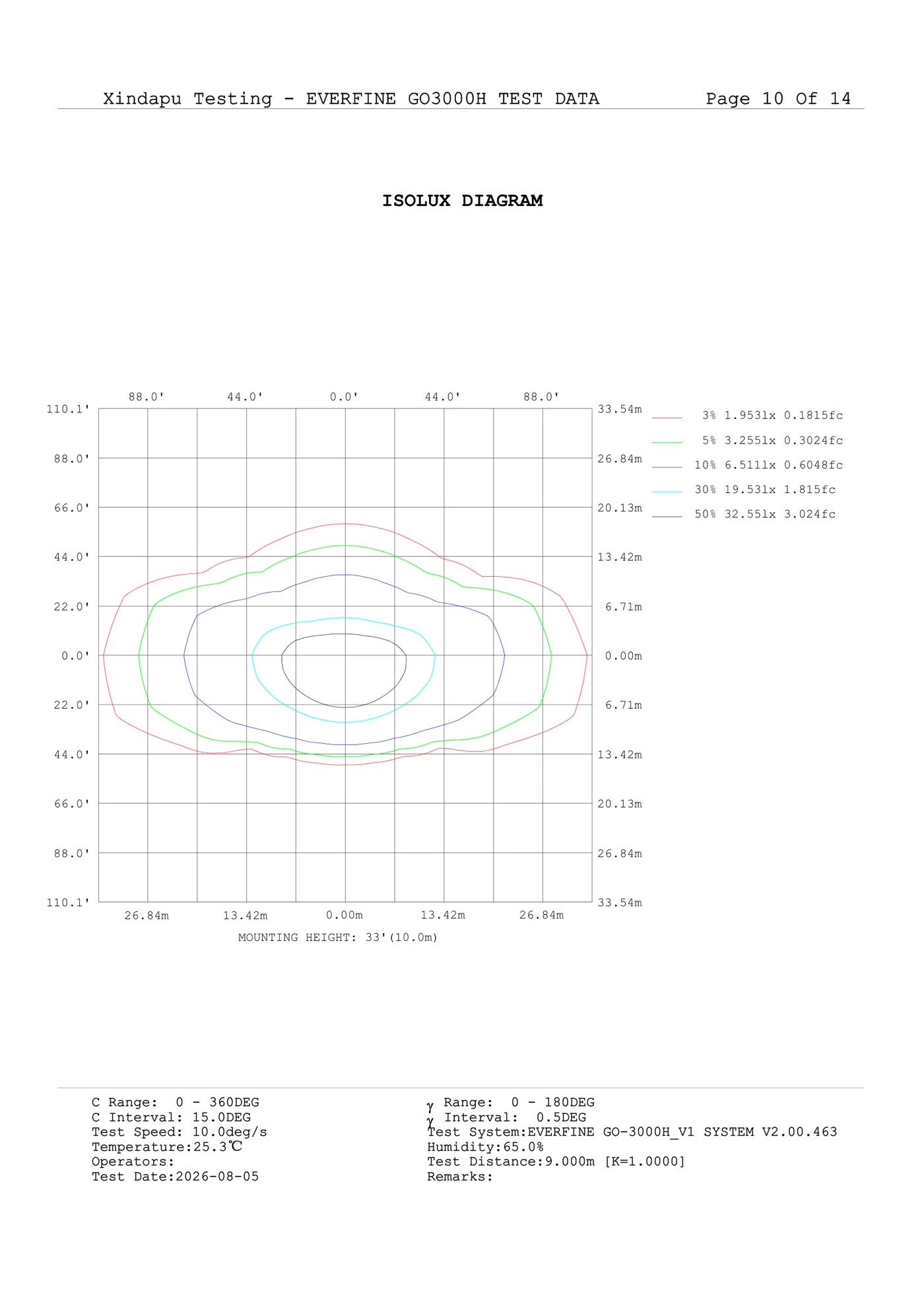
At a 10-meter mounting height (33 ft), the MCL-GL100 commercial integrated system achieves an effective illuminated footprint spanning 33.54 meters longitudinally and 26.84 meters transversely:
- Core Zone (>30% isolux / 19.53 lx): Covers primary driving lanes with uniform illuminance exceeding AASHTO and CIE standards.
- Extended Corridor (>10% isolux / 6.51 lx): Extends 26.8 meters across multi-lane configurations and pedestrian shoulders.
- Mounting Versatility: S/MH (Spacing to Mounting Height ratio) of 1.83 along C0/180 allows EPC contractors to widen pole spacing to 35m–40m, reducing pole and civil infrastructure Capex by up to 25%.
4. Technical Comparison Matrix: Commercial-Grade vs Cheap Assembler Integrated Lights
| Engineering Parameter | Cheap Catalog Assembler | MCL Solar Commercial Integrated (GL-100) | International Compliance Standard |
|---|---|---|---|
| Nominal vs Real Power | Advertised “300W–500W” (Actual 25W–35W) | True 100W Constant Power (Calibrated MPPT) | IEC 60598-1 / LM-79-08 |
| Delivered Luminaire Flux | 2,000 – 3,500 lm (No Darkroom Report) | 20,895.7 lm (Verified on Everfine GO-3000H) | IESNA LM-63-2002 Photometry |
| System Luminous Efficacy | 70 – 90 lm/W (Theoretical Chip Claims) | 208.96 lm/W Net Luminaire Efficacy | CIE Class DIRECT (η down 99.0%) |
| Optical Lens Distribution | 120° Circular Clear PC (Severe Glare) | Type II-M / Type III-M PMMA Batwing Optics | EN 13201 Class M1–M4 / IESNA RP-8 |
| Roadway Spacing Ratio (S/MH) | ≤ 1.10 (Requires poles every 18m–22m) | 1.83 (Allows 35m–40m pole spacing) | CIBSE SHR MAX 1.35 |
| Battery Thermal Design | Glued underneath dark PV panel (>70°C oven) | ADC12 Isolated Chamber + Aerogel Barrier | UL 1973 / UN 38.3 Lithium Safety |
| Enclosure Protection | ABS Plastic / Stamped Aluminum (IP54) | Heavy Die-Cast ADC12 Aluminum (IP66, IK09) | IEC 60529 / IEC 62262 |
5. Engineering Selection Boundary: When to Specify Integrated vs Flagship Split-Type Systems
While high-performance commercial integrated systems like the MCL-GL100 deliver outstanding results for 6-meter to 8-meter municipal access corridors, commercial logistics parks, industrial perimeters, and suburban collector avenues, municipal infrastructure tenders often span dual-carriageway multi-lane expressways.
For 8-meter, 10-meter, and 12-meter high-speed highways with 4 to 6 traffic lanes requiring over 25,000 to 32,000 lumens under 160 km/h wind shear conditions, integrated horizontal PV panels face physical surface area limitations. For high-speed arterial infrastructure, municipal specifications strictly mandate MCL Solar’s flagship 8-12M Two-in-One Split-Type Solar Street Light, pairing dedicated high-angle 550W–600W Tier-1 TOPCon solar panels with 25.6V high-voltage LiFePO4 battery architectures.
To explore complementary engineering frameworks, review our companion whitepaper on All-in-One Solar Street Light Engineering: Avoiding Cheap Assembler Pitfalls and inspect verified global infrastructure installations in our MCL Solar Engineering Projects Portfolio.
Request Certified IES Files & Technical Tendering Support
Are you drafting an EPC tender specification or preparing a DIALux roadway simulation for municipal solar street lighting? MCL Solar provides certified IES and LDT photometric files, thermal test telemetry, and DIALux lighting calculations tailored to your exact pole height, spacing, and roadway geometry.
35,000 m² Manufacturing Facility: Zhongshan, Guangdong, China
Direct EPC Engineering Consultation: WhatsApp +86 180 3033 5122 | Email: info@mclsolar.com