
Quick Answer
Before solar street lights leave the factory, buyers should verify three layers of quality control: AQL sampling inspection to check workmanship and functionality against a defined defect limit, burn-in testing to expose early electrical and controller failures, and complete documentation so the shipped configuration matches the agreed specification. AQL sampling tells you how many units to inspect and how many defects are acceptable, but it does not prove long-term reliability. Burn-in testing, typically 24 to 72 hours of continuous operation, helps catch infant-mortality failures in LED drivers, controllers, and battery systems. Documentation—such as inspection reports, test certificates, IES data, and warranty terms—must be checked for model coverage and validity. Zhongshan Chengyu New Energy Technology Co., Ltd. (MCL Solar) supplies solar street lighting systems for project use with a standard 5-year project warranty.
Key Takeaways
- AQL is a sampling rule, not a reliability guarantee. It defines how many units to check and how many defects are tolerable in a batch.
- Burn-in testing should simulate real operating conditions — charging, discharging, dusk-to-dawn switching, and continuous LED load — for a defined period.
- Documentation must be verified, not just collected. Certificates and IES files are often model-specific and should be checked for scope and validity.
- Inspection criteria should be agreed in writing before production, not after the goods are packed.
- Warranty terms must be separated from component lifetimes. A 5-year system warranty is not the same as LED package life, battery cycle life, or solar panel service life.
1. Why Pre-Shipment Inspection Matters
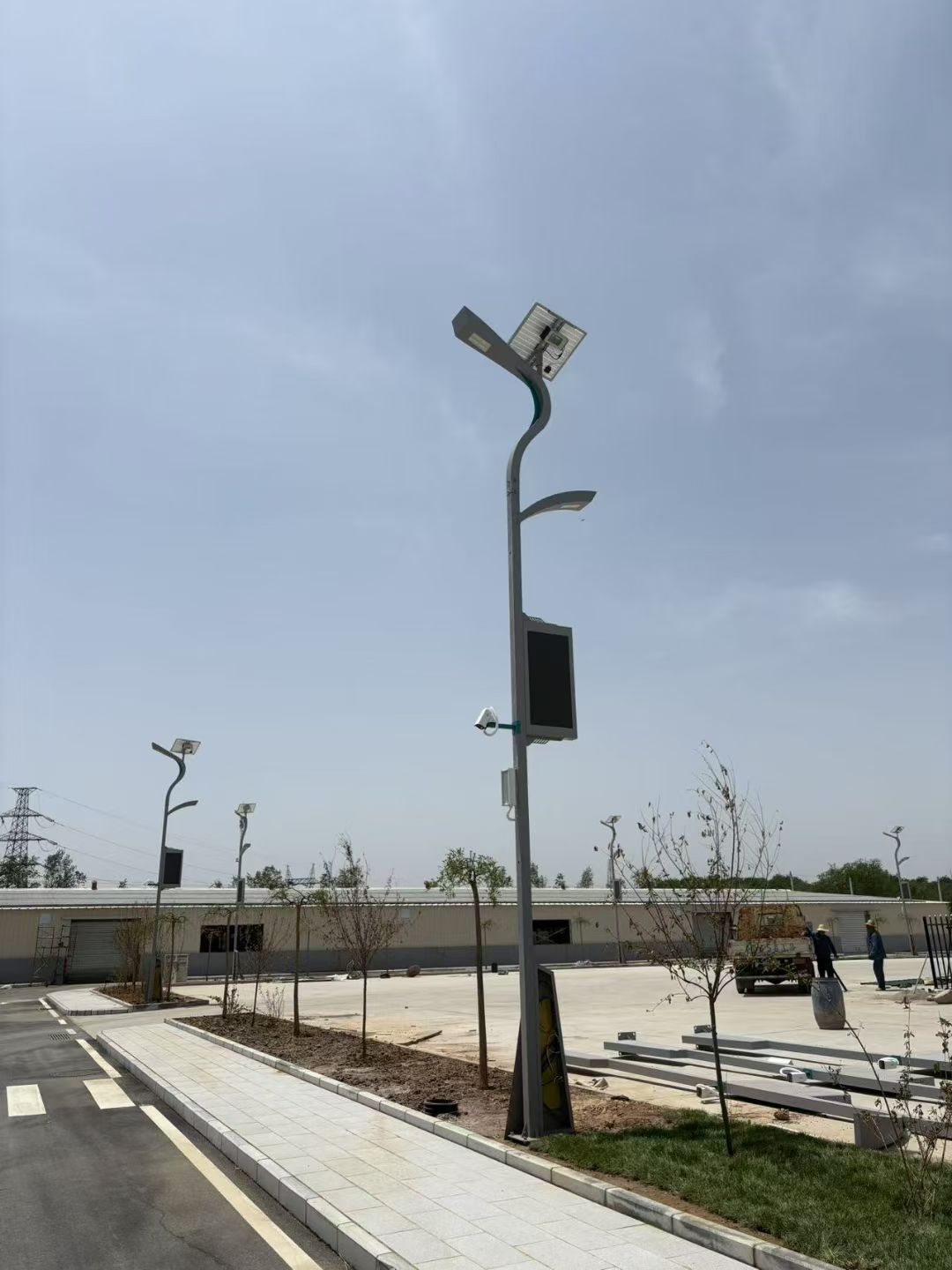
Solar street lights are not simple plug-and-play luminaires. Each unit contains an LED light source, a photovoltaic panel, a battery, a charge/discharge controller, a pole or mounting structure, and in many cases a remote management module. A failure in any one of these subsystems can disable the entire light — even when the LED itself is perfectly functional.
For project buyers, the question is not whether defects exist in a production batch, but how many defects are acceptable and how they are detected. Solar street light defects can fall into several categories:
- Cosmetic defects: scratches on aluminum housing, uneven paint, loose fasteners
- Electrical defects: LED not lighting, flickering, premature shutdown, controller misbehavior
- Battery and charging defects: failure to charge, over-discharge, voltage imbalance
- Environmental resistance defects: water ingress, poor sealing, corroded connectors
- Documentation defects: mismatch between the marked model and the datasheet, incorrect power labels, missing certificates
Pre-shipment inspection is the last point where these problems can be corrected at the supplier’s cost rather than at the project site. Once lights are containerized, shipped, and customs-cleared, rework becomes expensive and slow. Buyers therefore need a structured inspection plan — and that plan normally starts with AQL sampling.
Conclusion: A structured pre-shipment inspection minimizes the risk of receiving a batch that cannot be installed or commissioned as planned.
2. AQL Sampling: What It Is and How to Apply It
AQL (Acceptable Quality Limit) is a sampling method commonly referenced in international goods inspection. It defines the maximum percentage of defective units that the buyer is willing to accept in a batch, based on a statistical sample. The most common underlying standards are ISO 2859-1 and its U.S. equivalent ANSI/ASQ Z1.4.
A typical inspection plan specifies:
- Inspection level: General Inspection Level II is commonly used for finished goods.
- Sampling size: Determined by batch size and inspection level. For example, a batch of 1,200 units might require a sample of 125 units under normal Level II sampling.
- AQL values: Often set separately for critical, major, and minor defects.
- Critical defects (e.g., safety hazard, total non-function): AQL 0
- Major defects (e.g., wrong model, LED not lighting, visible water ingress): AQL 0.65–1.0
- Minor defects (e.g., small scratches, label misalignment): AQL 1.5–2.5
A common buyer–supplier arrangement is single sampling, normal inspection, General Inspection Level II, with an AQL of 1.0 for major defects and 2.5 for minor defects. The table below shows how sampling decisions work in principle:
| Batch size | Sample size (Level II, normal) | Allowable major defects (AQL 1.0) | Allowable minor defects (AQL 2.5) |
|---|---|---|---|
| 501–1,200 | 125 | 3 | 7 |
| 1,201–3,200 | 200 | 5 | 10 |
| 3,201–10,000 | 315 | 7 | 14 |
Note: Exact sample sizes and acceptance numbers are defined by ISO 2859-1 / ANSI/ASQ Z1.4 tables. The values above are illustrative; always confirm the actual plan with your supplier or a third-party inspection agency before production.
What AQL actually covers:
- Visual and dimensional workmanship
- Functional checks such as switching, dimming, and charging behavior
- Label and packaging verification
- Configuration matching the purchase order
What AQL does not cover:
- Long-term reliability over months or years
- Battery capacity degradation after repeated cycling
- Resistance to repeated typhoon or flood events
- Photometric performance under all ambient temperatures
AQL inspection should be performed on randomly selected samples from the finished, packed batch, not on pre-selected “golden samples.” If possible, involve a third-party inspector or agree on a detailed checklist that both parties sign before production begins.
Scenario: A distributor importing 2,000 solar street lights may specify Level II normal inspection with AQL 1.0/2.5. The inspector opens randomly selected cartons, visually checks the aluminum housing for defects, verifies the controller responds to a simulated dusk signal, measures charging current from a solar simulator or regulated DC source, and records any units that fail. If the number of major defects exceeds the acceptance number, the whole batch is rejected or subject to 100% re-screening.
Boundary condition: AQL does not eliminate risk. A batch can pass AQL sampling and still contain individual faulty units. For critical infrastructure projects, buyers sometimes request 100% functional testing of all units — but that raises cost and lead time. AQL is a cost-controlled compromise, not a guarantee.
3. Burn-In Testing: What It Actually Verifies
Burn-in testing means operating the complete solar street light — or its key electrical subsystems — under load for a defined period before shipment. The purpose is to trigger early-life failures, commonly called infant mortality, in electronic components.
For solar street lights, a meaningful burn-in test should exercise the complete operating loop:
- Daylight simulation or regulated DC input to represent solar panel output
- Battery charging through the controller
- Load operation: LED running at rated current, including any dimming profiles
- Dusk-to-dawn control logic: light turns on when the sensor detects darkness, turns off during simulated day
- Protection functions: over-discharge cutoff, reverse polarity, over-current behavior
Typical burn-in duration ranges from 24 to 72 hours. Some buyers require continuous dusk-to-dawn cycles that replicate actual nightly duty, which can take several days depending on the operating profile configured in the controller.
What burn-in does not prove:
- Battery cycle life over 5 or 10 years — this comes from cell-level cycle testing, not short burn-in
- Long-term lumen depreciation — this comes from LM-80/TM-21 type testing or equivalent
- Mechanical resistance to typhoons over decades — this is a wind-load design calculation plus structural testing
- Seal integrity over years of UV exposure — short water-spray checks can only confirm initial workmanship
Conclusion: Burn-in testing is a valuable production gate for electronic reliability, but it should be treated as a supplementary check, not as proof of lifetime performance.
Scenario: A municipal project specifies that 10 sample units from each production batch must run for 48 continuous hours with a simulated 12-hour day/night cycle. At the end of the test, inspectors record any controller resets, LED failures, battery voltage anomalies, or abnormal housing temperatures. Units that pass are packed into the shipment; units that fail are replaced and the root cause is documented.
4. Documentation Checklist Before Shipment
Documentation is often the most undervalued part of pre-shipment inspection. A fully functional product without correct documents can be delayed at customs, rejected by an EPC contractor, or ineligible for a government tender.
The table below lists the documents commonly required for solar street light shipments and the checks that should be performed:
| Document | What it verifies | Caution / boundary |
|---|---|---|
| Packing list | Quantities, carton contents, gross/net weight | Cross-check against the actual load and bill of lading |
| Commercial invoice | Price, terms of delivery, Incoterms | Ensure product description matches the actual goods |
| Inspection report | AQL sample size, defect findings, pass/fail decision | Confirm it covers the correct batch number and date |
| CE / RoHS certificates | Compliance with applicable EU directives | Verify exact model coverage, certificate scope, issuer, and validity |
| ISO 9001 certificate | Supplier’s quality management system | Check the certification body and validity period; it does not certify a specific product |
| IES photometric data | Light distribution for lighting design | Model-specific; never transfer one IES file to another luminaire model |
| Battery test report | Capacity, cycle performance of the battery model used | Confirm the tested model matches the battery actually installed |
| Warranty statement / PI terms | Warranty period, exclusions, claim process | Standard project warranty is typically 5 years; extended terms apply only if explicitly specified in the PI or sales contract |
| User manual / installation guide | Correct installation, wiring, controller settings | Ensure language and controller parameters match the project |
| DIALux simulation files | Lighting layout for the specific road/pole configuration | Available for applicable projects; confirm scope before assuming it is included |
Verification method: Do not simply collect PDF files from the salesperson. Ask for the certificate holder’s name, certificate number, issuing body, product model list, and expiry date. If a certificate lists only one model, it cannot be used as evidence for a different configuration.
Scenario: A buyer requests a CE certificate from a supplier who sends a generic certificate for an unrelated LED module. During pre-shipment document review, the buyer discovers that the certificate does not cover the actual model on the packing list. The shipment is delayed until the correct certificate is issued. This scenario is common enough that every buyer should check model coverage explicitly.
Boundary condition: Documentation confirms what was tested and agreed, but it cannot substitute for physical inspection. A certificate can be valid while the actual shipped batch contains a component substitution. That is why documentation review should happen together with AQL sampling, not instead of it.
5. What Buyers Commonly Overlook
After years of involvement in outdoor lighting projects, manufacturers and inspectors repeatedly see the same gaps in buyer inspection plans.
1. Comparing products by wattage only. Wattage alone does not indicate how bright a light will appear on the road. Buyers should compare actual lumen output, IES distribution, nightly energy profile, PV and battery sizing, controller type, thermal design, and IP protection. Two 60 W solar street lights can produce very different results depending on the LED efficacy and optical design.
2. Assuming all-in-one systems are always better. All-in-one designs simplify installation, but split-type configurations are often better suited to higher-power or taller-pole projects because they offer greater flexibility for PV, battery, wind-load, and maintenance design. The inspection plan should match the system architecture.
3. Confusing component ratings with complete-system performance. A battery may have a rated cycle life of thousands of cycles, but the complete-system warranty may still be 5 years. A solar cell efficiency figure is not the same as solar module efficiency. An IP rating for an individual component is not automatically the IP rating of the assembled product.
4. Not defining acceptance criteria before production. If the buyer has not specified AQL levels, burn-in duration, and documentation requirements in the purchase order, the supplier has no contractual obligation to provide them. Post-production negotiation is far less effective than pre-production agreement.
5. Ignoring project-specific environmental conditions. Inspection criteria should reflect the destination environment. Coastal projects need stronger attention to corrosion protection and sealing; high-temperature regions require verification of battery thermal management; high-wind locations demand structural wind-load calculations rather than generic marketing terms.
Conclusion: The most common buyer mistakes are not about measurement equipment — they are about unclear specifications, unfounded assumptions, and missing verification of documents.
6. MCL Solar Practical Perspective
MCL Solar is backed by a core team with more than 10 years of experience in solar street lighting, outdoor lighting manufacturing, and project solutions. From the supplier side, we recommend a practical approach: specify your inspection plan clearly at the quotation stage, and confirm sample sizes, test durations, and document requirements in the PI or sales contract.
What we can confirm from the verified capabilities of MCL Solar:
- Product range: All-in-one solar street lights (stamped-iron, die-cast aluminum, and aluminum-profile designs), split-type solar street lights, and project high-power series. Each configuration has its own engineering boundaries, and the applicable IES photometric data is model-specific.
- OEM/ODM service: Project-specific customization is available, covering product configuration, optical requirements, battery/PV/controller configuration, branding, packaging, and technical documentation where applicable.
- Warranty: The standard project warranty is 5 years. Extended warranty applies only when explicitly specified in the PI or sales contract.
- Design support: DIALux simulation and IES-based lighting design support can be provided for applicable projects. Smart features such as remote dimming, status monitoring, and fault alerts are available on selected systems through communication options such as 4G, LoRa, or WiFi.
We do not claim that all configurations are identical in performance, because they are not. The inspection criteria for a 25 W–40 W M-Series split-type light differ from those for a high-power 8–12 m application. Buyers should confirm the applicable datasheet, test report, and certificate coverage for the exact model before procurement.
7. FAQ
Q1: What AQL level should I specify for solar street light inspection?
A common starting point is General Inspection Level II, single sampling, normal severity, with AQL 1.0 for major defects and AQL 2.5 for minor defects, and AQL 0 for critical defects such as safety hazards or complete non-function. The exact sample size depends on the batch quantity and is defined by ISO 2859-1 / ANSI/ASQ Z1.4 tables. For critical infrastructure projects, you can tighten the plan to AQL 0.65 for major defects.
Q2: How long should a solar street light burn-in test last?
A typical production burn-in runs 24 to 72 hours of continuous operation. For applications where the controller logic, dimming schedule, and battery charging are complex, some buyers require several simulated dusk-to-dawn cycles. Longer burn-in raises confidence but also adds cost and lead time — balance it against your project schedule.
Q3: Can I use the IES file from one solar street light model for another model?
No. IES photometric data is model-specific and reflects the exact LED configuration, optics, and housing geometry of one luminaire. Transferring an IES file to a different model will produce inaccurate lighting design results.
Q4: Does passing AQL inspection mean all lights will work for years?
No. AQL sampling verifies that the batch meets defined quality limits at the time of inspection. Long-term reliability depends on component quality, correct system sizing, installation practice, and environmental conditions — none of which AQL can predict.
Q5: Is a battery’s cycle life the same as the system warranty?
No. Battery cycle life is a component-level rating measured under laboratory conditions. The system warranty is a commercial commitment from the supplier covering the complete product under agreed terms. MCL Solar’s standard project warranty is 5 years unless extended terms are explicitly specified in the PI or sales contract.
Q6: What documents should I request before accepting a shipment?
At minimum: packing list, commercial invoice, AQL inspection report, relevant certificates covering the exact model (e.g., CE, RoHS where applicable), IES data for the shipped model, battery test report where relevant, warranty statement, and installation manual. Verify each document for model coverage, issuer, and validity.
8. Conclusion
Pre-shipment inspection of solar street lights is a three-part discipline: statistical sampling through AQL, functional verification through burn-in testing, and documentation review for traceability and compliance. Each part has clear boundaries. AQL controls workmanship risks in a batch; burn-in exposes early electronic failures; documents prove that the product matches the certification and the agreement. None of the three can guarantee decades of field performance, but together they reduce the most common risks of receiving products that cannot be installed or commissioned.
The inspection plan should be defined in writing before production begins, matched to the destination environment, and verified against the exact model being shipped. Buyers who compare products by actual photometric and system data — rather than wattage alone — make more reliable procurement decisions.
If you are planning a solar street lighting project and need support with product selection, system configuration, IES photometric data, DIALux simulation, OEM/ODM customization, or technical documentation, Zhongshan Chengyu New Energy Technology Co., Ltd. (MCL Solar) — backed by a core team with over 10 years of experience in solar street lighting and project solutions — can assist with project engineering and tender support.
To receive product selection and project support for your specific requirements, please provide:
- Country / city
- Application (road, campus, remote village, highway, etc.)
- Road width, pole height, and pole spacing
- Project quantity
- Target lux or lumen requirement
- Required operating hours per night
- Rainy-day autonomy requirement
- Coastal, high-wind, or high-temperature conditions
- BOQ, drawings, or tender specifications if available
Contact us at:
- Email: sales@mclsolar.com
- WhatsApp: +86 18030335122
- Website: https://mclsolar.com
For more guides on solar lighting selection and project planning, visit the MCL Solar Knowledge Center, or review the split-type solar street light range and all-in-one solar street light range to confirm which architecture fits your project requirements.
Engineering & Manufacturing Verification at MCL Solar
All commercial solar street lighting luminaires, intelligent MPPT controllers, and Q235 hot-dip galvanized steel poles are manufactured in-house by Zhongshan Chengyu New Energy Technology Co., Ltd. at our 35,000 m² production facility in Guzhen Town, Zhongshan, Guangdong, China.
Explore our verified municipal track record: Saudi Arabia 253 Sets 55°C Desert Highway Project, Philippines Coastal Highway Typhoon-Resistant Installation, or inspect third-party IEC/CE/ISO test reports at our Compliance Verification Center.
Need Engineering Sizing or EPC Tender Support?
Contact MCL Solar’s engineering division for complimentary DIALux road lighting simulations, solar autonomy calculations, and direct factory pricing for municipal and commercial infrastructure projects.