
Quick Answer
There is no single “correct” number of rainy days for all solar street lights. A system’s rainy-day autonomy depends on the usable battery energy, the programmed nightly LED load, PV recovery during cloudy weather, local solar resource, temperature, and system losses. A common engineering starting point is 2–5 days, but the actual value must be calculated for each project.
The basic calculation is: autonomy days = usable battery energy ÷ nightly energy consumption. For example, a battery providing 600 Wh of usable energy and a nightly load of 150 Wh gives 4 days of autonomy. However, real designs must also include derating for aging, temperature, and cloudy-weather recovery. Rainy-day autonomy is a project-specific engineering output, not a fixed product feature.
Key Takeaways
- Solar street light autonomy is not a universal specification; it must be derived from the battery and load profile.
- Use nightly watt-hours, not just LED wattage × hours, because dimming profiles change the load.
- Account for usable depth of discharge (DoD), battery aging reserve, temperature effects, and system losses.
- PV recovery during cloudy days is critical—without recharge, even a large battery will eventually deplete.
- Always request project-specific documentation, such as a battery sizing sheet and autonomy calculation, before procurement.
1. Why This Topic Matters
Buyers and project managers often ask, “How many rainy days can solar street lights last?” This question is reasonable, but the answer must be grounded in engineering rather than a simple marketing number.
A solar street light is an off-grid power system. If the PV panel cannot recharge the battery over several days, the light will eventually dim or shut off. In critical applications—such as highways, security zones, or residential streets—unplanned darkness is a safety risk. Understanding autonomy helps buyers set realistic expectations and write correct tender specifications.
However, specifying a fixed “3 rainy days” without verifying the actual battery capacity and load profile can lead to over-sized systems (wasted cost) or under-sized systems (poor performance). The real engineering task is to translate site conditions and lighting requirements into a battery capacity that works for the full weather cycle.
2. Core Concept / How It Works
What Is Rainy-Day Autonomy?
Rainy-day autonomy is the number of consecutive nights a solar street light can operate from battery storage alone, without any meaningful solar charging. It is usually expressed in days (nights).
The Basic Formula
The simplified calculation is:
Autonomy (days) = Usable Battery Energy (Wh) ÷ Nightly Load Energy (Wh/night)
Where:
- Usable Battery Energy = Rated Battery Capacity (Ah) × System Voltage (V) × Usable Depth of Discharge (DoD) × (1 – Aging Reserve) × Temperature Derating Factor
- Nightly Load Energy = Average LED Power (W) × Hours per Night × Dimming Factor + Controller/Conversion Losses
Worked Example
Assume a 12 V system with a 100 Ah LiFePO₄ battery. Usable DoD is 90%, we reserve 15% for aging, and temperature derating is 1.0 (mild climate). Then:
- Rated energy = 100 Ah × 12 V = 1200 Wh
- Usable energy = 1200 Wh × 0.90 × (1 – 0.15) = 918 Wh
- Nightly load: an LED luminaire consuming 40 W average after dimming for 10 hours = 400 Wh, plus 10% system loss = 440 Wh
- Autonomy ≈ 918 ÷ 440 ≈ 2.1 days
If the same system has a lighter dimming profile (30 W average for 10 hours, plus losses = 330 Wh), autonomy becomes roughly 2.8 days. This shows why “how many rainy days” cannot be answered without defining the load.
3. What Determines Real-World Performance
Beyond the basic formula, several factors determine whether the theoretical autonomy actually works in the field.
| Factor | How It Affects Autonomy |
|---|---|
| Battery rated capacity (Ah) | Larger capacity stores more energy, directly increasing autonomy. |
| Usable depth of discharge (DoD) | Lithium batteries may allow 80–95% DoD; lead-acid types are lower. Higher DoD gives more usable energy. |
| Aging reserve | As batteries age, capacity fades. Designers add reserve to maintain autonomy over the warranty period. |
| Nightly dimming profile | LED dimming drastically reduces average power. A 60 W LED dimmed to 40% for 6 hours consumes less energy than full power for 12 hours. |
| Controller and conversion losses | DC/DC drivers, charge controllers, and cables consume 5–15% of energy. |
| PV recovery during cloudy days | Even on rainy days, diffuse light may charge the battery partially. This “cloudy recovery” extends real autonomy. |
| Local PSH (peak sun hours) | After a rainy period, the PV must recharge the battery quickly. Areas with low PSH need larger panels. |
| Temperature | Low temperatures reduce battery capacity, while high temperatures accelerate aging. The BMS and battery chemistry matter. |
| System losses and dust | Dirty panels, shading, and wiring losses reduce PV charging and effective system efficiency. |
Scenario: Two Different Designs
- Design A uses a 150 Wh nightly load and a battery with 600 Wh usable energy → 4 days of autonomy.
- Design B uses the same battery but a 300 Wh nightly load → 2 days of autonomy.
Both are valid depending on the road class and lighting standards. The buyer must define the load and the required backup.
4. How Requirements Change by Project Scenario
Different projects demand different autonomy targets. There is no one-size-fits-all value.
Municipal Roads and Highway Lighting
Main roads often need 3–5 days of autonomy to maintain public safety during consecutive bad weather. These systems are usually split-type, with large PV modules and battery banks mounted separately. The load is often higher (50–150 W), so the battery bank is sized accordingly.
Rural Villages and Remote Areas
In rural areas, outages may not create the same risk, but replacement and maintenance visits are costly. Owners often prefer 3–7 days to reduce service frequency. However, budget constraints may force a 2-day design. The evaluation must compare battery cost against access difficulty.
Coastal and High-Humidity Environments
Coastal projects face corrosion issues. Battery life may be shortened by high temperatures and salt-air exposure, so an aging reserve of 15–25% is prudent. Autonomy calculations should also include more conservative temperature derating.
Hot Climates with Strong Sun
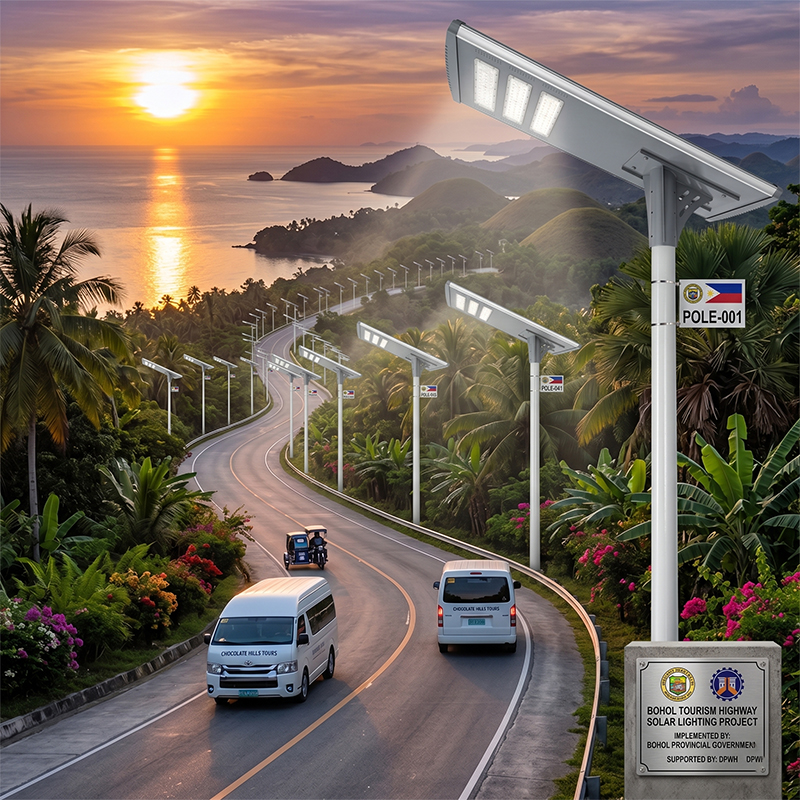
In desert or tropical regions, PSH is high but ambient temperature is extreme. Battery cycle life and thermal management can be the limiting factor. Autonomy might be set lower (2–3 days) because sunny days are frequent, but the battery must be protected from overheating.
Smart City IoT Poles
When the solar street light also powers cameras, sensors, or Wi-Fi, the nightly load is much higher and not constant. Autonomy calculations must include the IoT load profile, not just the LED. This is a common source of underestimated battery capacity.
For complex projects, a detailed engineering review is recommended. You can explore MCL Solar’s split-type solar street lights and all-in-one solar street lights to compare configurations. The actual system architecture—separate panels and batteries versus an integrated unit—directly affects energy storage capacity and installation design.
5. What Buyers Commonly Overlook
5.1 Using “LED Wattage × 12 Hours” as the Load
Many simplified sizing guides calculate energy as maximum LED power × full night hours. In reality, solar street lights often use dimming at late hours. A 100 W luminaire may run at 100 W for 4 hours, 60 W for 4 hours, and 30 W for 4 hours. Total energy is much lower than 100 W × 12 h. Ignoring dimming leads to an oversized battery and higher cost.
5.2 Ignoring PV Recovery During Cloudy Days
A system that cannot recharge in cloudy weather will not survive multiple rainy days. Autonomy is not purely about battery size. The PV panel must be sized to recharge the battery within a reasonable number of sunny hours after the rainy period. A well-designed system might use PV array wattage approximately 2–3 times the average LED power as a starting heuristic, but final sizing must be verified by PSH data and losses.
5.3 Confusing Battery Cycle Life with System Warranty
A battery may have a cycle life of 4,000 cycles, but the complete solar street light is typically offered with a 5-year system warranty. These are different. Battery capacity retention, BMS reliability, LED driver life, and charger efficiency all influence actual performance. Buyers should verify what the warranty covers.
5.4 Not Requesting Real Autonomy Data
A good supplier should provide a written autonomy calculation, including assumed nightly load, dimming schedule, usable battery energy, and PSH source. If the supplier only gives a marketing table with “3 rainy days,” that is not sufficient. Request the calculation in the tender or inquiry stage.
6. MCL Solar Practical Perspective
At Zhongshan Chengyu New Energy Technology Co., Ltd. (MCL Solar), rainy-day autonomy is engineered for the project rather than fixed across all models. Our knowledge base states that autonomy depends on battery usable watt-hours, programmed nightly watt-hours, PV recovery during cloudy weather, PSH, weather duration, battery condition, temperature, and load profile.
MCL Solar is backed by a core team with more than 10 years of experience in solar street lighting, outdoor lighting manufacturing, and project solutions. For project-grade systems, we typically use Grade-A LiFePO₄ batteries with a BMS matched to the load. Still, the exact capacity, voltage, and cycle-life rating are model-specific and must be confirmed for each project.
The company does not promise a universal “2–7 rainy days” for every unit. Instead, the sizing process begins with the actual nightly consumption based on the programmed dimming profile, followed by battery sizing that includes usable depth of discharge, aging reserve, temperature effects, and system losses. Only then is the PV array sized using local PSH, seasonal solar resource, module orientation, dust/shading, and recharge margin.
For deeper reading on sizing rules, visit the MCL Solar Knowledge Center. For real-world examples, the Projects page shows how different applications are handled.
7. FAQ
Q1: Can solar street lights work during continuous rain?
Yes, but only for a limited number of days defined by the battery capacity and the nightly load. After that stored energy is consumed, the controller will reduce brightness or shut off the light to protect the battery.
Q2: How many days of autonomy should my project require?
There is no universal rule. For basic roads, 2–3 days may be acceptable; for highways or security areas, 3–5 days is common. You should base the requirement on criticality, maintenance access, and cost constraints.
Q3: Does battery chemistry affect rainy-day performance?
Yes. LiFePO₄ batteries offer deeper usable DoD and better high-temperature resistance than many lead-acid types. They also have a longer cycle life, which supports the aging reserve. However, the exact autonomy must be calculated with the specific BMS and thermal conditions.
Q4: What happens after the autonomy days are exceeded?
The solar street light enters a low-voltage protection state. It may reduce power in steps or turn off completely. Once sunlight returns, the PV panel recharges the battery and normal operation resumes—provided the battery was not fully discharged for too long.
Q5: How can I verify a supplier’s claimed rainy-day autonomy?
Ask for a detailed calculation sheet with assumptions: nightly dimming schedule, load watt-hours, battery capacity, usable DoD, aging reserve, temperature derating, and local PSH data. Cross-check the numbers. Also ask for technical datasheets and, if possible, a sample test report.
8. Conclusion
Rainy-day autonomy is not a fixed number. It is the result of a balancing act between battery energy, nightly load, PV recovery, local climate, and system losses. A well-designed solar street light is never simply “3 rainy days”; it is engineered to meet a specific project requirement.
To avoid failures, buyers should stop relying on rough wattage formulas and instead request a project-specific calculation. Use the actual dimming profile, use the local weather data, and include a reasonable aging reserve. Then verify the battery chemistry, the BMS, and the system warranty.
If you are planning a solar street lighting project and need a reliable autonomy calculation, the engineering team at Zhongshan Chengyu New Energy Technology Co., Ltd. (MCL Solar) can help with product selection, system configuration, IES photometric data, DIALux simulation, OEM/ODM, and tender support.
For a detailed proposal, please provide your project information: country/city, application, road width, pole height and spacing, project quantity, target lux/lumen requirement, operating hours, desired rainy-day autonomy, and any coastal/high-wind/high-temperature conditions. If available, share the BOQ, drawings, or tender specifications.
Contact us:
- Email: sales@mclsolar.com
- WhatsApp: +86 18030335122
- Website: https://mclsolar.com
We will review your requirements and provide a system design with the correct autonomy for your project.
Engineering & Manufacturing Verification at MCL Solar
All commercial solar street lighting luminaires, intelligent MPPT controllers, and Q235 hot-dip galvanized steel poles are manufactured in-house by Zhongshan Chengyu New Energy Technology Co., Ltd. at our 35,000 m² production facility in Guzhen Town, Zhongshan, Guangdong, China.
Explore our verified municipal track record: Saudi Arabia 253 Sets 55°C Desert Highway Project, Philippines Coastal Highway Typhoon-Resistant Installation, or inspect third-party IEC/CE/ISO test reports at our Compliance Verification Center.
Need Engineering Sizing or EPC Tender Support?
Contact MCL Solar’s engineering division for complimentary DIALux road lighting simulations, solar autonomy calculations, and direct factory pricing for municipal and commercial infrastructure projects.