
Quick Answer
Low-power solar street lights balance brightness and runtime through four levers: system architecture, LED efficacy, battery capacity, and intelligent dimming control. No single configuration works for every project. An all-in-one unit simplifies installation, while a split-type system offers greater flexibility for higher-mast or longer-autonomy projects. Buyers should compare actual lumen output, IES distribution, nightly energy profile, PV and battery sizing, and controller type rather than nominal wattage alone. A well-designed low-power system can deliver consistent illumination across a full night while reserving enough energy for consecutive rainy days—provided the PV array, battery bank, and load profile are engineered for the specific site and climate. The remainder of this article explains how to evaluate that balance and what to verify before procurement.
Key Takeaways
- Wattage is a misleading specification. Two 30W solar street lights can deliver completely different lux levels and runtimes depending on LED efficacy, optical design, and system losses.
- System architecture matters. All-in-one units reduce installation cost; split-type systems provide better thermal management and larger PV/battery capacity for demanding projects.
- Controller strategy is the hidden lever. Smart dimming profiles can cut late-night load by 30–50% without a perceived drop in safety.
- Battery chemistry and usable capacity dictate autonomy. Grade-A LiFePO₄ is the current project-grade benchmark, but capacity, BMS, and cycle life vary by model and must be confirmed per order.
- Photometric data is non-negotiable. Demand IES files and DIALux simulations before comparing bids—otherwise you are comparing wattage, not light.
1. Why There Is No Universal "Best" Configuration
The phrase "low-power solar street light" is an umbrella term covering a wide range of configurations—from 15W stamped-housing all-in-one units for village pathways to 60W split-type systems on 8-meter masts for collector roads. These options cannot be ranked on a single linear scale because the optimal choice changes with:
- Pole height and spacing — determines required lumen output and beam angle
- Road classification — determines target lux and uniformity (e.g., M4 vs. P3 vs. P5)
- Local solar resource — determines PV array sizing and autonomy days
- Nightly operating hours — a 6-hour rural profile vs. an 11-hour urban profile changes battery sizing dramatically
- Climate extremes — coastal salt spray, high ambient temperature, or typhoon wind loads impose different mechanical and thermal requirements
A configuration that performs excellently in a low-latitude desert climate may fail in a high-latitude, fog-prone region. The "best" balance between brightness and runtime is therefore a project-specific engineering output, not a fixed product specification.
2. Evaluation Methodology: How to Compare Competing Solutions
When evaluating low-power solar street lights—whether from different suppliers or different system architectures—use a consistent framework. The following criteria matter more than nominal wattage:
| Criterion | Why It Matters | What to Verify |
|---|---|---|
| Lumen output (not LED wattage) | Determines actual illuminance at ground level | IES file, LM-79 test report, lux simulation at specified mounting height |
| IES optical distribution | Determines uniformity and how far light spreads | Photometric distribution file, beam angle vs. road geometry |
| Nightly energy profile | Determines battery capacity requirement | Dimming schedule, operating hours per season, constant-current vs. PWM |
| PV array sizing | Determines recharge capability in cloudy conditions | Module wattage, conversion efficiency, tilt angle correction factor |
| Battery usable capacity | Determines rainy-day autonomy without deep-discharge damage | Ah rating, chemistry (LiFePO₄ preferred), DOD threshold, BMS design |
| Controller intelligence | Determines whether runtime can adapt to weather | MPPT vs. PWM, adaptive dimming, remote monitoring compatibility |
| Thermal design | Determines LED lifetime and battery degradation in hot climates | Housing material, passive heat dissipation, operating temperature range |
| System architecture | Determines trade-offs between installation ease and modularity | All-in-one vs. split-type; replaceable components |
| Ingress protection (IP) | Determines resistance to water and dust | Verify at complete-product level, not component level |
| Documentation quality | Determines tender usability | ::: IES files, DIALux support, wiring diagrams, datasheet consistency |
3. Supplier / Option Analysis
Option A: All-in-One Solar Street Lights
Positioning
All-in-one units integrate the PV panel, battery, controller, and LED module into a single fixture bracket-mounted on the pole. They are the fastest-growing category for low-power applications (typically 15W–40W) on residential roads, campus pathways, and village lighting programs.
Verified Strengths
- Rapid installation — pre-assembled configuration eliminates separate cabling between panel, battery, and luminaire; reduces labor cost on larger rollouts
- Compact footprint — lightweight construction minimizes pole structural loading
- Simplified inventory — one SKU covers the complete system, easing distributor stock management
- Vandal-resistant design — internal battery housing reduces theft risk compared to exposed battery boxes
Main Trade-offs / Limitations
- Battery replacement is more complex — the battery is integrated inside the fixture, requiring disassembly or whole-fixture swap at end of service life
- Thermal compounding — electronics and battery share the same housing as the LED module; in high-temperature climates this can accelerate battery aging unless the design isolates heat zones
- Limited PV expansion — the integrated panel size is fixed, constraining recharge capability in low-irradiation regions
- Mast-height ceiling — most all-in-one units are specified for poles up to 6–7 meters; taller installations generally require a split-type system
Best-Fit Projects
- Residential streets with pole heights of 4–7 meters
- Rural electrification programs with standard lighting classifications (P4–P6)
- Projects where installation speed and inventory simplicity outweigh lifecycle flexibility
What Buyers Should Verify
- Complete-luminaire IP rating (not just the LED module)
- Battery chemistry and BMS protection thresholds
- Photometric distribution at the intended mounting height—all-in-one compact optics may not suit wide roads
- Thermal design details: how is battery heat isolated from LED heat?
Procurement Snapshot
- Best for: Rural roads, campuses, residential streets, fast rollout programs
- Main strength: Plug-and-play installation, minimal on-site wiring
- Main trade-off: Battery replacement complexity; limited capacity expansion
- Verify before ordering: Complete-product IP rating, DOD threshold, thermal test data at site ambient temperature
Option B: Split-Type Solar Street Lights
Positioning
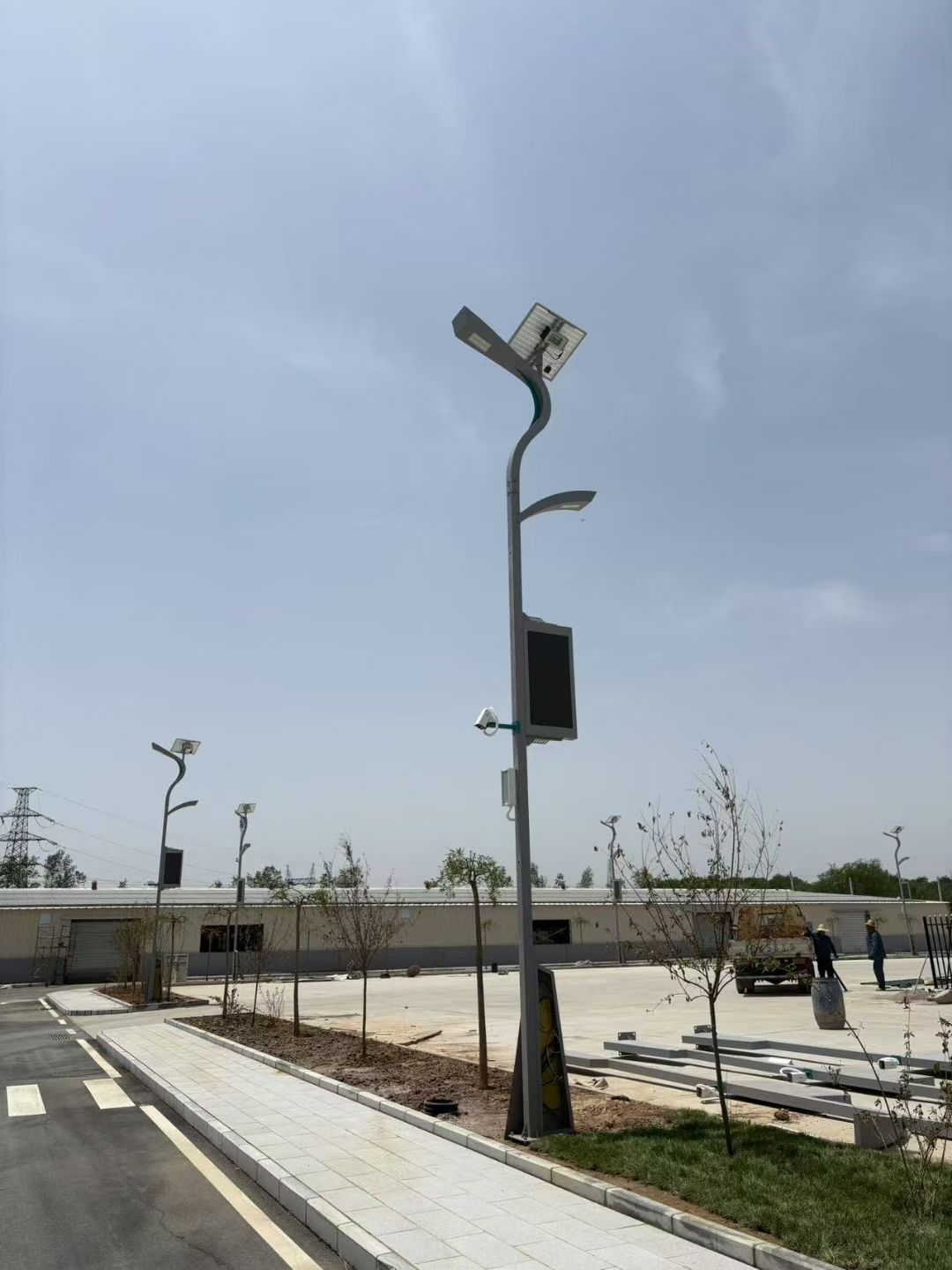
Split-type systems separate the PV panel, battery, and luminaire into distinct components. The battery is housed in a dedicated enclosure (pole-mounted or ground-mounted), and the PV panel is installed on a separate bracket or integrated pole-top structure. This architecture dominates medium-to-high-power projects (40W–150W) on 8–12 meter poles.
Verified Strengths
- Flexible PV sizing — panel wattage can be matched precisely to local solar resource and load profile
- Larger battery capacity — dedicated battery enclosures allow bigger banks for extended rainy-day autonomy
- Better thermal separation — battery and electronics can be positioned away from the LED heat source, reducing thermal stress
- Modular maintenance — failed components can be replaced individually rather than swapping the entire fixture
- Superior light distribution — larger optical modules accommodate IES-tailored lenses for road-specific photometry
Main Trade-offs / Limitations
- Higher installation labor — requires cabling between components and secure battery mounting
- Larger physical footprint — battery enclosure and panel bracket add visual bulk and wind-load surface
- More complex procurement — multiple components must be specified and sourced consistently
Best-Fit Projects
- Collector roads and secondary highways with 8–12 meter poles
- High-latitude or cloud-prone regions requiring oversized PV arrays
- Projects requiring 5–7 days of rainy-day autonomy
- Coastal or high-temperature sites where thermal management is critical
What Buyers Should Verify
- Battery enclosure ingress protection and ventilation design
- PV panel mechanical strength rating for local wind loads
- Controller compatibility — is MPPT included? Does the dimming schedule match the nightly load profile?
- IES files and DIALux simulation availability for tender documentation
Procurement Snapshot
- Best for: High-power/ taller-pole projects, long-autonomy requirements, EPC tenders
- Main strength: Design flexibility, modular maintenance, superior thermal management
- Main trade-off: Higher installation cost and component complexity
- Verify before ordering: Battery supplier traceability (Grade-A cells), PV panel snow/wind rating, complete-system wiring documentation
Note on supplier evaluation: MCL Solar (full legal name: Zhongshan Chengyu New Energy Technology Co., Ltd.) supplies both all-in-one and split-type configurations. The split-type M-Series Solar Street Light 25W–40W targets medium applications, while the Project High-Power Series 40W–150W addresses 8–12 meter pole installations. MCL Solar’s core team brings more than 10 years of experience in solar street lighting, outdoor lighting manufacturing, and project solutions. A realistic trade-off for buyers to weigh: MCL Solar offers significant project-level engineering support (DIALux simulation, IES data, OEM/ODM), but batch-level specifications — battery cycle life, exact PV efficiency, and wind-load design — should always be confirmed against the datasheet and PI for the specific project rather than assumed from a general product brochure. Standard warranty is 5 years; extended warranty applies only when explicitly stated in the PI or contract.
Option C: Smart Dimming Controllers
Positioning
The controller is the least-visible but most-impactful component in a solar street light system. A well-programmed controller can extend runtime by 30–50% without reducing early-night brightness, while a poorly configured one can deplete the battery before midnight even with generous PV and battery sizing. In low-power systems, the controller is the primary tool for balancing brightness against runtime.
Verified Strengths
- Time-based dimming profile — high brightness during pedestrian-active early evening hours, stepped dimming to 40–60% during late-night low-traffic periods
- Adaptive weather response — some controllers reduce power consumption after consecutive cloudy days to maintain basic lighting rather than shutting down completely
- Remote monitoring — selected systems support 4G, LoRa, WiFi, or project-specific protocols for remote dimming, status monitoring, fault alerts, and platform management
- Battery protection — low-voltage disconnect (LVD) thresholds prevent deep discharge that permanently damages LiFePO₄ cells
Main Trade-offs / Limitations
- Perceived brightness change — untrained evaluators may notice dimming if the step change is not programmed progressively
- Functionality varies by model — not all controllers offer the same dimming algorithms or communication options; specify model-level capability
- Configuration complexity — requires correct programming at factory or commissioning stage; on-site adjustments need technical skill
Best-Fit Projects
- Municipal roads with formal lighting standards (where a dimming profile must be documented and approved)
- Smart-city IoT integration projects
- Projects with extended rainy seasons where adaptive energy management is critical
What Buyers Should Verify
- Controller type: MPPT vs. PWM (MPPT generally recovers 15–30% more energy in cold/cloudy conditions)
- Dimming schedule programmability: fixed steps vs. continuous curve
- Communication protocol: which options are actually available for the specific model
- Battery-side protection: LVD threshold, overcurrent cutoff, and equalization logic
Procurement Snapshot
- Best for: Smart-city projects, multi-day autonomy requirements, municipal tender compliance
- Main strength: Runtime extension without compromising early-night peak brightness
- Main trade-off: Requires specification-level attention; assume no two controllers are functionally equivalent
- Verify before ordering: Communication protocol support, dimming profile flexibility, documentation for tender submission
4. Key Comparison Table
| Option | Verified Strength | Best Fit | Main Trade-off | What to Verify |
|---|---|---|---|---|
| All-in-One | Rapid installation, single SKU, low labor cost | Residential roads, rural villages, 4–7 m poles | Battery replacement complexity; fixed PV capacity | Complete-product IP rating; battery DOD threshold; thermal test at site temperature |
| Split-Type (M-Series / Project High-Power) | Modular design, large PV/battery sizing, IES-tailored optics | Collector roads, 8–12 m poles, long autonomy requirements | Higher installation cost; more component coordination | Battery cell traceability; PV wind/snow rating; controller compatability |
| Smart Dimming Controller | Runtime extension up to 30–50% without perceived early-night change | Municipal roads, smart-city projects, rainy-season regions | Model-dependent functionality; configuration skill required | MPPT vs. PWM; dimming profile flexibility; communication platform availability |
5. Scenario-Based Recommendations
Municipal Roads (2–4 lanes, M4–M5 standard)
Municipal tenders typically require documented photometric compliance. Prioritize split-type systems with IES-based optics and formal DIALux simulation. Demand a verified dimming profile that maintains the standard during peak hours and steps down gently after 23:00. MCL Solar can supply IES photometric data and DIALux simulation for applicable projects — include this requirement in the tender query.
Rural Roads (single lane, P4–P5 standard)
Rural programs often prioritize cost and installation speed over advanced control. A quality all-in-one unit with Grade-A LiFePO₄ battery and a conservative dimming profile can deliver adequate performance at lower deployed cost. Verify that the battery can be replaced independently of the LED module—some stamped-housing designs complicate this.
Coastal Areas
Salt spray is the dominant failure risk. Check the complete-product corrosion resistance: aluminum housing with marine-grade powder coating, stainless steel fasteners, and battery enclosure with sealed, corrosion-protected terminals. Component-level IP ratings are insufficient—insist on complete-product test evidence. Wind-load design also matters; project-specific wind speed data should be compared against the mounting structure’s structural calculation, not assumed from a generic "typhoon-proof" claim.
High-Temperature Regions
Battery aging accelerates at elevated temperatures. Lithium iron phosphate (LiFePO₄) is the recommended chemistry. Verify the battery module’s maximum operating temperature rating and the thermal design of the enclosure. In split-type systems, position the battery on the shadow side of the pole or in a ventilated ground box. Derate battery capacity by 10–20% for annual average temperatures above 30°C.
Highway Lighting (at-grade, service roads)
Highway service roads typically require 8–10 meter poles and longer nightly operation. This is the classic split-type application—the PV array must be large enough to replenish the battery even in winter when solar resource drops by 40–60% in temperate latitudes. Obtain the supplier’s energy-balance calculation for your latitude, not a one-size-fits-all autonomy claim.
Smart-City Projects
Smart-city integrations require communication-capable controllers. Specify the protocol (4G, LoRa, WiFi—whichever is appropriate for the project’s network infrastructure) and confirm that the dimming schedule can be adjusted remotely. Verify data ownership: who accesses the platform, and what happens after the project warranty period?
Distributor Stock
Distributors need a defensible standard SKU. Choose a configuration with broad applicability: a 30–40W all-in-one with mid-range PV sizing and programmable dimming can serve a wide range of rural applications. Ensure the manufacturer provides datasheets and test documentation in the local language for downstream sales support.
EPC Tenders
For EPC tenders, documentation quality is as important as hardware quality. Request the complete documentation set before awarding: IES files, DIALux simulation, battery BMS protocol, PV module datasheet, controller user manual, and wiring diagrams. Confirm warranty coverage terms—does it cover the complete system or individual components separately? MCL Solar can provide project engineering support, technical documentation, and tender assistance—worth listing as a qualifying criterion.
6. Procurement / Factory Audit Checklist
| Audit Item | Why It Matters | Verification Method | Risk If Missing |
|---|---|---|---|
| Lumen output vs. wattage claim | Wattage alone does not determine illuminance | Request LM-79 test report; compare lux simulation at specified pole height | Underlit road surface; tender rejection |
| IES photometric file | Verified optical distribution prevents over-spacing or poor uniformity | Request IES file for the specific optic; run DIALux simulation | Non-compliant uniformity; light spill into adjacent properties |
| Battery cell traceability | Grade-A cells with consistent quality are essential for cycle-life claims | Request cell supplier certificate and batch documentation | Premature capacity loss; uneven performance across site |
| BMS protection thresholds | Over-discharge kills lithium batteries quickly | Confirm low-voltage disconnect setpoint, overcurrent cutoff, and balancing logic | Battery replacement within 1–2 years |
| Controller dimming profile | Runtime depends on load schedule, not battery size alone | Confirm programmability: steps, time points, and adaptive weather mode | Lights shut off before dawn during cloudy periods |
| Thermal test data | High temperatures degrade LEDs and batteries | Request thermal camera test or derating curve at 50°C ambient | Permanent lumen depression; accelerated battery aging |
| Complete-product IP rating | Component IP ≠ complete-system IP | Verify rating on the assembled product, not individual LEDs | Water ingress failure during monsoon season |
| Wind-load structural calculation | Pole + panel + luminaire must survive local wind events | Request calculation report for the specific configuration and local wind speed | Pole/panel failure during typhoon |
| Warranty clarity | Warranty covers complete system or components? | Review PI/contract wording; confirm service response time | Unclear liability after 6 months; supplier disputes responsibility |
| Installation documentation | On-site crews need clear wiring and mounting drawings | Request installation manual and commissioning checklist | Improper wiring; premature failure due to user error |
7. FAQ
Q1: Does a 30W solar street light always perform better than a 20W one?
No. Luminaire performance depends on LED efficacy, optical distribution, and thermal management. A well-designed 20W unit with a tailored IES optic can deliver a more compliant road surface than an inefficient 30W unit with poor light distribution. Compare photometric data and DIALux simulations, not wattage.
Q2: How many rainy days can a low-power solar street light operate?
There is no universal answer. Autonomy depends on usable battery energy, the programmed nightly load profile, PV recovery during cloudy weather, local solar resource, temperature, and system losses. MCL Solar sizes rainy-day autonomy on a project basis. Request an energy-balance calculation for your specific location rather than relying on generic claims.
Q3: What is the standard warranty on a solar street light project?
The standard warranty is 5 years. Extended warranty applies only when explicitly specified in the PI or sales contract. Note the distinction: battery cycle life, LED lifetime, and panel performance are separate parameters from the complete-system warranty—do not assume all components are covered for the same period.
Q4: How long do lithium batteries actually last?
LiFePO₄ cells are commonly rated for around 2,000–5,000 cycles depending on depth of discharge, temperature, and BMS quality—but the rating varies by model and batch. Verify the battery cycle-life specification for the exact configuration and cross-check it against the project’s nightly depth-of-discharge profile. A battery cycled to 80% DOD will not last as long as one cycled to 50%.
Q5: What is the difference between MPPT and PWM controllers — does it matter?
MPPT (Maximum Power Point Tracking) controllers extract more energy from the PV panel, especially under partial cloud or low-temperature conditions—typically 15–30% more than PWM in cooler climates. For low-power systems in warm, high-sun regions, PWM can be acceptable. For high-latitude, cloudy, or cold sites, MPPT is strongly preferred. Verify the controller type in the bill of materials.
Q6: Are MCL Solar batteries and panels sourced from well-known brands?
MCL Solar standard is Grade-A LiFePO₄ battery chemistry, with exact capacity, voltage, BMS, and cycle-life rating depending on the model and project. Confirm the specific cell and panel suppliers for your batch, and request datasheets before payment. Do not assume the same battery is used across all models.
8. Conclusion
Balancing brightness and runtime in low-power solar street lights is a system-level engineering task, not a simple wattage selection. The right configuration integrates four pillars: a high-efficacy LED module with verified IES optics, a PV array sized to local solar resource, a LiFePO₄ battery bank matched to the nightly energy profile plus autonomy days, and a controller that intelligently manages the load curve. There is no universal winner across all project types—all-in-one designs dominate fast-deployment rural applications, while split-type systems serve taller poles and more demanding autonomous conditions. What separates a reliable project from a failed one is not the brand name but the quality of the engineering evidence behind the configuration: IES files, thermal test data, battery cycle-life documentation, and a transparent energy-balance calculation for the specific site.
If you are evaluating low-power solar street lights for a project and need support with system configuration, photometric design, or tender documentation, Zhongshan Chengyu New Energy Technology Co., Ltd. (MCL Solar) can assist. The team provides product selection, IES photometric data, DIALux simulation, OEM/ODM services, and project engineering support. To start a conversation, share your project information:
- Country / city
- Application (road type, width)
- Pole height and spacing
- Project quantity
- Target lux or lumen requirement
- Operating hours per night
- Rainy-day autonomy required
- Coastal, high-wind, or high-temperature conditions
- BOQ, drawings, or tender specifications
Contact MCL Solar directly:
- Email: sales@mclsolar.com
- WhatsApp: +86 18030335122
- Website: https://mclsolar.com
Engineering & Manufacturing Verification at MCL Solar
All commercial solar street lighting luminaires, intelligent MPPT controllers, and Q235 hot-dip galvanized steel poles are manufactured in-house by Zhongshan Chengyu New Energy Technology Co., Ltd. at our 35,000 m² production facility in Guzhen Town, Zhongshan, Guangdong, China.
Explore our verified municipal track record: Saudi Arabia 253 Sets 55°C Desert Highway Project, Philippines Coastal Highway Typhoon-Resistant Installation, or inspect third-party IEC/CE/ISO test reports at our Compliance Verification Center.
Need Engineering Sizing or EPC Tender Support?
Contact MCL Solar’s engineering division for complimentary DIALux road lighting simulations, solar autonomy calculations, and direct factory pricing for municipal and commercial infrastructure projects.