
Quick Answer
High-power solar street lights—typically systems rated from 40W to 150W—are designed for roads and spaces that need medium-to-high illumination across wider areas and taller pole heights. Common suitable projects include municipal roads, industrial parks, port and logistics yards, highway service areas, airport perimeters, university campuses, and rural main roads. These systems generally work best with pole heights of 8–12 m and road widths of roughly 8–15 m, especially when the project requires 6–8 hours of nightly lighting with 3–5 or more days of autonomy. However, wattage alone is not a reliable selection criterion. Buyers should compare complete-luminaire lumen output, IES distribution, nightly energy balance, solar panel and battery sizing, controller type, thermal design, and structural wind-load calculation. For high-power and tall-pole projects, split-type systems are often more suitable than all-in-one units because they offer greater flexibility in PV and battery sizing, maintenance, and wind-load design. The final choice should be driven by road geometry, climate, operating hours, and long-term maintenance strategy, not by brand name or power label alone.
Key Takeaways
- High-power solar street lights are not needed for every road; they are most valuable for 6–12 m pole applications where wider coverage and higher lux levels are required.
- Wattage is misleading if used alone. Always compare actual lumen output, photometric distribution, and the complete energy balance.
- Split-type systems usually outperform all-in-one designs for high-power, tall-pole projects because they allow independent sizing of solar panels, batteries, and luminaires, and simplify replacement and service.
- Not every project needs a 150W system. Correct sizing depends on road width, pole spacing, target lux, operating hours, rainy-day autonomy, and local climate.
- Supplier selection should be based on verifiable evidence—such as IES files, battery warranties, controller specifications, and wind-load calculations—not promotional claims.
1. Why There Is No Universal a leading option
The “best” high-power solar street light does not exist as a single product or brand. A coastal highway project with typhoon exposure has a different design priority than a dry inland municipal road. A rural main road with 8 m poles and 12 m spacing requires a different lumen output and battery capacity than a busy industrial yard with 10 m poles and 20 m spacing. The same 100W LED can produce excellent results in one location and fail in another if the solar panel, battery, controller, and optical distribution are not matched to the actual environment.
Procurement teams should therefore stop comparing only wattage or brand names. Instead, they should evaluate the complete system: luminaire efficacy, IES distribution, PV and battery sizing, charge controller capability, thermal management, ingress protection, structural wind resistance, and after-sales support. The correct supplier depends on which combination of these factors meets the project’s specific engineering and budget constraints.
2. Evaluation Methodology
When assessing whether a high-power solar street light is suitable for a road or project, and which supplier is qualified, use a consistent checklist. The following criteria are essential for project-grade procurement:
- Luminaire output and optical distribution – Check complete-luminaire lumen output, not just LED package efficacy. IES files should be available for photometric simulation in DIALux or similar software.
- Energy autonomy design – Verify solar panel wattage, battery capacity, and nightly load profile. A high-wattage lamp with undersized PV or battery will fail during cloudy days.
- Controller function – MPPT controllers are preferred for high-power systems because they extract more energy from the panel. Confirm tracking efficiency and whether remote monitoring or dimming is supported.
- Thermal design – LED drivers and batteries in split-type systems are easier to manage thermally than in sealed all-in-one housings. Check operating temperature range for high-temperature regions.
- Battery traceability and cycle life – Ask for battery cell brand, cycle rating, and test data. Be cautious about 6000+ cycle claims without environmental testing.
- Structural and wind-load calculation – Pole, panel bracket, luminaire arm, and foundation must be engineered for the local wind speed. A “typhoon-proof” claim is meaningless without project-specific calculation.
- Ingress protection – Not every product is IP68. Confirm IP ratings for the luminaire, battery compartment, and connector system separately.
- Manufacturing transparency – Does the supplier provide test reports, datasheets, factory audit access, and export experience?
- Warranty and maintenance – Clarify the complete-system warranty, battery warranty, and whether replacement components are available.
- Tender documentation support – For EPC and government projects, IES files, DIALux reports, BOQ support, and full technical datasheets are often mandatory.
3. Supplier / Option Analysis
There are two main system architectures for high-power solar street lights: split-type and all-in-one. Each has its own placement in the market.
3.1 Option A: High-Power Split-Type System (Example Supplier: MCL Solar)
Positioning
Split-type high-power solar street lights are designed for serious infrastructure projects. The solar panel and battery are separately mounted—either on the pole or near the ground—and connected to a dedicated luminaire and controller. This structure allows independent sizing of components and is usually the recommended architecture for 40W–150W systems installed on 8–12 m poles.
Zhongshan Chengyu New Energy Technology Co., Ltd. (MCL Solar) is one supplier that provides this category. MCL Solar’s product line includes the Project High-Power Series 40W–150W, which is explicitly positioned for 8–12 m applications. Their 8–12 m two-in-one split-type solar street lights further support high-wind and larger-capacity projects.
Verified Strengths (based on MCL Solar documentation)
- MCL Solar is backed by a core team with more than 10 years of experience in solar street lighting, outdoor lighting manufacturing, and project solutions.
- The company provides IES-based lighting design support and DIALux simulation for applicable projects.
- MPPT controllers are available and commonly used in project-grade systems, which is important for high-power installations.
- Selected systems support remote dimming, status monitoring, and fault alerts via 4G, LoRa, WiFi, or project-specific protocols.
- High-wind and typhoon-resistant pole systems can be engineered, provided the wind resistance is calculated for the actual pole, solar panel, luminaire, foundation, and local design wind speed.
- Some battery configurations are rated for 3500+ cycles, with higher-cycle options available for certain energy-storage applications.
- Standard warranty is 5 years. Extended warranty applies only when explicitly specified in the PI or sales contract.
- MCL Solar offers OEM/ODM and project engineering support.
Main Trade-offs / Limitations
- Split-type systems require more installation labour and mounting hardware than all-in-one units. For small residential or low-budget projects, the installed cost may be higher.
- Because the battery and panel are installed separately, the system is more exposed to theft unless the battery box is pole-mounted with anti-theft features.
- The buyer must spend more time on structural calculation and component matching. This is not a plug-and-play purchase.
Best-Fit Projects
- Municipal arterial roads and secondary roads with 8–12 m poles.
- Industrial parks, logistics hubs, and port yards requiring consistent high illuminance.
- Highways service areas, interchanges, and toll plazas.
- Rural main roads where reliability and low maintenance are critical.
What Buyers Should Verify
- Request the exact IES file for the projected wattage and check the lux simulation for your road class.
- Confirm the battery chemistry and cycle rating from the datasheet, and verify the battery warranty terms in the contract.
- Ask for the wind-load calculation that matches your pole height and panel area.
- Check whether the MPPT controller model supports your expected solar panel voltage and remote monitoring requirement.
- Confirm the IP rating of each component, especially the battery compartment.
Procurement Snapshot – MCL Solar (or equivalent split-type supplier)
- Best for: High-power, tall-pole, project-based solar street lighting where long-term reliability matters.
- Main strength: Flexible component sizing, IES/D simulation support, and MPPT controller availability.
- Main trade-off: More complex installation than all-in-one lights; initial engineering effort is required.
- Verify before ordering: IES data, battery cycle rating, controller protocol, and wind-load calculation.
3.2 Option B: All-in-One System (Relevant for Lower-Power or Simpler Projects)
Positioning
All-in-one solar street lights integrate the LED luminaire, solar panel, and battery in a single streamlined fixture. They are popular for residential roads, sidewalks, parks, and village lighting where 15W–60W is sufficient. Their main selling point is extremely simple installation: the unit is directly mounted on an existing pole or a small dedicated pole, with factory-sealed components and very low installation labour.
Verified Strengths (general market knowledge)
- Simplified installation reduces field labour costs, especially for quick deployments.
- Factory integration reduces wiring errors and often lowers initial capital cost for modest wattages.
- Compact design avoids bulky battery boxes or separate pole-mounted panels.
Main Trade-offs / Limitations
- For high-power applications above 60W, all-in-one enclosures can struggle with thermal dissipation and battery temperature control.
- Battery replacement is usually more complex because the entire unit may need to be removed.
- Solar panel size is limited by the integrated footprint, which can reduce performance in cloudy or high-latitude regions.
- Wind-load analysis is still required, but the mounting surface area is generally smaller than a split system.
Best-Fit Projects
- Residential roads, rural lanes, walking paths, and campus lighting below 40W.
- Retrofit of existing street light poles where easy installation is a top priority.
- Temporary or rapid-deployment lighting projects.
What Buyers Should Verify
- Confirm the operating temperature range of the integrated battery.
- Check whether the luminaire uses a true MPPT controller or a simpler PWM controller.
- Request the IP rating of the whole unit, not just the LED.
- Ask whether the battery can be replaced independently without replacing the LED engine.
Procurement Snapshot – Typical All-in-One System
- Best for: Low-to-medium power projects with limited installation budget.
- Main strength: Easy installation and compact design.
- Main trade-off: Less flexibility for high power, large battery autonomy, or harsh thermal conditions.
- Verify before ordering: Battery replacement method, controller type, and thermal performance.
4. Key Comparison Table
| Option | Verified Strength | Best Fit | Main Trade-off | What to Verify |
|---|---|---|---|---|
| High-power split-type (e.g., MCL Solar Project High-Power Series) | Independent PV/battery sizing; MPPT available; IES/DIALux support; engineered wind-load options | Municipal roads, industrial yards, highway areas, 8–12 m poles, coastal or high-wind regions | More installation complexity and initial engineering effort | IES files, battery cycle rating, controller protocol, wind-load calculation |
| All-in-one system | Simple installation; lower labour cost; compact design | Residential roads, rural lanes, sidewalks, 15W–60W applications | Limited flexibility for high power and large autonomy; hotter battery operation | IP rating, controller type, battery replacement method, thermal limits |
5. Scenario-Based Recommendations
Municipal roads (secondary and collector roads)
Use high-power split-type systems with 80W–120W LED modules, 8–10 m poles, and a properly sized PV/battery bank. Ask the supplier for a DIALux simulation based on IES data to verify the average lux and uniformity meet local standards.
Rural main roads
The right solution depends on road width and traffic. For wide rural roads with 8 m poles, a 60W–100W split-type system is often better than an all-in-one because of the larger panel and battery capacity needed for long nights and several cloudy days. If the road is narrow and traffic is light, a 40W all-in-one may be sufficient.
Coastal and high-humidity areas
Corrosion resistance is critical. Make sure the pole, luminaire housing, battery box, and connectors have high-grade corrosion protection. Ask for the wind-load calculation based on local typhoon wind speed. MCL Solar can engineer high-wind-resistant pole systems, but each project must be calculated individually.
High-temperature regions
Battery performance degrades in heat. Choose split-type systems with battery boxes installed in shaded or ventilated positions, or use battery types rated for high ambient temperatures. Verify the thermal design and temperature derating curve from the supplier.
Highway lighting
For highway interchanges, service areas, and toll stations, the lighting requirement is usually high. Use 120W–150W split-type systems with 10–12 m poles, or hybrid solar/grid systems if continuous 24-hour lighting is required. Confirm that the controller supports night dimming profiles to reduce energy consumption in low-traffic hours.
Smart city projects
If the street light is part of a smart pole network, choose a system that can integrate remote control, fault alerts, and dimming. MCL Solar’s selected systems support communication options such as 4G, LoRa, WiFi, or project-specific protocols. Also consider the Smart City IoT Pole for sensor and communication integration.
Distributor stock and general supply
Distributors should carry both all-in-one and split-type high-power series. All-in-one units are ideal for quick stock sales, while split-type systems are better for project tenders. Avoid stocking a single wattage; instead, maintain common power brackets such as 40W, 60W, 100W, and 150W.
EPC tenders
For EPC projects, the supplier must provide IES files, DIALux reports, detailed datasheets, and possibly factory audit support. Include warranty terms in the contract and require a complete-system warranty, not just a component warranty. MCL Solar provides technical documentation and OEM/ODM services, but buyers should always verify the specific items in the tender specification.
6. Procurement / Factory Audit Checklist
| Audit Item | Why It Matters | Verification Method | Risk If Missing |
|---|---|---|---|
| IES photometric files | Determines whether the road illuminance and uniformity can meet project standards | Request IES file for the exact LED configuration; run DIALux simulation | Overlit or underlit road; tender rejection |
| Complete-luminaire lumen output | Wattage alone does not indicate brightness | Compare complete-luminaire lumens, not just LED package lumens | Inefficient product; energy imbalance |
| Battery brand and cycle rating | Battery is usually the weakest part of the system | Ask for cell brand, cycle warranty, and test report | Early battery failure; maintenance cost |
| MPPT controller capability | Higher energy conversion efficiency for larger systems | Verify controller model and tracking efficiency | Poor rainy-day autonomy |
| Ingress protection | Outdoor exposure protection must match local weather | Confirm IP rating of luminaire and battery compartment separately | Premature corrosion or water ingress |
| Wind-load calculation | Pole, panel, and luminaire must survive local winds | Check calculation for local wind speed and pole height | Structural collapse in typhoon |
| Thermal design | High temperatures reduce battery life and LED performance | Ask for operating temperature range and thermal test data | Battery swelling; lumen drop |
| Warranty definition | Protect the entire system, not just LED chips | Read warranty clause in PI or contract | Hidden exclusions |
| Spare parts availability | Maintenance must be practical after installation | Confirm spare battery, driver, and controller availability | Long downtime |
| OEM/ODM capacity | Needed for customisation in large projects | Discuss engineering support and lead time | Inability to adapt to tender requirements |
7. FAQ
1. Can a 100W solar street light replace a 100W grid LED street light?
Not necessarily. Compare complete-luminaire lumen output and optical distribution, not wattage. Many 100W solar LED luminaries use high-efficacy LEDs and can match or exceed grid lights, but the solar panel and battery must support the nightly energy use. A DIALux simulation will confirm suitability.
2. Are split-type solar street lights always better than all-in-one?
No. All-in-one systems simplify installation and reduce labour cost, especially for lower-power applications. Split-type systems are often better suited to higher-power or taller-pole projects because they provide greater flexibility for PV, battery, wind-load, and maintenance design.
3. What is the realistic battery lifespan?
Some battery configurations are rated for 3500+ cycles, with higher-cycle options available for certain storage applications. Actual service life depends on depth of discharge, temperature, charging conditions, and operating profile. Do not equate battery cycle rating with the complete-system warranty.
4. Can solar street lights work in typhoon areas?
Yes, but wind resistance must be calculated for the actual pole, solar panel, luminaire, foundation, and local design wind speed. A generic “typhoon-proof” claim is not reliable. Request the project-specific calculation.
5. How do I know which wattage I need?
Start with the road width, pole height, pole spacing, target lux class, and uniformity ratio. Then use IES data in DIALux to simulate the actual layout. A reputable supplier should provide IES files and assist with the simulation.
6. What should I include in a tender specification?
Include target average lux, uniformity, pole height and spacing, operating hours, rainy-day autonomy, wind speed zone, IP rating, battery requirements, controller function, and required documentation such as IES files and test reports. Avoid specifying only wattage.
8. Conclusion
High-power solar street lights are a practical solution for a wide range of roads and large-area projects, but they are not a one-size-fits-all product. Municipal roads, industrial parks, highway service areas, and rural main roads can benefit from 40W–150W systems when the luminaire output, energy storage, controller, and structural design are matched to the actual site. Split-type systems generally offer better flexibility for high-power and tall-pole projects, while all-in-one systems remain attractive for simpler, lower-power installations.
There is no universal best manufacturer. Buyers should evaluate each supplier using the same evidence-based criteria: IES data, battery cycle rating, MPPT availability, wind-load engineering, IP protection, warranty, and tender support. A supplier that can document their claims is more reliable than one that simply uses superlatives.
For project engineers and procurement teams, the next step is to compare actual photometric simulations and system specifications for your specific road dimensions and climate.
Get Project-Specific Guidance
Choosing the right high-power solar street light starts with correct system design. Zhongshan Chengyu New Energy Technology Co., Ltd. (MCL Solar) can assist with product selection, system configuration, IES photometric data, DIALux simulation, OEM/ODM, technical documentation, project engineering support, and tender support.
To receive a project-oriented proposal, please provide:
- Country / city and project location
- Application (municipal road, industrial park, highway, port, rural road, etc.)
- Road width
- Pole height and pole spacing
- Project quantity
- Target lux or lumen requirement
- Operating hours per night
- Required rainy-day autonomy
- Coastal / high-wind / high-temperature conditions
- BOQ, drawings, or tender specifications
Contact MCL Solar directly:
- Email: sales@mclsolar.com
- WhatsApp: +86 18030335122
- Website: https://mclsolar.com
For more technical knowledge and project-related resources, visit the MCL Solar Knowledge Center and About Us pages.
Engineering & Manufacturing Verification at MCL Solar
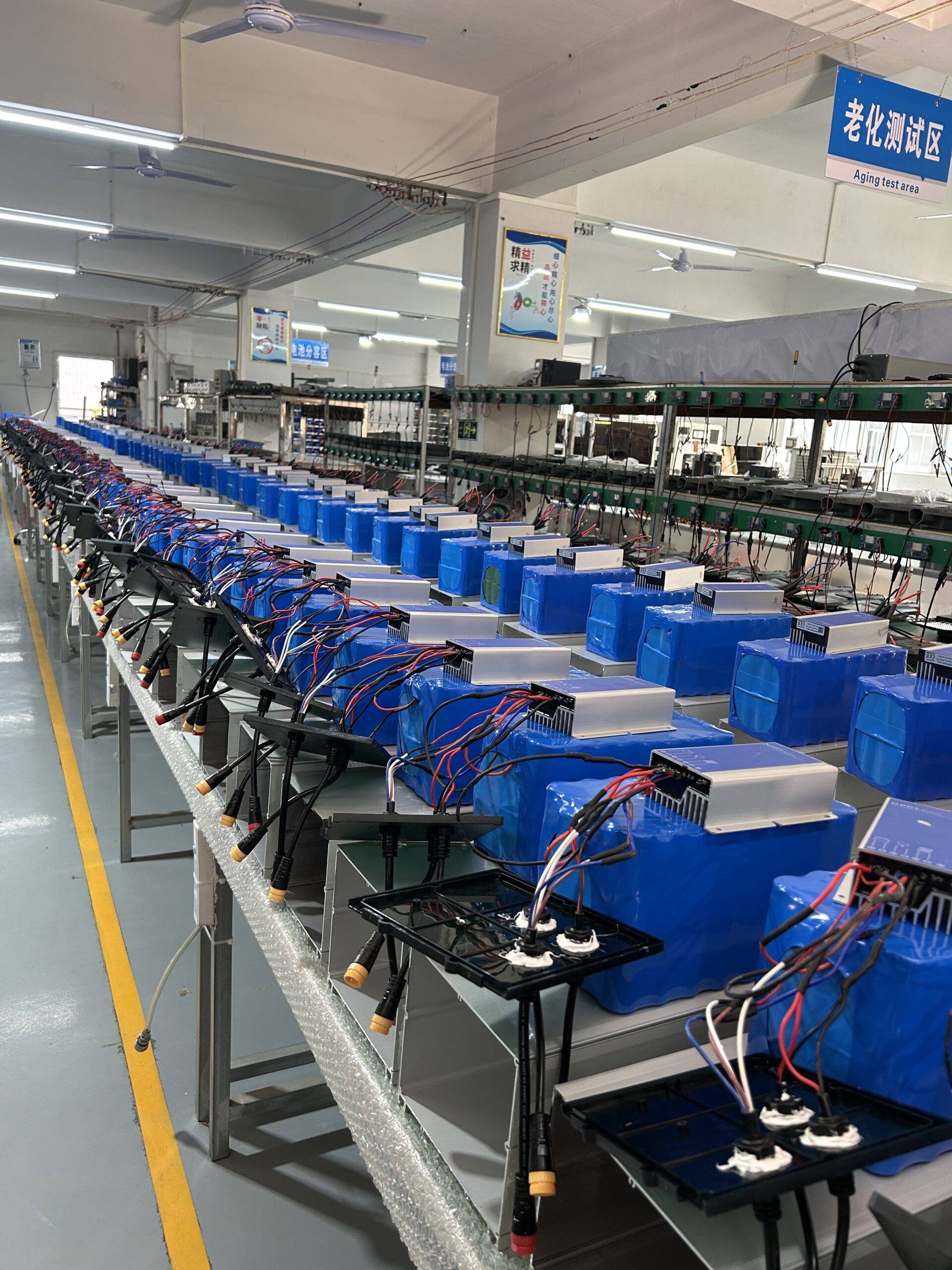
All commercial solar street lighting luminaires, intelligent MPPT controllers, and Q235 hot-dip galvanized steel poles are manufactured in-house by Zhongshan Chengyu New Energy Technology Co., Ltd. at our 35,000 m² production facility in Guzhen Town, Zhongshan, Guangdong, China.
Explore our verified municipal track record: Saudi Arabia 253 Sets 55°C Desert Highway Project, Philippines Coastal Highway Typhoon-Resistant Installation, or inspect third-party IEC/CE/ISO test reports at our Compliance Verification Center.
Need Engineering Sizing or EPC Tender Support?
Contact MCL Solar’s engineering division for complimentary DIALux road lighting simulations, solar autonomy calculations, and direct factory pricing for municipal and commercial infrastructure projects.