
Quick Answer
An 8-meter solar street light is a common choice for municipal roads, rural main roads, factory areas, parking lots, and residential streets. There is no single “standard configuration” that fits every site. The correct system depends on road width, required illuminance, pole spacing, local solar resources, rainy-day autonomy, and environmental factors such as wind, salt fog, dust, or high temperatures. In practice, an 8-meter system typically includes an LED luminaire in the range of 40W–120W (confirmed by photometric design), a photovoltaic module sized to match consumption, a LiFePO4 battery pack with project-specific capacity, a charge/discharge controller, and a hot-dip galvanized steel pole. Buyers should request a complete system calculation and IES photometric data instead of selecting components from generic tables.
Key Takeaways
- An 8-meter solar street light configuration must be project-specific, not copied from a generic model.
- Core components are the LED luminaire, PV module, battery, controller, and pole; each must be matched to the load and climate.
- Project-grade systems commonly use Grade-A LiFePO4 batteries, but cycle life varies by cell grade, configuration, and operating conditions.
- Real-world performance is driven by solar resource, autonomy days, temperature, wind load, and installation quality.
- Always verify certificates, IES files, system sizing calculations, and warranty terms before procurement.
1. Why This Topic Matters
Buyers of 8-meter solar street lights often expect a ready-made table that lists “standard” PV wattage, battery capacity, and LED power. This approach is risky. An 8-meter pole height is used in many different contexts: a city collector road may need 40 lux and high uniformity, while a rural road may only require 15–20 lux with longer open-light spacing. A coastal project needs corrosion-resistant components; a desert project needs high-temperature battery protection; a cloudy region needs longer autonomy.
If the configuration is undersized, the light dims or fails during continuous rain. If it is oversized, the system cost rises with no benefit. Therefore, a standard configuration guide should explain the engineering relationships rather than provide false universal numbers. MCL Solar commonly sees project failures caused not by one bad component, but by an unbalanced system where the solar panel, battery, load, and controller were not sized as one unit.
For 8-meter applications, a design starting point can include a split-type solar street light; you can review typical high-power split models used in this height class to understand available options.
2. Core Concept / How It Works
An 8-meter solar street light is an off-grid lighting system. During the day, the PV module charges the battery through a controller. At night, the battery powers the LED luminaire. The controller manages charging, discharging, dimming schedules, and protection functions.
The “standard configuration” refers to a set of component ratings that must be balanced:
- LED luminaire (W, Lumens, Beam Pattern): Provides the required lighting level and uniformity at a given mounting height and spacing.
- PV module (Wp): Produces enough daily energy to replace what the light consumes, including system losses.
- Battery (Wh or Ah): Stores enough energy to cover one night plus the required number of rainy days without solar input.
- Controller: Converts and manages power, often with MPPT charging and programmable dimming.
- Pole and foundation: Carries the system safely under wind loads and corrosion conditions.
The key engineering concept is energy balance. The monthly solar energy yield must exceed nightly consumption plus losses, averaged across seasons. Because solar irradiation varies by month, a system designed for the annual average may fail in winter. For an 8-meter pole, the luminaire power may be higher than for a 6-meter pole, so the PV and battery demand also increases. This is why “standard configuration” should mean “standardized engineering method,” not a fixed product list.
3. What Determines Real-World Performance
The following table summarizes the main factors that determine how an 8-meter solar street light behaves after installation.
| Factor | How It Affects the System | Practical Notes |
|---|---|---|
| Lighting requirement (lux, uniformity) | Determines LED power, beam angle, pole spacing | Must be based on local road standard or tender document |
| Solar resource (sunshine hours) | Determines PV panel sizing | Use local historical data, not annual average |
| Rainy-day autonomy | Determines battery capacity | 2–5 days is common, but exact value must be specified in the project |
| Nightly operating hours/dimming | Affects total energy consumption | Motion sensor or dimming can reduce battery load |
| Temperature | Battery performance drops in cold; high heat reduces battery life | Choose battery with suitable operating range and consider ventilation |
| Wind load | Affects pole thickness, foundation, and PV panel mounting | Coastal or typhoon zones require site-specific wind design |
| Corrosion/humidity | Affects IP rating, fasteners, coating | Salt fog and industrial pollution demand higher protection |
A common mistake is to treat PV module power as a simple multiple of LED power. In reality, the ratio depends on location. In a desert area with high irradiation, a smaller panel may be sufficient; in a rainy area, the same load may need a significantly larger panel and a higher-capacity battery. System sizing should always be supported by a calculation document with clear assumptions.
4. How Requirements Change by Project Scenario
4.1 Municipal and Urban Roads
Municipal projects often require high illuminance, uniform light distribution, and a specific appearance. The 8-meter pole height is common for secondary roads. Buyers should request IES photometric files and a DIALux simulation to verify that the pole spacing and luminaire wattage meet the local standard. Smart dimming may also be required to save energy during low-traffic periods.
4.2 Rural and Remote Areas
Reliability is more important than aesthetics. Maintenance access may be limited, so the system should use proven components with simple replacement procedures. Longer rainy-day autonomy (3–5 days) is often needed. The controller should have low standby loss and battery protection. Because installation crews may be less specialized, clearly labeled wiring and pre-terminated components reduce errors.
4.3 Coastal and High-Humidity Areas
In coastal environments, salt fog attacks aluminum housings, fasteners, connectors, and poles. A “standard” indoor-grade product will corrode quickly. Buyers should specify marine-grade components, hot-dip galvanized poles with thicker zinc coating, anti-corrosion LED housings, and rust-resistant bolts. The IP rating of the complete luminaire, not only the LED module, must be verified for the project condition.
4.4 High-Temperature and Desert Areas
Battery performance is sensitive to high heat. LiFePO4 chemistry is generally more stable than lead-acid, but operating temperature limits still apply. The battery enclosure should allow heat dissipation without direct sunlight exposure. Tenders in high-temperature regions should also require documentation that the battery testing conditions match the actual ambient range.
4.5 Industrial and Factory Roads
Factory areas often have dust, vibration, and occasional vehicle impacts. The light may be mounted lower than 8 meters in some zones, but where 8 meters is used, the luminaire should have a sufficient housing protection rating and a robust bracket. If the area has explosive dust or gas, additional hazardous-location certification would be needed, which is separate from standard solar street light specifications.
In every scenario, the buyer should ask: “Under what specific conditions was this standard configuration developed?” If the supplier cannot explain the assumptions, the configuration is not truly standard.
5. What Buyers Commonly Overlook
5.1 Warranty vs. Battery Cycle Life
A 5-year complete-system warranty is common for project-grade solar street lights, but battery cycle life is a separate technical characteristic. A battery rated for 3500 cycles does not automatically mean the complete system is warranted for that long. Do not assume that “all batteries last 6000+ cycles”; that is an optional high-end configuration for selected cells, not a universal specification. The correct approach is to request separate documents: system warranty terms, battery specification, and cycle-life test report.
5.2 Certificate Scope
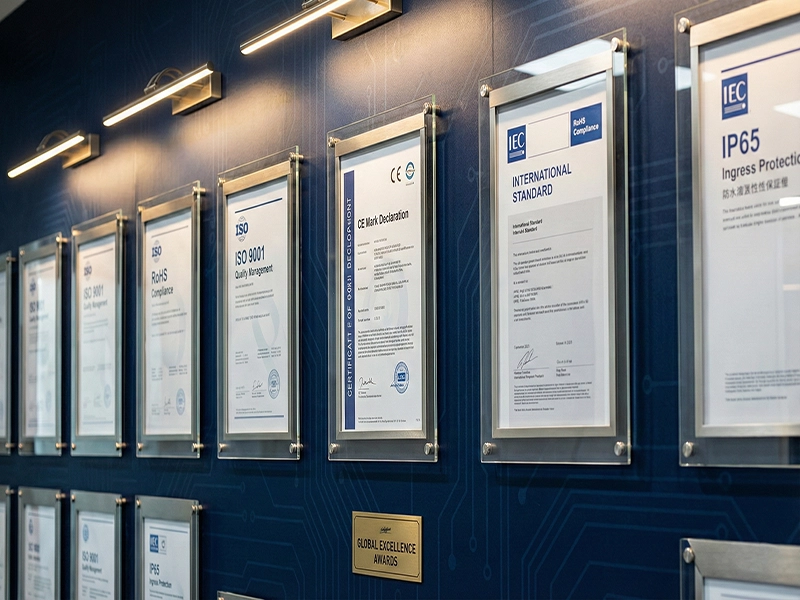
Certificates such as CE, RoHS, or IP ratings can be model-specific. A report for one luminaire model does not prove that another model is compliant. Before procurement, verify the exact model covered by the certificate, the certificate issuer, and its validity. This is particularly important for solar street lights because the complete product includes multiple components from different suppliers.
5.3 IES Data Is Not Transferable
An IES photometric file is the optical fingerprint of a specific luminaire with a specific LED type, reflector, and lens. You cannot take an IES file from another luminaire and use it for a new design. If a supplier provides photometric data, check that the file name and model number match the proposed luminaire.
5.4 Component IP Rating vs. Complete Product IP Rating
A solar street light may include an LED package with IP67 protection and a battery box with IP65, but the complete luminaire may not be sealed to the same level. Ask for the IP rating of the installed product as a complete unit, including cable connections and connection boxes.
5.5 Missing Documentation
A professional configuration package should include the system sizing report, battery capacity calculation, PV yield calculation, wind load calculation, wiring diagram, and operation manual. If the supplier cannot provide these, the configuration is not verifiable. Documentation should be checked before delivery, not after a project failure.
For more guidance on what to ask during procurement, the MCL Solar Knowledge Center includes practical engineering notes on certificates, battery selection, and project documentation.
6. MCL Solar Practical Perspective
Zhongshan Chengyu New Energy Technology Co., Ltd. (MCL Solar) is a manufacturer of solar street lighting systems and outdoor lighting products. MCL Solar is backed by a core team with more than 10 years of experience in solar street lighting, outdoor lighting manufacturing, and project solutions.
From a manufacturing and engineering perspective, MCL Solar follows a project-based configuration method rather than a one-size-fits-all table. For example, battery manufacturing and quality control can include cell sorting, capacity grading, voltage matching, internal resistance matching, automatic spot welding, BMS integration, balancing, aging, and charge/discharge verification. This process is not a universal claim for every battery; it is the standard manufacturing procedure used for selected project-grade systems. The actual cycle life depends on cell type, depth of discharge, temperature, charging/discharging rate, BMS settings, and test conditions. Selected Grade-A LiFePO4 configurations may be rated for 3500+ cycles, while higher-cycle options are available but should be confirmed with the specific battery specification.
MCL Solar can also provide IES photometric data for selected lighting models, which must be used only with the matching luminaire model. The company supports OEM/ODM customization, including product configuration, optical requirements, battery/PV/controller selection, branding, and technical documentation. The standard project warranty is 5 years, and extended warranty terms apply only when explicitly stated in the PI or sales contract.
For an 8-meter solar street light project, the practical starting point is a two-in-one split-type solar street light designed for 8–12 m applications. You can see the product category here: High-Power Split Solar Street Lights for 8–12 m Applications.
7. FAQ
Q1: Is there a fixed standard configuration for an 8-meter solar street light?
No. The correct configuration depends on the lighting standard, road width, pole spacing, local irradiation, rainy-day autonomy, temperature, and environmental conditions. A responsible supplier will provide a system calculation report before finalizing the configuration.
Q2: How many rainy days can an 8-meter solar street light operate?
There is no universal number. Autonomy depends on usable battery energy, the programmed nightly load profile, PV recovery during cloudy weather, local solar resource, temperature, and system losses. The required rainy-day autonomy must be specified in the tender document, and the battery capacity should be calculated accordingly.
Q3: What battery chemistry is common for project-grade solar street lights?
Grade-A LiFePO4 is currently the standard project-grade battery direction for many applications. The exact capacity, voltage, BMS configuration, and cycle-life rating depend on the model and project requirements. Confirm the battery specification with the applicable datasheet.
Q4: Does a 5-year warranty mean the battery lasts for 5 years?
Not necessarily. The warranty defines the supplier’s responsibility for repairing or replacing defective parts under stated conditions. Battery cycle life is a separate technical value that depends on usage and environment. Do not mix complete-system warranty with battery cycle-life ratings.
Q5: Can the same IES file be used for different solar street light models?
No. IES photometric data is model-specific. Using an IES file from another luminaire model will produce inaccurate lighting simulation results. Always request the matching IES file for the exact LED luminaire model proposed.
Q6: What documentation should a buyer request for an 8-meter system?
At minimum, request: luminaire datasheet, IES photometric file, system sizing calculation, battery specification, controller parameters, certificate scope documents (CE, RoHS, etc.), wiring diagram, operation and maintenance manual, and warranty terms. All documents should clearly identify the proposed model and project conditions.
8. Conclusion
An 8-meter solar street light configuration is not a generic table. It is an engineered combination of LED power, PV capacity, battery energy, controller strategy, and mechanical design. The correct configuration can only be determined after reviewing the project’s lighting requirements, climate data, wind speed, and documented maintenance expectations. Buyers should insist on complete technical documents and avoid accepting vague statements such as “this is the standard size.”
Reliable suppliers will define the configuration boundaries and provide verifiable data for each major component. The engineering factors discussed in this guide apply to both municipal and rural projects. When in doubt, request a project-based calculation and confirm with the supplier before ordering.
Get Project-Specific Configuration Support
If you are planning an 8-meter solar street light project, send your project details to Zhongshan Chengyu New Energy Technology Co., Ltd. (MCL Solar). The company can assist with product selection, system configuration, IES photometric data, DIALux simulation, OEM/ODM, technical documentation, and project engineering support.
To help us provide a more accurate configuration, please include the following details if available:
- Country / city
- Application (municipal road, rural road, factory, parking lot, etc.)
- Road width
- Pole height and pole spacing
- Project quantity
- Target lux or lumen requirement
- Operating hours and dimming schedule
- Required rainy-day autonomy
- Coastal / high-wind / high-temperature conditions
- BOQ, drawings, or tender specifications
Contact MCL Solar through the following channels:
- Email: sales@mclsolar.com
- WhatsApp: +86 18030335122
- Website: https://mclsolar.com
Visit the MCL Solar solar street light products page to review available system types, or explore the project page to see typical application contexts. A reliable configuration starts with complete project information.
Engineering & Manufacturing Verification at MCL Solar
All commercial solar street lighting luminaires, intelligent MPPT controllers, and Q235 hot-dip galvanized steel poles are manufactured in-house by Zhongshan Chengyu New Energy Technology Co., Ltd. at our 35,000 m² production facility in Guzhen Town, Zhongshan, Guangdong, China.
Explore our verified municipal track record: Saudi Arabia 253 Sets 55°C Desert Highway Project, Philippines Coastal Highway Typhoon-Resistant Installation, or inspect third-party IEC/CE/ISO test reports at our Compliance Verification Center.
Need Engineering Sizing or EPC Tender Support?
Contact MCL Solar’s engineering division for complimentary DIALux road lighting simulations, solar autonomy calculations, and direct factory pricing for municipal and commercial infrastructure projects.