
Key Takeaways
- Solar street lights for the Philippines must withstand heavy rain, high humidity, and typhoon-force winds; IP66 waterproofing and corrosion-resistant poles are non-negotiable.
- Grade-A LiFePO4 batteries paired with real MPPT controllers provide reliable autonomy during extended rainy seasons (2–7 days of backup depending on configuration) [K3].
- Barangay and municipal projects benefit from all-in-one designs that reduce installation complexity and long-term maintenance costs, as demonstrated in Iloilo and Cebu deployments [K1, K2, K4].
- Motion-sensor and intelligent power-saving modes help extend battery life without compromising nighttime safety.
1. Introduction
The Philippines presents a unique challenge for outdoor solar lighting. With over 20 typhoons entering the Philippine Area of Responsibility each year, prolonged rainy seasons, and high humidity levels that corrode standard equipment, selecting the right solar street light is not a simple purchase — it is a long-term infrastructure decision.
For local government units (LGUs) managing barangay roads, rural access routes, and community streets, the stakes are high. Unstable utility power, flood-prone areas, and the need for reliable nighttime safety mean that a poorly chosen light can lead to frequent breakdowns, high replacement costs, and disappointed residents.
This article explains exactly how to evaluate solar street lights for Philippine conditions. We will cover weather resistance, battery autonomy during rainy days, brightness requirements, and real-world project examples — including the Barangay Road Lighting Improvement Project in Iloilo Province and the Smart Barangay Solar Road Lighting Project in Cebu City [K2, K4]. By the end, you will have a clear decision framework for choosing lights that survive typhoons and perform through the rainy season.
2. Weather Resistance: IP Rating, Poles, and Corrosion
Core conclusion: For Philippine conditions, a minimum IP66 waterproof rating is essential. All components — the light housing, solar panel junction box, and battery enclosure — must be sealed against water ingress.
Why IP66 Matters
During a typhoon, rain is driven horizontally by wind speeds that can exceed 150 km/h. A standard IP65-rated fixture may protect against low-pressure water jets, but IP66 is designed for powerful water jets and heavy seas. In the Iloilo project, MCL Solar supplied lights with an IP66 structure specifically for a "heavy rainy season area with frequent typhoons" [K2]. This is not optional: water entering the battery compartment or controller will cause immediate failure.
Pole and Mounting Considerations
Beyond the light itself, the pole must resist corrosion. Hot-dip galvanized poles (as used in the Iloilo and Cebu projects) provide a durable zinc coating that prevents rust in coastal and humid environments [K2, K4]. Standard painted poles will peel and rust within two years in many Philippine barangays.
Practical checklist:
- Light housing: IP66 minimum
- Battery compartment: IP66 or better
- Pole material: Hot-dip galvanized steel (HDG)
- Pole height: 6–7 meters for barangay roads (typical)
3. Battery Autonomy: How Many Rainy Days Can Solar Street Lights Work?
Core conclusion: A well-configured solar street light should support 2–7 days of autonomy during continuous cloudy or rainy weather. The exact number depends on battery capacity, solar panel size, daily operating hours, and local solar irradiation [K3].
The Technology Behind Autonomy
Grade-A LiFePO4 (lithium iron phosphate) batteries are the industry standard for tropical solar lighting. Unlike lead-acid batteries, LiFePO4 handles deep discharge cycles better, lasts longer (typically 3,000–5,000 cycles), and performs more reliably in high temperatures. Combined with a real MPPT (maximum power point tracking) controller, the system can extract up to 30% more energy from the solar panel each day, especially during overcast conditions [K1, K3].
Estimating Autonomy for Your Project
| Battery Capacity | Solar Panel (W) | Typical Rainy Day Autonomy | Best For |
|---|---|---|---|
| Grade-A LiFePO4 | High-efficiency mono | 2–4 days | Urban barangay roads with moderate shade |
| Grade-A LiFePO4 | High-efficiency mono | 5–7 days | Rural roads, long rainy seasons, critical safety areas |
In the Iloilo barangay project, the 80W all-in-one lights used a high-capacity LiFePO4 system with a real MPPT controller [K1]. The system was designed for the rainy season and delivered stable lighting despite "frequent heavy rain, high humidity, and unstable utility power" [K1].
Practical tip: Insist on real MPPT controllers, not PWM. A PWM controller can waste 20–40% of available solar energy, which is unacceptable during the Philippine rainy season. Also verify that the battery is Grade-A (new, not recycled cells) to avoid premature capacity loss.
4. Brightness and Light Distribution for Barangay Roads
Core conclusion: Engineering-grade solar street lights can fully meet the brightness requirements for barangay roads, with high-lumen LED systems achieving up to 230 lm/W efficiency [K5]. The key is matching lumen output to pole height and road width.
What Brightness Do You Need?
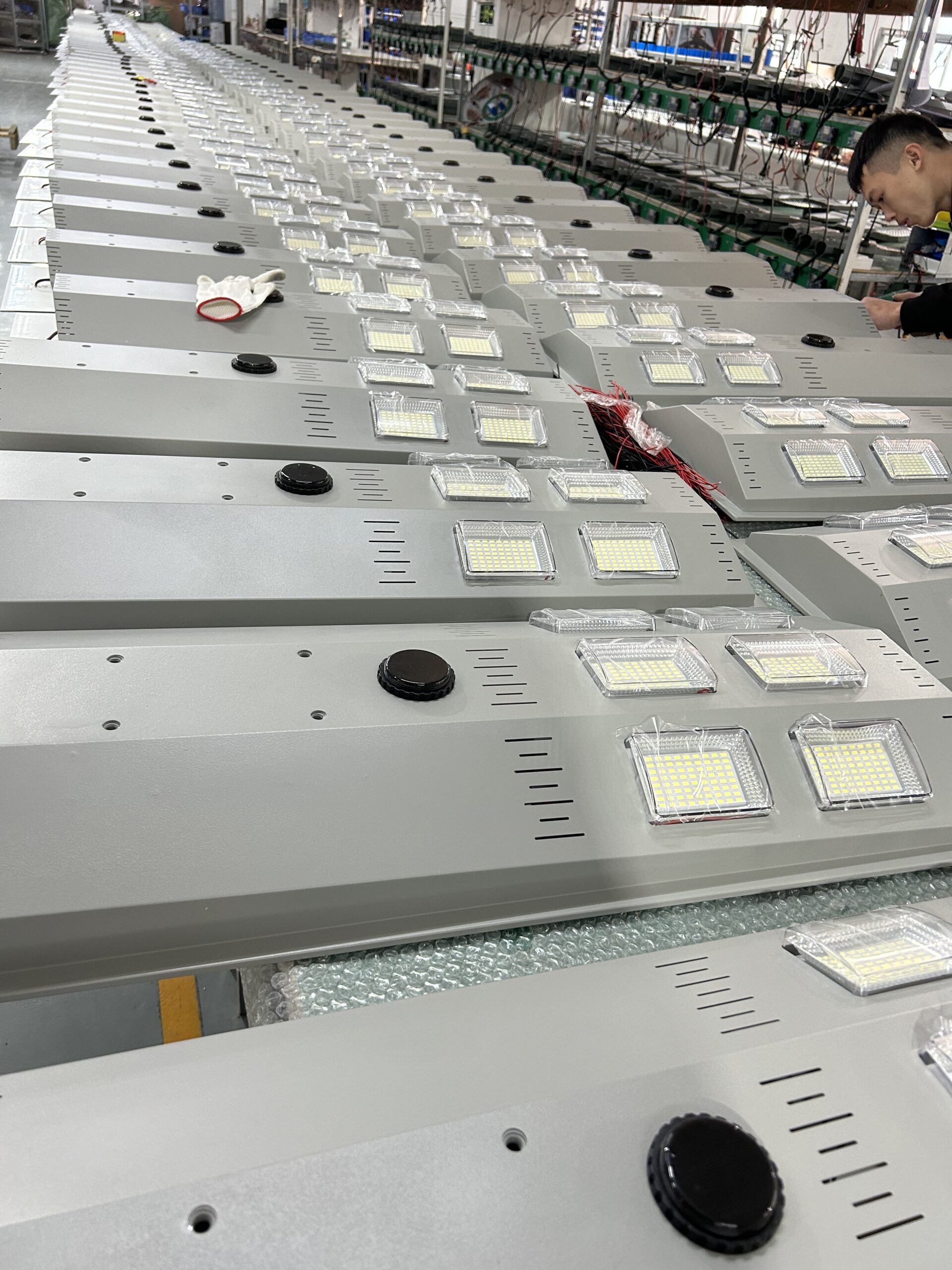
For a typical 6-meter pole on a barangay road (4–6 meters wide), a 60W–100W LED equivalent is sufficient. The Iloilo project used 80W fixtures, while the Cebu project opted for 100W lights on 7-meter poles for wider urban roads [K2, K4].
Lumen Output vs. Perceived Brightness
High-efficiency LEDs (using SMD chips like SMD3030) produce more light per watt. A 100W light with 230 lm/W efficiency delivers 23,000 lumens, which is more than adequate for most barangay applications [K5]. However, perceived brightness also depends on the optics:
- Uniform distribution is more important than raw lumens for road safety.
- Avoid glare: Lights should have a flat glass or lens that directs light downward, not sideways into homes or drivers’ eyes.
Practical advice: Ask for photometric data (road lighting class IES files) before purchasing. A reputable supplier can provide this. If they cannot, the product is likely not designed for road lighting.
5. Working Modes and Energy Optimization
Core conclusion: The best solar street lights for the Philippines combine dusk-to-dawn lighting with intelligent power-saving features. This ensures safety all night while preserving battery capacity for successive rainy days.
Common Working Modes
- Dusk to dawn (constant): Light stays at 100% brightness all night. Simple but consumes the most battery.
- Dusk to dawn + motion sensor: Dims to 30–50% when no motion is detected, boosts to 100% when pedestrians or vehicles pass. Extends rainy day autonomy significantly. This was used in the Cebu City project [K4].
- Time-based dimming: 100% for first 4–6 hours, then dims to 50% for the rest of the night.
Which Mode Should You Choose?
For barangay roads with low nighttime traffic (residential streets), the motion sensor mode provides a good balance of safety and energy savings. For main barangay roads with continuous traffic, dusk-to-dawn with intelligent dimming (e.g., 100% until midnight, then 70% until dawn) is more practical.
Process summary:
- Assess traffic patterns on the road.
- Determine minimum required brightness for safety (consult local standards if available).
- Select a working mode that extends autonomy by at least 2 rainy days.
- Verify that the controller supports the chosen mode.
6. FAQ
Q1. How long do solar street lights last in the Philippines?
A well-made solar street light with Grade-A LiFePO4 batteries and IP66 housing should last 5–8 years before the battery requires replacement. The LED module itself typically lasts 50,000–100,000 hours (10–20 years at 10–12 hours per night). The solar panel degrades about 0.5% per year.
Q2. Can solar street lights work during a typhoon?
They can operate during light to moderate typhoon conditions, but during severe storms, the best strategy is intelligent shutoff to protect the battery. Most quality systems include overcharge, over-discharge, and short-circuit protection. Reinforced poles and brackets are recommended for areas with sustained winds over 120 km/h.
Q3. What is the cost range for a complete solar street light for a barangay road?
A complete system (light, battery, controller, pole, and installation) for a barangay road typically ranges from PHP 12,000 to PHP 25,000 per unit for an 80–100W configuration, depending on pole height, battery capacity, and features. Bulk projects (100+ units) often receive discounts.
Q4. Do I need a special foundation for the pole?
Yes. A concrete foundation (typically 0.4m × 0.4m × 0.6m deep) is required to anchor the pole against wind loads. In flood-prone areas, the pole base should be elevated above the flood level to prevent water damage to the electrical connections.
7. Conclusion
Choosing solar street lights for the Philippines is not about picking the cheapest option — it is about selecting a system that can survive the climate, deliver consistent lighting during the rainy season, and reduce the maintenance burden on local government.
Final recommendations:
- For barangay roads in heavy rain/typhoon areas: Choose all-in-one lights with IP66 rating, Grade-A LiFePO4 batteries, real MPPT controllers, and hot-dip galvanized poles. The 80W–100W range (as used in Iloilo and Cebu) is a proven, practical choice [K1, K2, K4].
- For priority safety areas (main roads, intersections): Configure for 5–7 days of autonomy and use dusk-to-dawn mode.
- For residential streets: Use motion sensor mode to extend autonomy and reduce light pollution.
- Work with experienced suppliers: Look for suppliers with documented project experience in the Philippines, not just generic catalog products.
The evidence from real barangay projects in Iloilo and Cebu confirms that properly specified solar street lights can deliver reliable, low-maintenance lighting even under the most challenging tropical conditions. By focusing on weather resistance, battery autonomy, and appropriate brightness, you will make a sound long-term investment for your community.
Engineering & Manufacturing Verification at MCL Solar
All commercial solar street lighting luminaires, intelligent MPPT controllers, and Q235 hot-dip galvanized steel poles are manufactured in-house by Zhongshan Chengyu New Energy Technology Co., Ltd. at our 35,000 m² production facility in Guzhen Town, Zhongshan, Guangdong, China.
Explore our verified municipal track record: Saudi Arabia 253 Sets 55°C Desert Highway Project, Philippines Coastal Highway Typhoon-Resistant Installation, or inspect third-party IEC/CE/ISO test reports at our Compliance Verification Center.
Need Engineering Sizing or EPC Tender Support?
Contact MCL Solar’s engineering division for complimentary DIALux road lighting simulations, solar autonomy calculations, and direct factory pricing for municipal and commercial infrastructure projects.