
As of May 17, 2026, forward-thinking municipal buyers and engineering contractors are fundamentally changing how they evaluate All in One Solar Street Light systems. Initial price is no longer the main deciding factor. Instead, infrastructure procurement teams are focusing heavily on Total Cost of Ownership (TCO), multi-decade reliability, and long-term serviceability.
Many contractors across global installation sites have learned a painful, budget-draining lesson: cheap, non-serviceable “glue-sealed” integrated solar lights often become expensive electronic waste once a single battery cell or charge controller fails. This systemic vulnerability has driven a massive, growing demand for truly modular, repairable solar lighting solutions that support the industrial “Right to Repair” philosophy.
At MCL Solar (Zhongshan Chengyu New Energy Technology Co., Ltd.), a 12-year direct solar street light manufacturer China based in Guzhen, Zhongshan, we have engineered our 2026 product family with easy field maintenance in mind. Because we believe sustainable infrastructure must also be maintainable infrastructure.
The Hidden Trap of Non-Serviceable Integrated Systems
When direct purchasers source an All in One Solar Street Light via standard commercial channels, it is easy to fall into the “Wattage Trap.” Low-cost trading options often utilize consumer-grade stamped iron housings where internal components are permanently welded, hard-wired, or chemically encapsulated in epoxy resin.
In these low-tier configurations, if an intense lightning strike shocks the charger, or if the thermal stress of a tropical climate degrades the lithium pack after 3–4 years, the entire light head must be uninstalled and scrapped. For infrastructure operators managing sprawling installations in countries like the Philippines or Malaysia, the logistics of renting boom trucks, deploying technicians, and re-shipping entire replacement lamps can quickly double the initial project cost.
Decoding the 2026 Modular Architecture Standard
To completely neutralize early-stage systemic failure, professional engineering projects now mandate modular sub-assembly isolation. MCL Solar achieves this by treating the lighting system as three distinct, hot-swappable functional modules:
1. The Isolated Battery Drawer (The 2-Minute Maintenance)
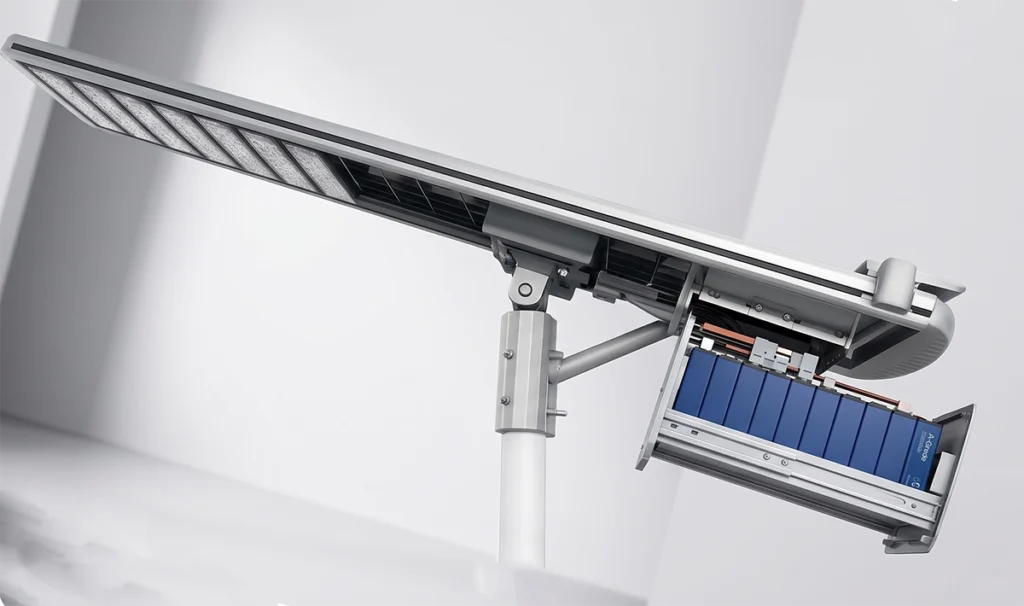
Lithium storage blocks should never be buried or glued deep within the main chassis structure. Our high-efficiency Aluminum profile All in One Solar Street Light models feature a sliding mechanical tray compartment.
When the internal LiFePO4 battery eventually reaches its cycle threshold after a decade of continuous nightly usage, field operators can open a designated safety hatch via a couple of captive screws, slide out the independent battery tray, and click a new pre-balanced block into place. This maintenance takes less than two minutes and is completed safely at pole-height without disconnecting the solar frame.
2. Plug-and-Play Aviation Connected Controllers
Our intelligent MPPT charging units utilize gold-plated, military-grade quick-connect aviation plugs. If an upgrade to a decentralized Smart-Urban IoT mesh network is required, or if a localized component must be serviced, technicians simply plug out the existing module and secure the updated system in seconds.
Technical Trinity: Component Synchronization vs. Technical Specs
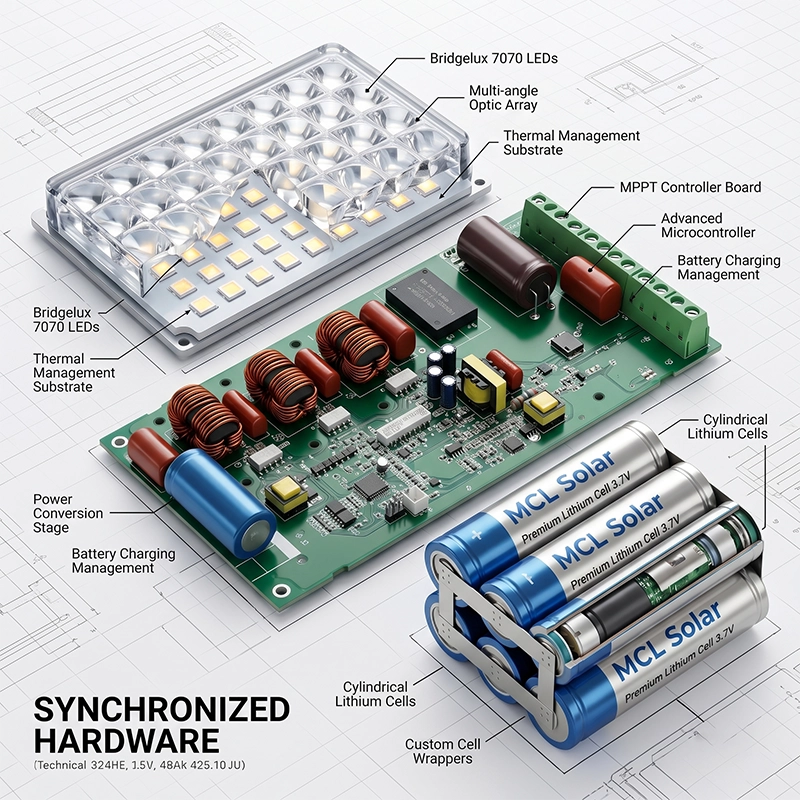
A robust, modular frame is only as reliable as the raw engineering materials synchronized inside. To protect the integrity of our comprehensive Standard warranty for solar street light systems: 5 years. Smart pole electronic components are covered separately according to the project configuration. Pole body and galvanized structural components are evaluated under structural manufacturing terms. Extended warranty is available only when specified in the PI or sales contract., MCL Solar avoids generic component sorting and enforces industrial matching standards across our production floor:
| Component Metric | Low-Cost Market Alternatives | MCL Solar Infrastructure Standard | Real Impact on Your Project TCO |
| LED Module Type | 5730 Consumer Chips (<100 lm/W) | Bridgelux 7070 / Philips 5050 | Achieves up to 200 lm/W; massive lux output with excellent heat dissipation. |
| Battery Storage | Salvaged Ternary / Low-grade Gel | Grade-A LiFePO4 (3,000+ Cycles) | 8–10 year robust service life in tropical heat exceeding 30°C. |
| Charge Regulation | Low-efficiency PWM Systems | Smart MPPT + ALS 3.0 AI Software | Performance must be verified for the project voltage, temperature, irradiance, controller efficiency, and required autonomy. |
| Frame Material | Recycled Plastics / Thin Stamped Iron | Heavy-Duty Aluminum Profile / ADC12 | Ingress and corrosion performance must match the proposed component reports and installation conditions. |
Through this deliberate hardware balancing, an MCL Solar M-Series (25-35W) architecture produces a far sharper and wider ground-level lux distribution pattern than uncalibrated market alternatives claiming much higher nominal wattages.
Selecting the Right System for Your Infrastructure Topography
Road layout and local weather dynamics dictate whether an integrated or split system fits your development profile. As a verified source factory supplying infrastructure networks in Nigeria, Peru, and the USA, we optimize product recommendations around exact engineering parameters:
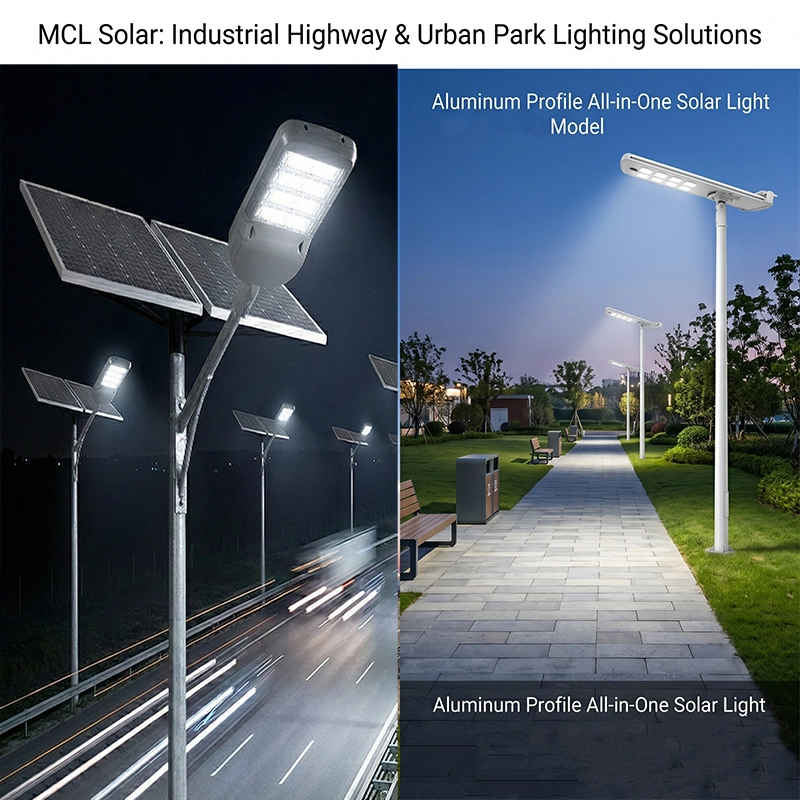
- Urban Boulevards, Parking Enclosures, & Residential Lanes (6–8m Poles): We recommend our modular All in One Solar Street Light utilizing an extruded Aluminum profile enclosure. This configuration features complete hidden wiring, protecting the infrastructure from cable cutting and outdoor theft while preserving clean architectural aesthetics.
- Interstate Highways & Heavy Municipal Trunk Roads (9–12m Poles): For heavy-duty industrial scale, our M-Series (40-150W) split setup remains the undisputed leader. Separating the solar frame allows engineers to expand the PV panel surface area on a heavy, hot-dip galvanized Lamp Pole (Hot-dip galvanized), pushing maximum raw current to high-power Split-Type Solar Street Light heads or High Power Split-Type assemblies even during deep monsoon seasons.

Frequently Asked Questions
Q: What makes a high power solar street light “smart” in 2026?
A: True smart integration requires the combination of an MPPT controller, Adaptive Lighting System (ALS 3.0) algorithms, and optional IoT communication modules that predict weather variations to prevent total battery depletion.
Q: How many rainy days can your systems support?
A: Thanks to our ALS 3.0 predictive energy loading, our premium systems safely guarantee continuous night-to-night illumination for 10+ consecutive rainy days under zero direct sunlight.
Q: Which is better for highways — Split-Type or All-in-One?
A: For heavy-duty highway applications requiring tall 8–12m poles, the M-Series (40-150W) split type is highly recommended, as it allows for large independent panel configurations to generate maximum high-lumen output.
Q: Are your lights suitable for DPWH projects in the Philippines?
A: Yes, absolutely. We regularly supply comprehensive technical documentation, authenticated ISO9001 factory certificates, and accurate IES photometric data to help contractors fully satisfy DPWH project requirements.
Q: Do you offer aStandard Warranty: 5 Years. Extended warranty is available only when specified in the PI or sales contract.?
A: Yes. MCL Solar provides a dependable 5-Year structural warranty on our core hardware lines, backed by premium, thoroughly tested components and extensive quality control auditing.
Partner with a Transparent, Verified Source Factory
Do not risk your corporate reputation with non-serviceable market alternatives that end up as early electronic waste. Partner with a direct manufacturer that provides elite component efficiency, verified certifications, and true modular durability.
- 📧 Request a Free Professional IES Lighting Simulation: sales@mclsolar.com
- 💬 Speak Directly with Our Factory Engineering Team: WhatsApp: +86 180 3033 5122
- 📂 Explore Our Completed Projects Database: Visit Explore Our Projects
- 🔎 Browse High-Power Technical Solutions: View the product catalog
Engineering & Manufacturing Verification at MCL Solar
All commercial solar street lighting luminaires, intelligent MPPT controllers, and Q235 hot-dip galvanized steel poles are manufactured in-house by Zhongshan Chengyu New Energy Technology Co., Ltd. at our 35,000 m² production facility in Guzhen Town, Zhongshan, Guangdong, China.
Explore our verified municipal track record: Saudi Arabia 253 Sets 55°C Desert Highway Project, Philippines Coastal Highway Typhoon-Resistant Installation, or inspect third-party IEC/CE/ISO test reports at our Compliance Verification Center.
Need Engineering Sizing or EPC Tender Support?
Contact MCL Solar’s engineering division for complimentary DIALux road lighting simulations, solar autonomy calculations, and direct factory pricing for municipal and commercial infrastructure projects.