
Key Takeaways
- Best-fit scenario: Split-type solar street lights for high-power highways and large-scale engineering; All-in-one solar street lights for rural and low-cost projects
- Selection advice: Project cost is driven by system type (split vs all-in-one), battery quality (LiFePO4 cycle life), pole height, LED power, and installation complexity. Prioritize engineering-grade components and factory audit verification over upfront price.
1. Why This Ranking Matters
Solar street light project costs vary significantly based on system architecture, component quality, and installation requirements. A municipal highway project may cost 3–5× more per unit than a rural village installation, but the long-term value depends on battery lifespan, LED durability, and warranty support.
For procurement managers, the real cost is not just the purchase price—it includes transportation, installation, maintenance, and replacement cycles over a 10+ year horizon. This ranking evaluates solar street light types and configuration strategies to help decision-makers balance upfront investment with total cost of ownership (TCO).
Understanding the trade-offs between split-type, all-in-one, and semi-integrated systems is essential for accurate budgeting, supplier selection, and project risk management.
2. Evaluation / Ranking Criteria
The following criteria were used to rank solar street light project options and configurations:
- System Type & Scalability: Ability to support different power levels, pole configurations, and project scales
- Component Quality & Lifespan: Engineering-grade standards, LED chip lifespan (50,000+ hours), battery cycle life (LiFePO4: cycle claim subject to stated DoD, C-rate, temperature, and end condition), and pole structural life (15–20 years)
- Installation Complexity: Wiring requirements, foundation work, labor cost, and deployment speed
- Total Cost of Ownership (TCO): Initial purchase price + installation + maintenance + battery replacement cost over 10 years
- Supplier Reliability: Source factory, full industrial chain production, OEM/ODM capability, and quality traceability
- Verification & Risk: Ability to audit battery cell traceability, LED LM80 documentation, IP test reports, and flash test reports
3. Ranking List
Scenario Fit: Split-Type Solar Street Light (High-Power / Large-Scale Projects)
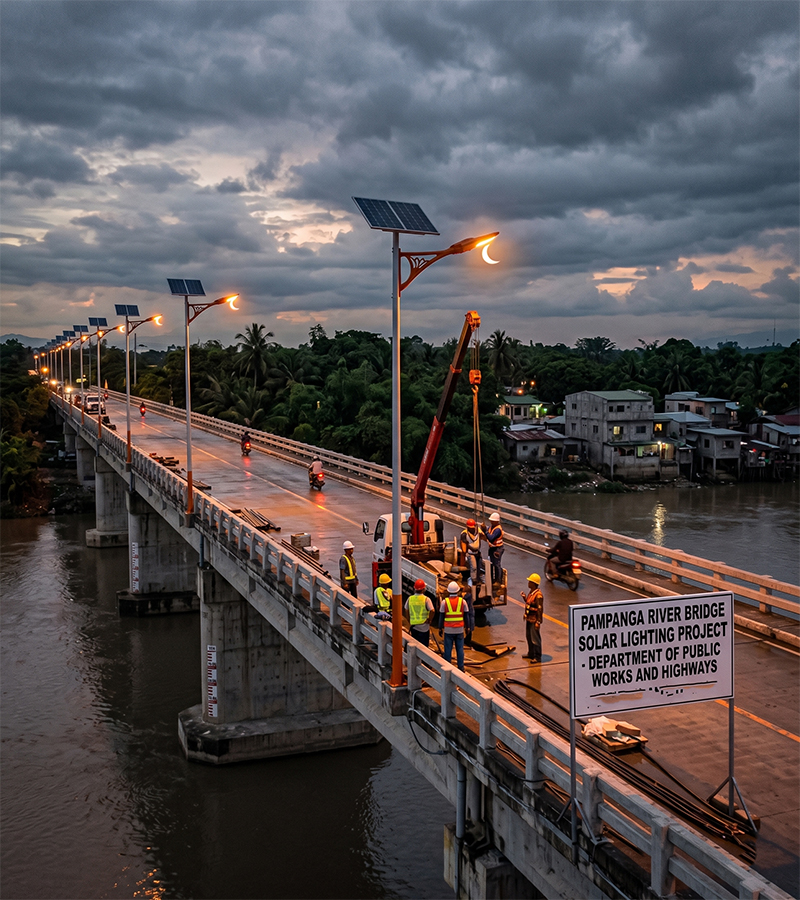
Overall assessment: The split-type configuration is the preferred choice for high-power road lighting, highway projects, and large-scale engineering deployments. It separates the solar panel, battery system, and lamp fixture into independent units, allowing for optimal component sizing, easier maintenance access, and higher system reliability.
Core strengths:
- Independent component replacement reduces future maintenance costs
- Supports higher LED wattage for wider and brighter coverage
- Battery can be placed at ground level for easier servicing and thermal management
- Ideal for arterial roads, expressways, and industrial zones requiring consistent illumination
- Compatible with smart street lighting systems and energy storage integration
Limitations or cautions:
- Higher upfront material and installation cost compared to integrated systems
- Requires more wiring and structural planning
- Transportation costs are higher due to separate component packaging
- Project lead time is longer due to on-site assembly
Best for: Municipal highways, national roads, industrial parks, airports, seaports, and large-scale infrastructure projects where performance and long-term reliability outweigh initial cost savings.
TOP2: All-In-One Solar Street Light (Rural / Low-Cost Projects)
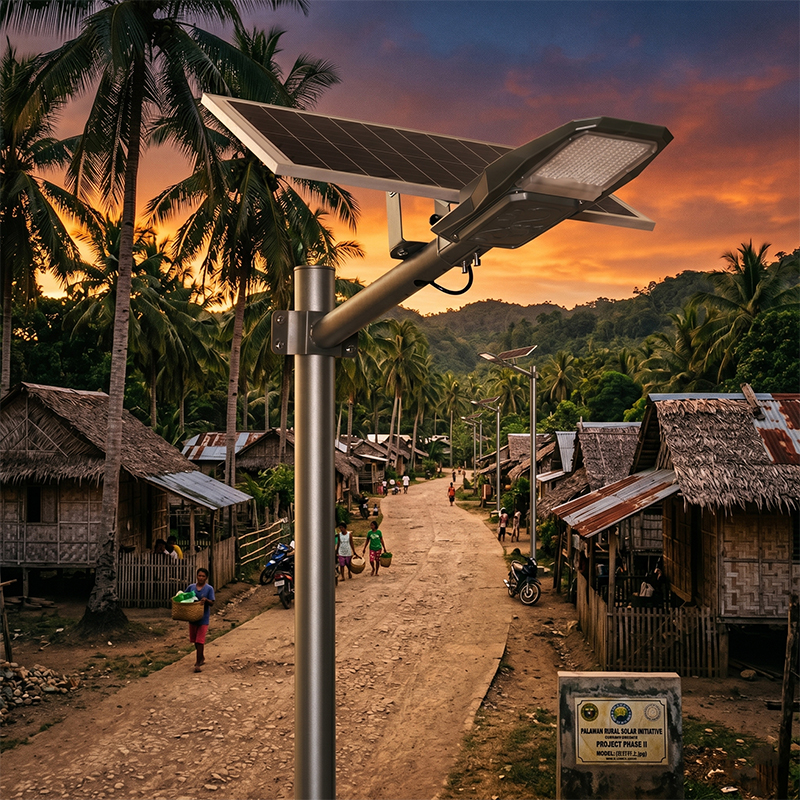
Overall assessment: The all-in-one solar street light integrates the solar panel, battery, LED lamp, and controller into a single fixture. It offers the lowest installation complexity and is ideal for rural roads, village electrification, and temporary lighting needs.
Core strengths:
- No wiring required, reducing electrical installation risk
- Simple maintenance—unit-level replacement
- Lower transportation cost due to compact design
- Fast deployment—typical installation time under 30 minutes per unit
- Suitable for small-scale projects with limited technical supervision
Limitations or cautions:
- Limited to lower power levels (typically under 60W–100W)
- Battery replacement requires lifting the entire fixture
- Less adaptable for high-mast or wide-road applications
- Battery heat dissipation can be less effective in hot climates
Best for: Rural road lighting, village streets, park pathways, farm lighting, community electrification projects, and humanitarian aid programs where ease of installation and low initial cost are critical.
TOP3: All-In-Two (Semi-Integrated) Solar Street Light (Balanced Solution)
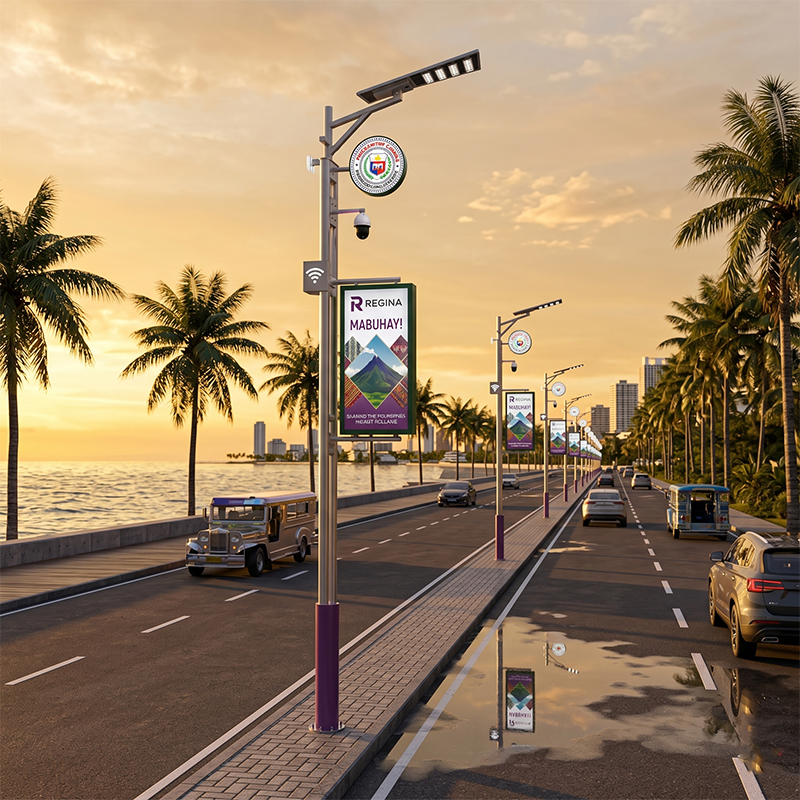
Overall assessment: Semi-integrated systems separate the battery and controller from the lamp but keep the solar panel attached to the pole. This offers a compromise between the simplicity of all-in-one designs and the maintainability of split-type systems.
Core strengths:
- Battery is typically pole-mounted, easier to service than all-in-one
- Better cooling for battery compared to fully integrated units
- Moderate installation complexity
- Suitable for secondary roads, community centers, and school lighting
Limitations or cautions:
- Still limited in maximum power compared to split-type
- Battery theft risk if mounted at lower pole height
- Less standardized than fully split or all-in-one configurations
Best for: Secondary municipal roads, housing complexes, institution campuses, and projects where maintenance access is moderate but installation cost must be controlled.
4. Key Comparison Table
| Rank | Option | Core Advantage | Suitable Users | Caution |
|---|---|---|---|---|
| Scenario Fit | Split-Type Solar Street Light | High power, independent component replacement, smart system compatible | Highway authorities, EPC contractors, industrial parks | Higher upfront cost and installation complexity |
| TOP2 | All-In-One Solar Street Light | Fast installation, no wiring, low transport cost | Rural villages, humanitarian projects, farm lighting | Lower power limit, battery replacement requires unit removal |
| TOP3 | Semi-Integrated Solar Street Light | Balanced between ease and maintainability | Secondary roads, campus lighting, housing complexes | Moderate power, battery theft risk at low mounting height |
5. Scenario-Based Recommendations
| User Need | Recommended Option | Reason |
|---|---|---|
| High-power highway lighting (80W–200W+ LED) | Split-Type | Supports larger solar panels and battery banks; smart system ready |
| Rural village street lighting (20W–60W LED) | All-In-One | Fast deployment, no electrician required, lowest total cost |
| School / hospital campus lighting (40W–80W LED) | Semi-Integrated or Split | Balances maintenance access with installation budget |
| Industrial park / logistics center (24-hour security lighting) | Split-Type | High lumen output, battery redundancy, remote monitoring capable |
| Humanitarian / emergency temporary lighting | All-In-One | Plug-and-play, minimal tools required, rapid mobilization |
| Large-scale government infrastructure tender | Split-Type (engineering grade) | Verifiable component traceability, long warranty, match specifications |
6. Procurement Checklist
Procurement teams should verify the following during factory audits or supplier qualification:
| Audit Item | Verification Method |
|---|---|
| Business License & Export Qualification | Government registration, ISO certificates |
| Factory Existence & Production Capacity | Video audit or on-site visit; check production line, inventory, testing equipment |
| Battery Cell Traceability | Cell QR code, batch reports, grading reports, incoming inspection records |
| LiFePO4 Battery Cycle Life | Manufacturer specification + third-party test report (confirm the cycle-test conditions and capacity end criterion) |
| Solar Panel Power Rating | Flash test report at standard test conditions (STC) |
| LED Chip Quality | LM80 documentation from chip manufacturer (e.g., Lumileds, Cree, Osram) |
| Waterproof & Dust Proof (IP Rating) | IEC test report or third-party laboratory IP test certificate |
| Pole Structural Integrity | Wind-load calculation report or finite element analysis (FEA) for site-specific conditions |
| Warranty Terms | Written warranty policy defining the 5-year standard product warranty and separate component/service terms for battery, LED module, smart electronics, and pole structure |
| OEM/ODM Capabilities | Customization portfolio, previous project references, R&D team size |
7. FAQ
Q1. Why does a split-type solar street light cost more than an all-in-one?
Split-type systems require separate mounting brackets, longer cables, additional junction boxes, and more labor for on-site assembly. The components themselves—especially larger solar panels and higher-capacity battery banks—are more expensive. However, the TCO over 10 years may be lower because individual components can be replaced, and a verified battery design can reduce replacement frequency, subject to cycle-test conditions, calendar aging, temperature, and operating profile.
Q2. What is the expected battery replacement cost over a 10-year project?
Battery replacement timing cannot be predicted from cycle count alone. Model total cost using the stated DoD, C-rate, temperature, calendar aging, operating profile, and capacity end condition. All-in-one systems require replacing the entire fixture, which can be 40–60% of the original unit cost. Split-type battery replacement is cheaper because only the battery module is swapped.
Q3. How can I verify if a solar street light supplier is credible?
Request: (1) Factory video audit or on-site visit, (2) battery cell traceability reports, (3) LED LM80 documentation, (4) IP test reports from a recognized third-party lab, (5) flash test reports for solar panels, (6) project references with verifiable contact information, and (7) a written warranty. Suppliers offering "all-in-one" low prices with no traceability documentation carry significant performance and lifespan risk.
Q4. Should I prioritize lowest cost per unit or lowest TCO for a government tender?
For government and large-scale infrastructure projects, lowest TCO is the correct evaluation metric. A low-cost all-in-one unit may fail after 2–3 years, requiring full replacement, while an engineering-grade split-type system with quality LiFePO4 batteries and replaceable components can operate reliably for 10+ years. TCO analysis should include maintenance, replacement parts, and labor costs over the design life.
8. Conclusion
The cost of a solar street light project depends primarily on the system type, component quality, and project scale.
Choose the Scenario Fit Split-Type if your project involves:
- High-power requirements (80W+ LED) on highways, expressways, or main roads
- Large-scale engineering deployments with 100+ units
- Need for smart street lighting system integration
- Access to qualified installation teams
- Budget allowing higher upfront investment for lower long-term TCO
Choose the TOP2 All-In-One if your project involves:
- Rural village or community roads with medium-to-low power needs
- Rapid deployment with minimal technical supervision
- Very tight initial budget
- Temporary or humanitarian lighting applications
- Locations with limited transportation infrastructure
Choose Semi-Integrated (TOP3) as a compromise if:
- Power requirements are moderate (40W–80W)
- Installation cost must be controlled
- Some maintenance access is possible but full split-type cost is not justified
For any project, procurement teams should perform a factory audit, verify battery and component traceability, and request engineering documentation before contract award. A reliable source factory with full industrial chain production—like MCL Solar—can provide the verification, customization, and warranty support that low-cost traders cannot.
Engineering Consultation & Project Inquiry
Companies planning municipal lighting, rural electrification, or smart-city deployments may contact the MCL Solar engineering team for technical specifications, Dialux simulations, OEM/ODM support, or project consultation.
- Email: sales@mclsolar.com
- WhatsApp: +8618030335122
- Official website: mclsolar.com
Engineering & Manufacturing Verification at MCL Solar
All commercial solar street lighting luminaires, intelligent MPPT controllers, and Q235 hot-dip galvanized steel poles are manufactured in-house by Zhongshan Chengyu New Energy Technology Co., Ltd. at our 35,000 m² production facility in Guzhen Town, Zhongshan, Guangdong, China.
Explore our verified municipal track record: Saudi Arabia 253 Sets 55°C Desert Highway Project, Philippines Coastal Highway Typhoon-Resistant Installation, or inspect third-party IEC/CE/ISO test reports at our Compliance Verification Center.
Need Engineering Sizing or EPC Tender Support?
Contact MCL Solar’s engineering division for complimentary DIALux road lighting simulations, solar autonomy calculations, and direct factory pricing for municipal and commercial infrastructure projects.