
Most municipal tender failures in commercial solar roadway lighting do not happen because of solar resource shortages. They happen because an EPC procurement team awarded a multi-million-dollar supply contract to an export trading office, believing it was a primary production plant. When evaluating the top commercial solar street light manufacturers in china, institutional buyers face a starkly divided supply chain: fewer than 5% of registered vendors operate true Tier-1 integrated plants—with dedicated die-casting molds, SMT pick-and-place lines, cleanroom LiFePO4 pack assembly, and submerged-arc pole welding—while the remaining 95% assemble spot-market catalog parts on manual workbenches.
When municipal solar lighting installations fail between 12 and 36 months in the field, forensic teardowns trace the fault directly to four assembly-shop compromises: unmatched B-grade battery capacity drift, cold solder joint fractures under diurnal heat cycling, yellowing acrylic lenses, and base-plate weld failure from thin cold galvanizing. This technical audit guide establishes verified factory-floor criteria for qualifying Chinese manufacturing partners—benchmarking established industry players including SOKOYO, Leadsun, Anern, and Sresky against verified production processes at MCL Solar’s 35,000 m² manufacturing base in Guzhen, Zhongshan.
2026 China Manufacturer Engineering Comparison Matrix
To assist municipal evaluation committees and EPC procurement teams during tender qualification, the matrix below benchmarks the primary Chinese manufacturers across five essential engineering capabilities:
| Manufacturer / Brand | Plant Scale & Tooling Model | Battery Pack Assembly & Testing | Structural Pole Fabrication | Highway & Arterial Engineering |
|---|---|---|---|---|
| MCL Solar (承宇新能源) Zhongshan Base |
35,000 m² Integrated OEM/ODM 38 proprietary private die-cast molds; multi-tier 48-72h electronic load burn-in aging lines. |
100% In-House Automated PACK Brand-new Grade-A LiFePO4 cells (>3,500 cycles @ 80% DOD), 4-wire Ri sorting, modular drawer architecture. |
In-House Heavy Steel Line Coil uncoiling, submerged arc welding, ISO 1461 hot-dip galvanizing (≥86μm zinc layer), 160 km/h wind certified. |
Flagship Two-in-One Split Engineered for 8-12m multi-lane arterial expressways; Batwing Type II-M/III-M photometrics up to 26,000 lumens. |
| SOKOYO (苏柯源) Yangzhou Base |
Traditional split-system lighting pole plant; strong heritage in welded sheet metal poles. | Historically reliant on outsourced gel/lead-acid batteries; slower transition to in-house LiFePO4 PACK. | Extensive automated pole manufacturing, but limited private tooling for precision all-in-one optical heads. | Traditional split fixtures; bulkier aesthetics and higher crane/installation labor costs. |
| Leadsun (立德瑞) Zhuhai / Export |
Early pioneer in compact all-in-one concepts; operates primarily as an assembly and export brand. | Monolithic sealed/glued battery compartments; difficult field battery maintenance atop bucket trucks. | Outsources heavy structural steel poles to regional subcontract galvanizing yards. | Limited by all-in-one integrated PV dimensions on wide 4-to-6 lane municipal highways. |
| Anern (安能) Guangzhou / Export |
Commercial trading catalog covering inverters, residential solar kits, and commercial street lighting. | Outsourced finished battery modules; high component variance between different tender production runs. | Outsourced pole fabrication; depends on third-party fabricators for public tenders. | Standard commercial lighting; lacks specialized darkroom goniophotometer optical optimization. |
Factory Audit Protocol 1: Multi-Tier Luminaire Electronic Burn-In Aging
The primary technical gate separating an authentic Tier-1 plant from an assembly workshop is the Luminaire Burn-in Aging Facility. Low-cost assemblers run a 30-second flash test before packing. That 30-second check catches dead shorts, but it completely misses the early-failure zone on the bathtub reliability curve. Cold solder joints, out-of-spec driver MOSFETs, and marginally bonded LED dies survive packing and fail three months into deployment.
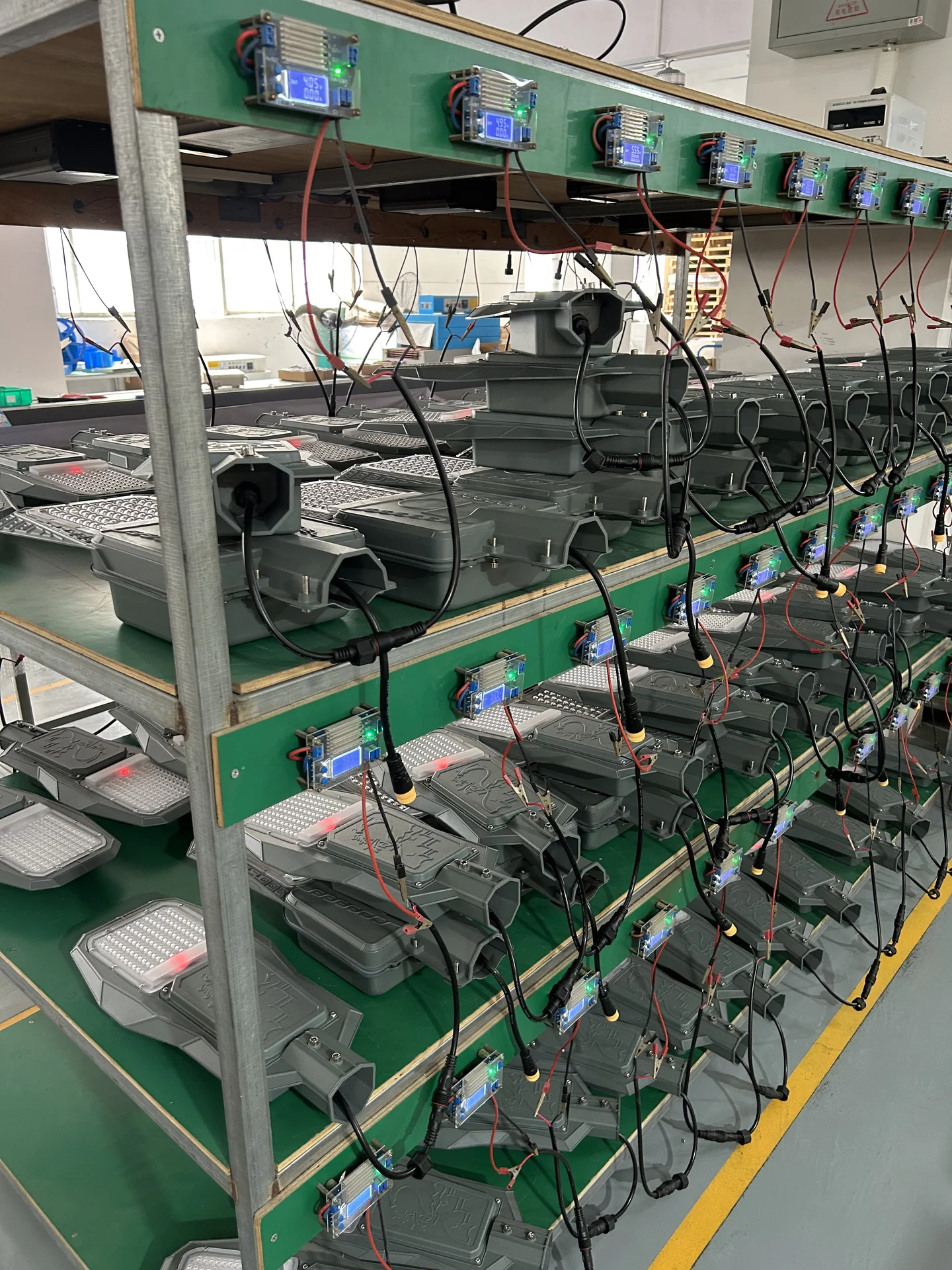
Figure 1: Dedicated electronic load aging test racks at MCL Solar. Each luminaire position is monitored by digital volt-ampere meters logging operational voltage (12.8V-25.6V DC) and drive current.
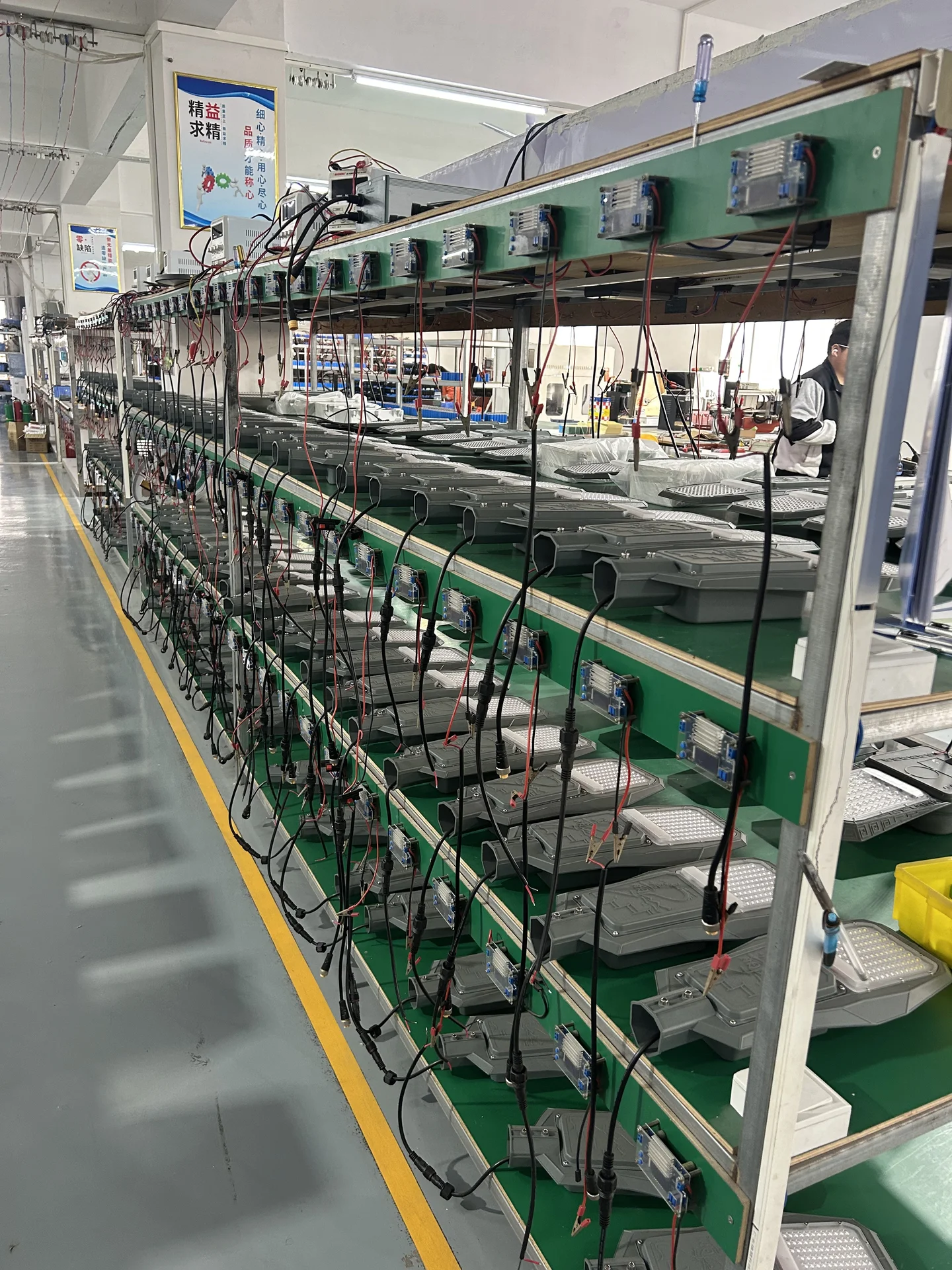
Figure 2: Multi-tier 48 to 72-hour full-load thermal burn-in aging workshop inside MCL Solar’s 35,000 m² smart production base in Guzhen, Zhongshan.
Audit standards required for institutional highway and municipal contracts:
- 100% Full-Load Thermal Burn-In: Every single luminaire must run continuously for a minimum of 48 hours (72 hours for highway EPC contracts) at maximum rated operational wattage before cartoning.
- Pulse Impact Switching Stress: Automated cycling switches power every 45 seconds on / 15 seconds off to simulate abrupt MPPT transitions and verify driver surge suppressors under thermal shock.
Factory Audit Protocol 2: In-House LiFePO4 Battery Pack Capacity Grading & Ri Sorting
The battery energy storage system accounts for 45% to 55% of the bill of materials. Spot-market workshops reduce quotation prices by sourcing unverified B-grade decommissioned EV cells or assembling uncalibrated cylindrical cells without thermal spacers.
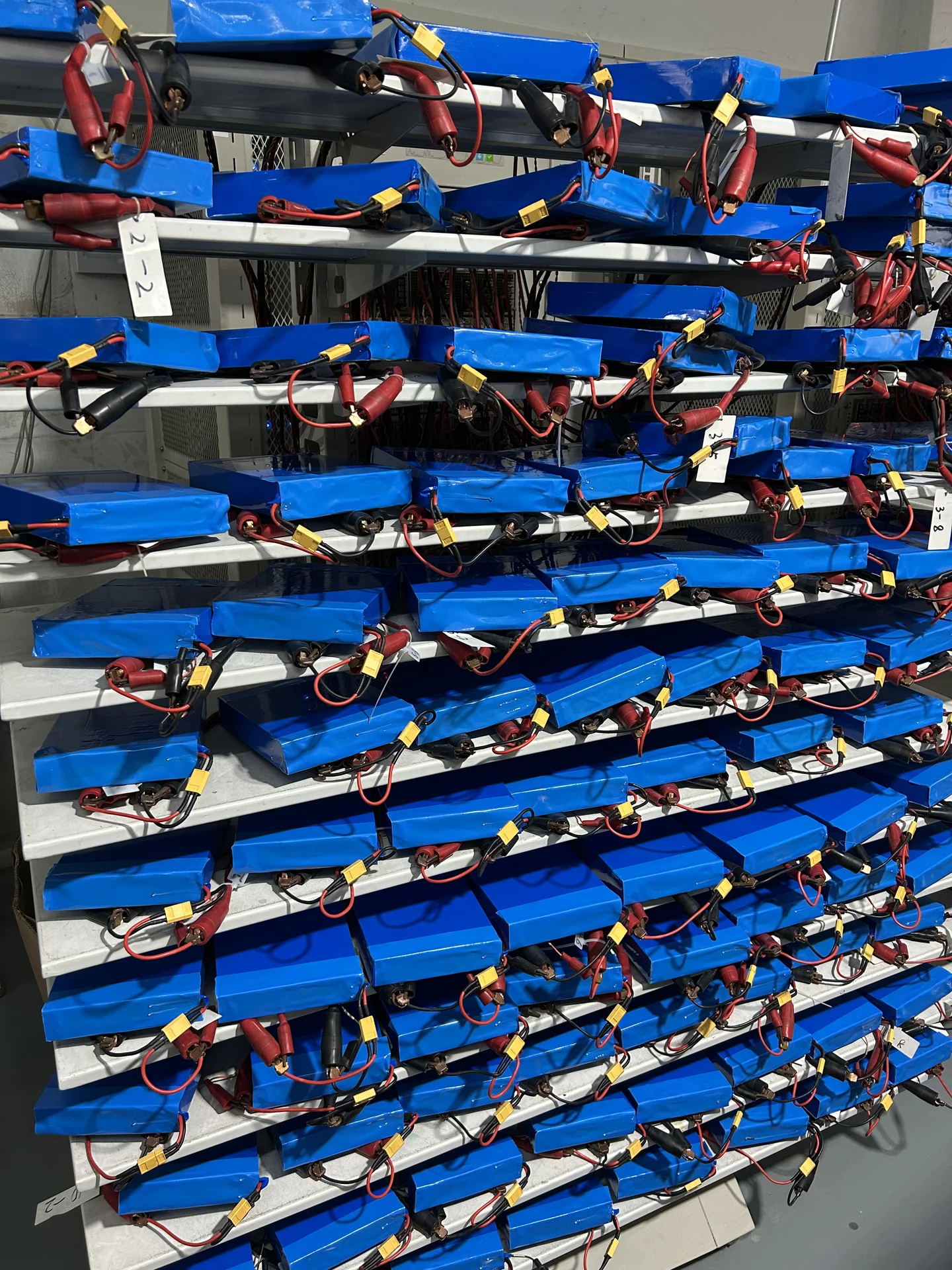
When inspecting a supplier’s battery assembly room, insist on reviewing raw grading telemetry:
- Four-Wire AC Internal Resistance (Ri) Sorting: Brand-new Grade-A cylindrical LiFePO4 32700 cells must show internal resistance variance within ±1.5 mΩ. Mixing unmatched internal resistance values causes uneven current distribution, localized heating, and premature battery bank shutdown.
- Automated Laser Spot Welding: Pure nickel interconnect plates must be laser-welded onto flame-retardant ABS/PC cellular holders with Highland barley insulating gaskets, preventing mechanical fatigue under wind vibration.
- Intelligent BMS Protection: Digital Battery Management Systems must incorporate dual NTC temperature sensors with high-temperature charging cutoff at +65°C and low-temperature cutoff at -20°C.
Factory Audit Protocol 3: Commercial Traceability & Real Procurement Records
A legitimate Tier-1 manufacturing partner provides verifiable commercial export documentation, official proforma invoices (PI), and third-party laboratory test files with matching company stamps. Intermediaries often present forged CE certificates or generic test reports borrowed from unrelated component vendors.
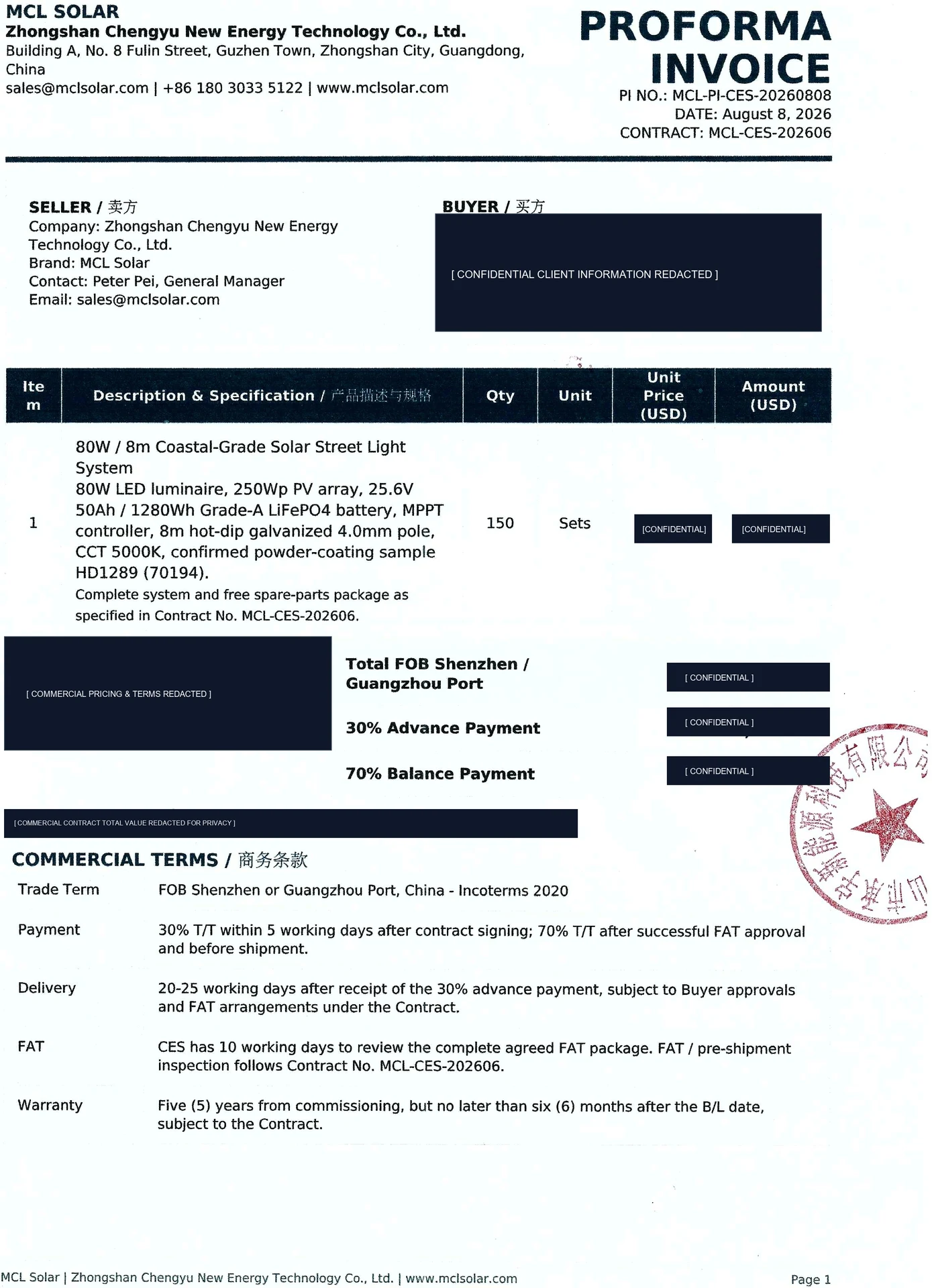
Figure 4: Official MCL Solar Proforma Invoice (Ref: MCL-PI-CES-20260808) for 150 Sets 80W/8M Coastal-Grade Municipal Solar Lighting Systems, demonstrating verified corporate execution and official seal.
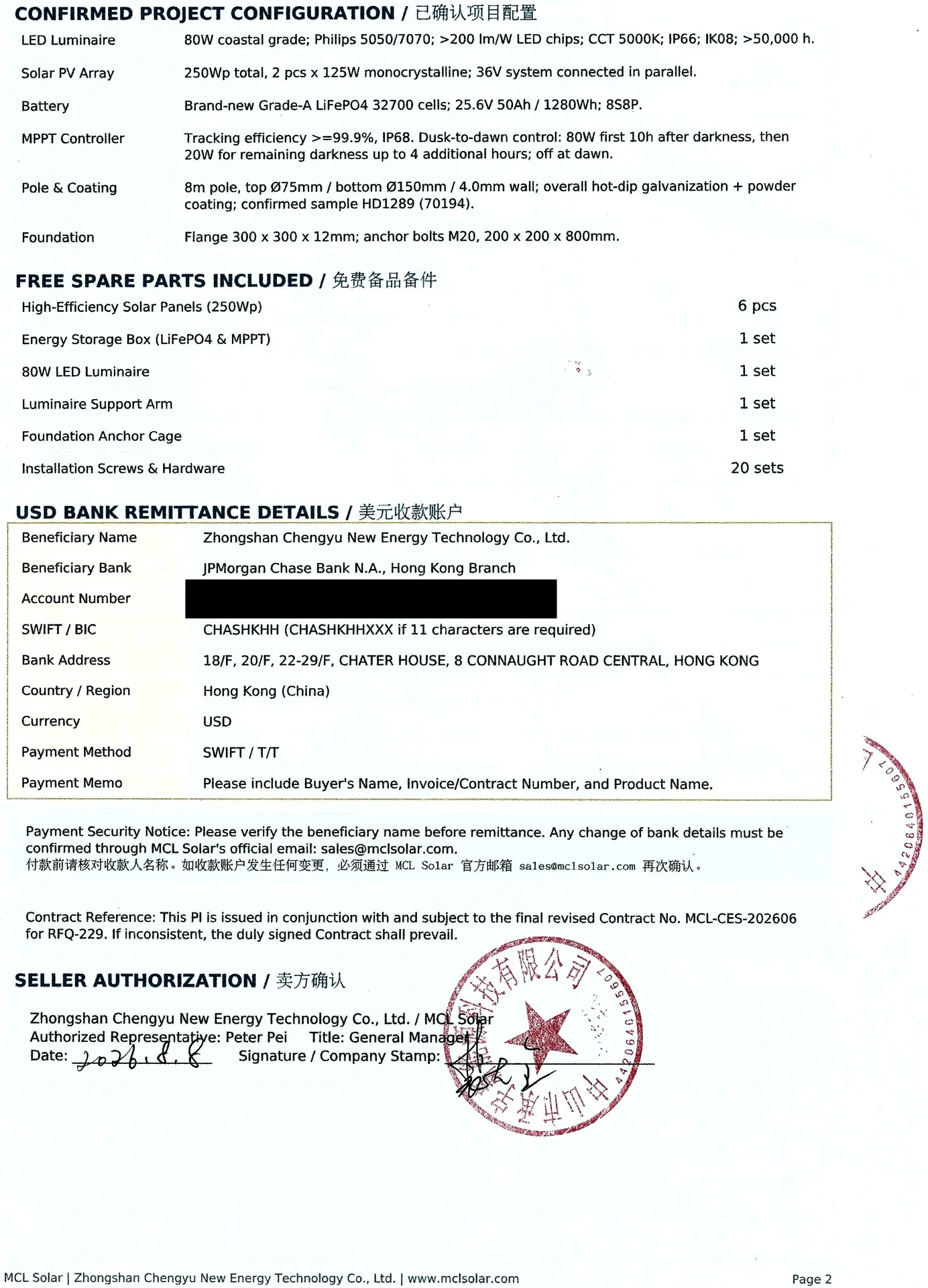
Figure 5: Confirmed project technical configuration dossier detailing Philips 5050/7070 LED chips (>200 lm/W), 250Wp bifacial solar arrays, 25.6V 50Ah Grade-A LiFePO4 packs, and 8m hot-dip galvanized poles.
Factory Audit Protocol 4: Container Staging & Export Staging Infrastructure
Physical plant throughput reveals itself clearly on the shipping dock. Export trading offices sublease shared urban warehouse space that cannot stage container-volume freight. MCL Solar operates dedicated container loading bays at Building A with overhead forklift cranes and heavy staging docks:
Video 1: Heavy-duty forklift container stuffing and palletized staging at MCL Solar factory Building A staging yard.
Video 2: High-volume commercial solar luminaire export container stuffing, featuring drop-tested 7-layer cartons and UN 38.3 Class 9 DG palletization.
Video 3: Comprehensive overview of MCL Solar’s 35,000 m² intelligent manufacturing base, staging docks, and commercial dispatch yard in Guzhen Town, Zhongshan.
High-Power Highway Lighting: The Engineering Boundary of All-in-One Lights
An experienced engineering manufacturer will never specify all-in-one solar luminaires where roadway physics require decoupled split infrastructure. For multi-lane highways, ring expressways, and port corridors needing 8m to 12m mounting heights, attempting to deploy integrated fixtures produces severe under-illumination and chronic battery starvation.
Under international highway specifications (CIE 115 / EN 13201 Class M1–M3), multi-lane arteries demand 15,000 to 26,000 lumens with asymmetric Batwing Type II-M/III-M beam distribution (Uo ≥ 0.40). For these demanding infrastructure projects, tender specifications mandate our flagship platform:
Tier-1 Municipal Highway Flagship Specification: MCL 8-12M Two-in-One Split
For municipal boulevards, multi-lane expressways, and high-wind coastal corridors, review the engineering dossier for MCL Solar’s dedicated highway platform:
Official Engineering Dossier: MCL Solar 8-12m Two-in-One Split Type High-Power Highway Solar Street Light. Featuring independent monocrystalline bifacial panels (up to 400W), aerodynamically separated ADC12 aluminum die-cast heat sinks, Grade-A LiFePO4 battery packs (>3,500 cycles @ 80% DOD), intelligent digital MPPT controllers (>99% efficiency), and Everfine GO-3000H darkroom certified IES distribution files.
Source-Factory Partnership & Factory Audit Scheduling
Evaluating the top commercial solar street light manufacturers in China determines whether a municipal project operates maintenance-free for a decade or fails within two seasons. MCL Solar (Zhongshan Chengyu New Energy Technology Co., Ltd.) welcomes international procurement delegations, public works ministries, and accredited third-party audit agencies (SGS, Bureau Veritas, TÜV) to inspect our 35,000 m² manufacturing plant.
Schedule an On-Site Factory Tour or Request Tender Dossiers
Contact our Chief Engineering Office directly to arrange an on-site factory audit in Guzhen, request certified DIALux simulation files, or obtain comprehensive ISO/IEC qualification packages.
Direct Engineering WhatsApp: +86 180 3033 5122
Official Project Portfolio: Explore Global MCL Solar Municipal Infrastructure Projects →