
For municipal transport authorities, highway concessionaires, and civil engineering EPC contractors, proper highway solar street light sizing represents the critical difference between compliant, decade-long roadway safety and catastrophic nighttime blackouts or pole structural collapse. While residential and secondary access roads can function with compact integrated lights, multi-lane expressways, intercity arterial corridors, and high-speed bypasses impose non-negotiable optical, electrical, and mechanical criteria under international standards such as EN 13201 (Road Lighting) and IESNA RP-8.
Generic all-in-one commercial fixtures routinely fail on arterial corridors because their fixed horizontal solar panels cannot be tilted toward optimal solar azimuth angles, their small internal batteries overheat at the pole top (exceeding 60°C under summer solar radiation), and their total luminous flux is physically capped below 12,000 lumens—leaving highway surfaces far below minimum required luminance levels.
To establish an engineering benchmark for global municipal tenders, MCL Solar provides this comprehensive technical sizing whitepaper based on empirical field telemetry and certified manufacturing protocols from our 35,000 m² Zhongshan manufacturing headquarters.
1. Photometric Illuminance Standards & Luminaire Optical Sizing (EN 13201 Class M1–M3)
In high-speed transportation corridors (60 km/h to 120 km/h), vehicle braking distances require continuous roadway luminance uniformity to eliminate driver visual fatigue and blind spots. Under European standard EN 13201 for motorway classifications M1 through M3, lighting systems must achieve:
- Average Road Surface Luminance (Lavg): ≥ 1.5 cd/m² to 2.0 cd/m².
- Overall Uniformity (Uo = Lmin / Lavg): ≥ 0.40.
- Longitudinal Uniformity (Ul = Lmin / Lmax): ≥ 0.70 along lane centerlines.
- Threshold Increment (TI – Glare Mitigation): ≤ 10% to 15%.
To satisfy these metrics at pole mounting heights of 8 meters, 10 meters, and 12 meters with pole spacing of 35 to 45 meters, luminaires must produce between 18,000 lumens and 32,000 lumens of usable downward light. MCL Solar achieves this with project-grade modular die-cast aluminum luminaires utilizing high-flux Bridgelux 5050 / 7070 LED arrays delivering certified optical efficiency up to 208.96 lm/W.
Figure 1: Quality assembly and optical lens inspection of MCL Solar 150W high-power highway split luminaire with Type II-M batwing distribution at our Zhongshan facility.
Batwing Optical Distribution vs Generic Symmetrical Lenses
Generic street lights emit round, conical light pools that produce severe bright circles beneath the pole and pitch-black zones between poles. MCL Solar utilizes precision multi-cavity PMMA optical lenses engineered with Type II-M and Type III-M batwing distributions. This spreads the beam laterally across 3 to 4 highway lanes and longitudinally across 40 meters, ensuring zero light trespass into adjacent green belts while maximizing road surface luminance uniformity.
2. Electrical Architecture: 25.6V High-Voltage Battery Storage & Daily Autonomy Sizing
One of the most consequential engineering decisions in highway solar street light sizing is operating system voltage. While low-cost commercial vendors rely on 12.8V systems, delivering 150W to 200W of power at 12.8V requires currents between 12A and 16A. Over a 10-meter to 12-meter pole height, this causes severe Joule heating (I²R copper losses), exceeding 8% to 12% of total generated solar energy.
MCL Solar standardizes high-power highway split systems on a 25.6V nominal architecture:
- 50% Current Reduction: Halving current cuts transmission resistive line losses by 75% (Ploss = I²R).
- Controller Efficiency: High-voltage digital MPPT controllers achieve >99.2% peak tracking efficiency, reducing thermal stress on internal MOSFETs.
- Battery Chemistry: Built exclusively with 100% Brand-New Grade-A LiFePO4 (Lithium Iron Phosphate) prismatic cells certified for >3,500 charge cycles at 80% Depth of Discharge (DOD).
Figure 2: Automated packing, BMS telemetry calibration, and burn-in load testing of 25.6V LiFePO4 battery modules in the MCL Solar energy storage department.
Mathematical Energy Autonomy Formula
To guarantee 3 to 5 consecutive overcast or rainy days without lighting failure (100% DOD lockout prevention), total battery capacity is calculated as:
Ebattery (Wh) = [PLED (W) × tnight (hours) × Nautonomy (days)] / [DODmax × ηmppt × ηdriver]
Worked Example for 10-Meter Highway Pole (150W LED, 12h nightly operation, 3 autonomy days):
- Daily Energy Consumption: 150W × 12 hours = 1,800 Wh/night.
- Total Required Stored Energy (3-day buffer, 85% DOD, 92% combined system efficiency): 1,800 Wh × 3 / (0.85 × 0.92) ≈ 6,905 Wh (25.6V 270Ah).
- Photovoltaic Array Sizing: 6,905 Wh / (4.2 Peak Sun Hours × 0.82 system PR) ≈ 550W–600W Tier-1 Monocrystalline N-Type TOPCon module.
Generic all-in-one lights with 600Wh batteries and 100W panels fall 75% short of this engineering requirement, explaining why commercial fixtures black out by midnight after a single overcast day.
3. Structural Engineering: 160 km/h Wind Resistance & ASTM A123 Hot-Dip Galvanization
Unlike slender conventional utility poles that only support small light fixtures, solar roadway poles carry massive top-mounted sails: a 550W–600W PV module possesses a surface area exceeding 2.8 m². At wind velocities of 160 km/h (44.4 m/s), aerodynamic drag exerts bending moments exceeding 18,500 N·m (18.5 kN·m) at the base flange.
Figure 3: Full-immersion hot-dip galvanizing process of Q235/Q345 structural steel lighting poles at 450°C in our certified zinc bath, achieving metallurgical alloy bonding ≥86μm.
Q235/Q345 Hot-Dip Galvanization vs Cold Electroplating
To eliminate subsurface galvanic corrosion in coastal marine (C4/C5-M) corridors:
- Molten Zinc Immersion (ASTM A123 / ISO 1461): Steel columns undergo automated degreasing, multi-tank acid pickling, rinsing, fluxing, and molten zinc immersion at 450°C. Internal and external zinc coating thickness exceeds 86 μm (vs <25 μm on electroplated commercial tubing), providing a 30-year design life.
- Submerged Arc Longitudinal Welding (AWS D1.1): 100% penetration weld seams inspected via ultrasonic non-destructive testing (NDT), preventing crack initiation under dynamic aerodynamic vortex shedding.
- Reinforced Anchor Flange Base: Flange plates of 20 mm to 24 mm thickness reinforced with 8 triangular gusset stiffeners, anchored by high-tensile J-bolts embedded in C30/37 concrete footings.
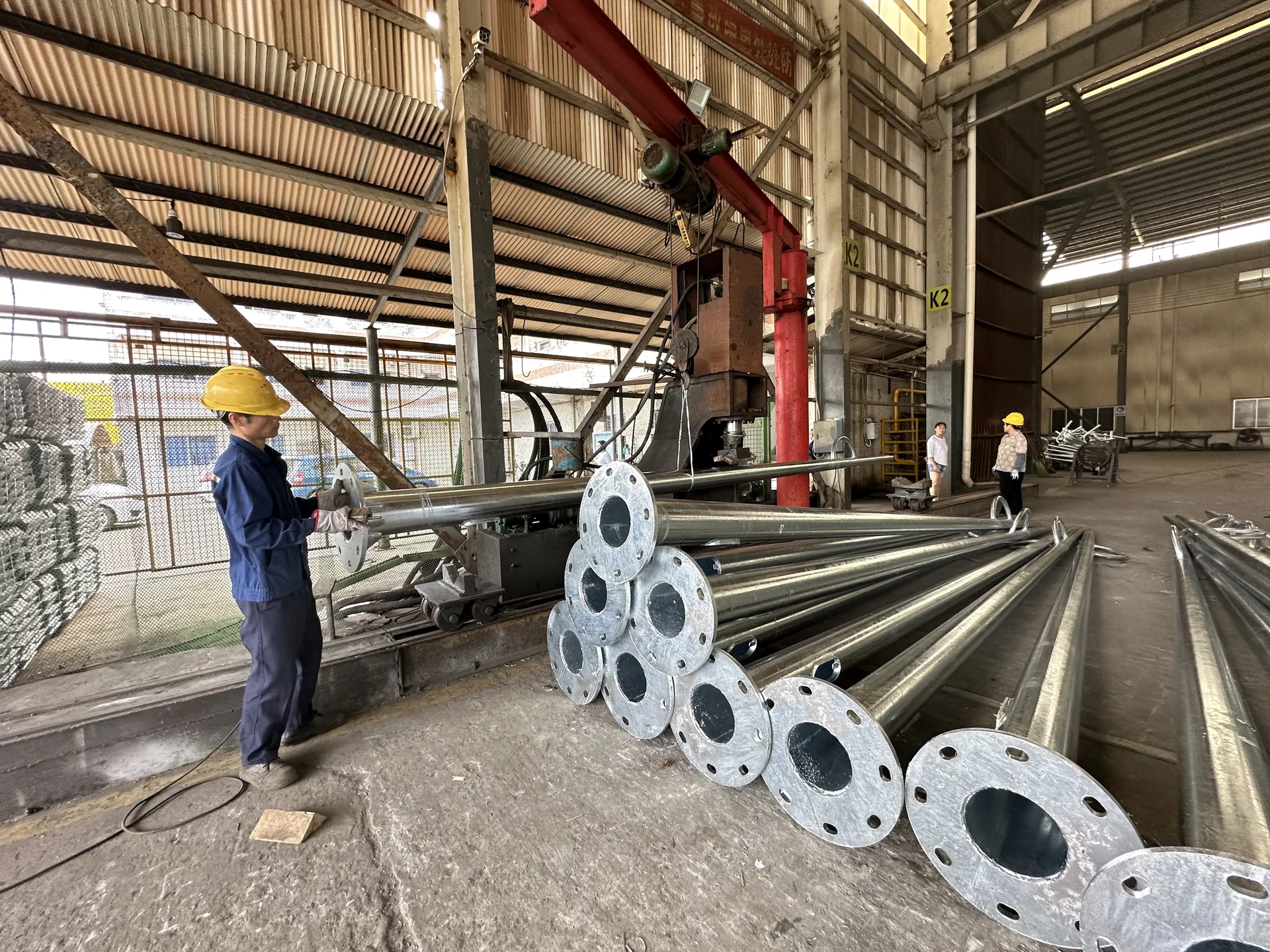
Figure 4: Quality engineering inspection of 8-12M conical lighting poles with heavy-duty anchor flanges and hot-dip galvanized finish at the MCL Solar factory.
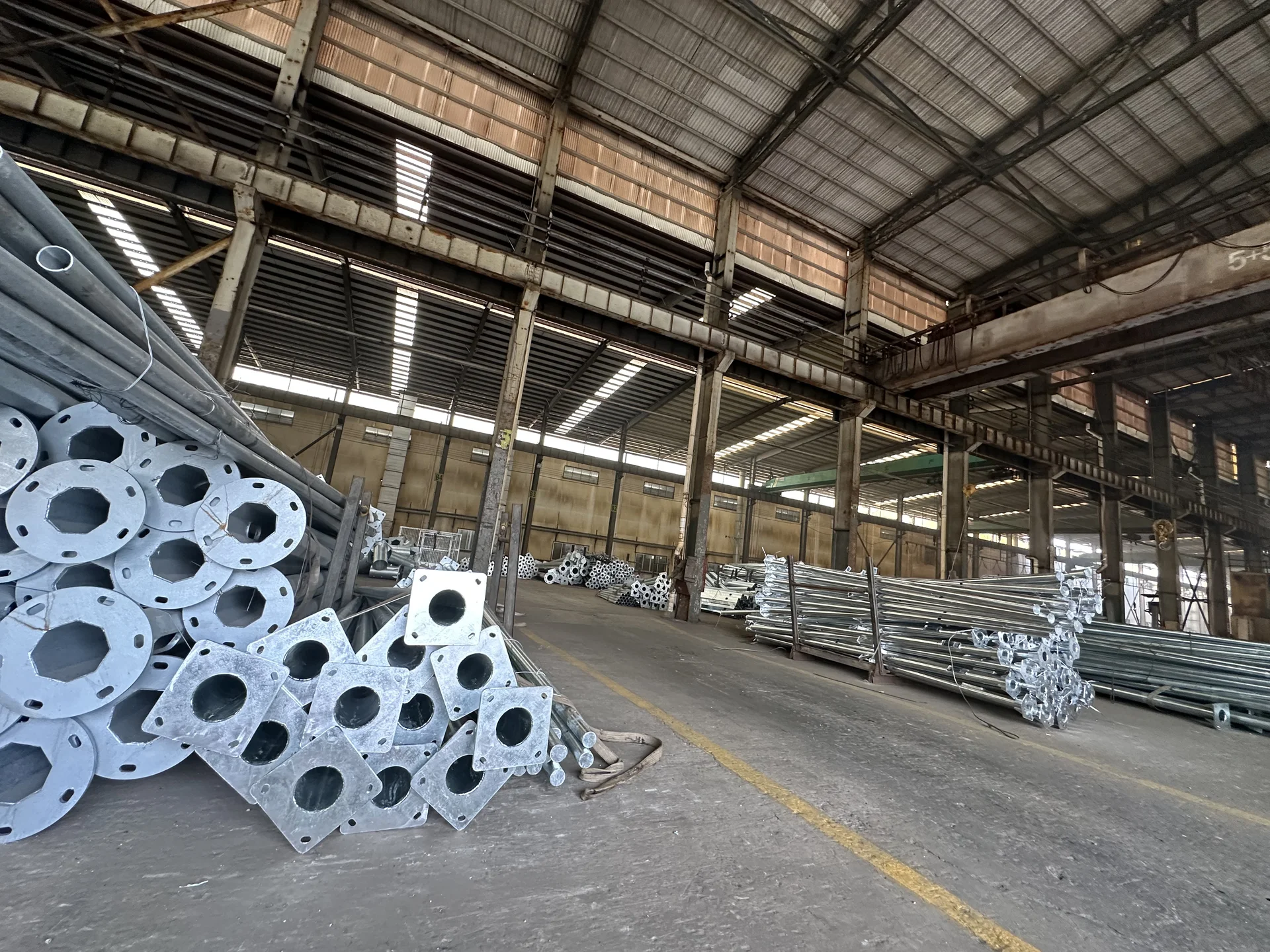
Figure 5: Large-scale municipal inventory staging inside MCL Solar’s 35,000m² manufacturing warehouse, ready for export containerized shipment.
4. Technical Comparison Matrix: Commercial Assemblers vs MCL Solar Municipal Split-Type System
| Technical Specification | Generic All-In-One Commercial | Regional Reseller Assembled | MCL Solar Flagship 8-12M Split-Type |
|---|---|---|---|
| Recommended Application | Gardens, pathways, 4-6M paths | Rural roads, secondary lanes | 8-12M Expressways, Arterials, Harbors |
| Luminous Output & Efficacy | 6,000 – 12,000 lm (120 lm/W) | 12,000 – 16,000 lm (140 lm/W) | 18,000 – 32,000 lm (208.96 lm/W real) |
| Roadway Optical Distribution | Circular conical (No batwing) | Generic Type II (Uncalibrated) | Batwing Type II-M / III-M (DIALux verified) |
| System Architecture & Voltage | 3.2V / 12.8V Low Voltage | 12.8V Standard | 25.6V High-Efficiency Architecture |
| Battery Life & Thermal Protection | Pouch / Recycled cells (<1,000 cyc) | Standard LiFePO4 (2,000 cycles) | Grade-A LiFePO4 >3,500 cyc + MCL-HTBS™ |
| Wind Resistance & FEA Stress | Unverified (Fails <100 km/h) | Theoretical 120 km/h | 160 km/h Certified (EN 40-3-2 & Eurocode 1) |
| Galvanizing Standard | Cold electroplate (<20 μm) | Hot-dip galvanized (<50 μm) | ASTM A123 / ISO 1461 Hot-Dip (≥86 μm) |
5. Tender Specifications, Official Dossiers & Direct Engineering Consultation
When preparing municipal expressway tenders or reviewing EPC bid submissions, demand verified DIALux illuminance calculations, ASTM A123 zinc thickness certifications, and LM-80/TM-21 LED lifespan dossiers. Never deploy undersized all-in-one residential lights on multi-lane transportation arteries.
🚀 Official Highway Infrastructure Product Solutions & Engineering Portals:
- Explore the Flagship 8-12M Highway System: MCL Solar 8-12M Two-in-One Highway Solar Street Light System
- Global Project Dossier & Case Studies: MCL Solar Official Global Engineering Projects
- Pole Engineering Standards: Solar Street Light Pole Wind Resistance & Hot-Dip Galvanization Whitepaper
- Manufacturing Scale: Certified 35,000 m² Integrated Industrial Base in Guzhen, Zhongshan, China.
- Direct EPC Technical Consultation WhatsApp: +86 180 3033 5122
- Official EPC Email: info@mclsolar.com