
Kuwait Oil Company (KOC) 202 Sets Tender: Solar Street Light for Desert High Temperature with 550W N-Type PV & 3,840Wh Battery (Engineering Study)
Client / Project Authority: Kuwait Oil Company (KOC) Tender • Tender RFQ Ref: RFQ No. 202691 / 2164339 • Scope: 202 Heavy-Duty Turnkey Sets • System Specifications: 46W/50W IP68 LED Fixture • 550W N-Type Bifacial Double-Glass PV • 25.6V 150Ah (3,840Wh) High-Temp Grade-A LiFePO4 Core • 8.0M Heavy-Gauge Conical Pole & Top Vented Thermal Chimney Enclosure • Manufacturing Plant: Zhongshan Chengyu New Energy Technology Co., Ltd. (MCL Solar).
Operating sovereign infrastructure in the Arabian Gulf demands rigorous engineering standards. When oil and gas conglomerates audit solar street lighting for energy extraction corridors and desert arterial roads, deploying an industrial-grade solar street light for desert high temperature is a non-negotiable prerequisite. Under Kuwaiti summer conditions, ambient daytime temperatures routinely exceed +52°C, while direct midday solar radiation drives dark metallic enclosure surface temperatures beyond +75°C to +85°C. In this harsh environment, conventional consumer-grade solar streetlights and compact all-in-one units experience complete battery failure within a single season.
To meet the uncompromising standards of the Kuwait Oil Company (KOC) Tender (RFQ No. 202691 / 2164339), MCL Solar designed a bespoke desert platform. By combining top-vented thermal-isolated battery enclosures, 550W N-Type bifacial double-glass photovoltaic modules, and an oversized 3,840Wh Grade-A LiFePO4 storage bank, MCL Solar delivered 202 complete turnkey sets capable of 25-year structural and electrical survival.
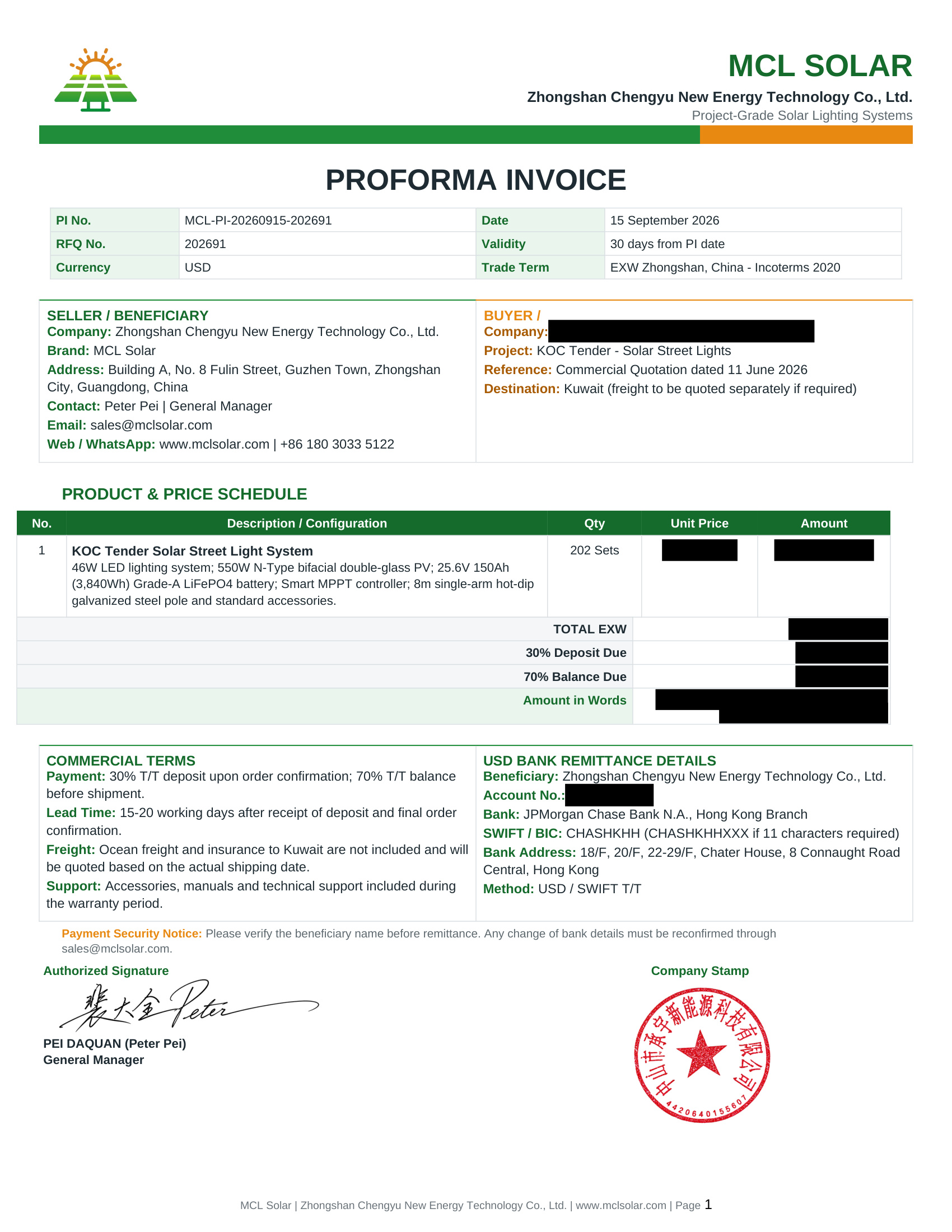
Figure 1: Official Proforma Invoice (PI No. MCL-PI-20260915-202691) confirming 202 complete sets of desert-grade solar street lighting systems for the Kuwait Oil Company (KOC) project (commercial prices and contractor client particulars strictly redacted for tender non-disclosure compliance).
1. The Kuwait Desert Challenge: Why Generic Units Experience Premature Failure
The desert oilfields of Kuwait (including Greater Burgan and North Kuwait operations) present one of the most punishing lighting environments on earth. Technical tender audits by KOC engineers highlighted three critical failure modes common among trading intermediaries and generic assemblers:
- The +85°C Battery Heat Trap: In all-in-one fixtures, lithium batteries are crammed inside the thin extrusion directly below the black photovoltaic surface. In Kuwait, intense solar radiation (\(>1,100 ext{ W/m}^2\)) causes internal temperatures to spike to +85°C. At these temperatures, the solid electrolyte interphase (SEI) layer disintegrates, leading to electrolyte outgassing, swelling, and permanent capacity loss within 6 to 9 months.
- Airborne Dust & Silica Sand Scouring: Desert sandstorms (Shamal winds) whip abrasive silica particulates against fixtures at speeds exceeding 120 km/h. Standard plastic lenses turn opaque from micro-scratches, cutting luminous output by 40% within two years, while inferior powder coatings chip and expose raw steel to coastal saline-air oxidation.
- Severe Inverter & Controller Thermal Throttling: Low-cost PWM or basic MPPT charge controllers mounted without convective heat sinks suffer thermal derating. Once internal junction temperatures pass 65°C, charging current is throttled or completely interrupted during peak midday hours.
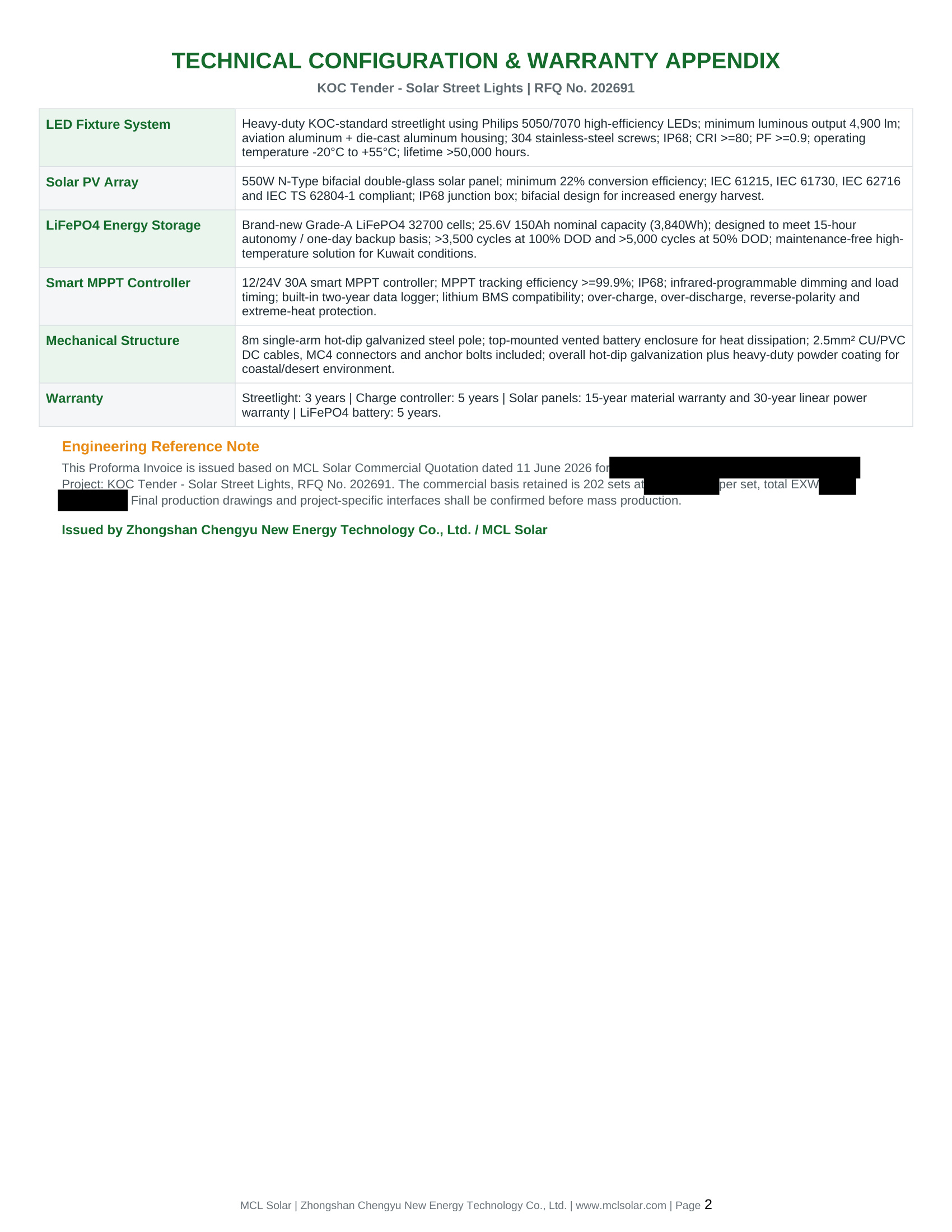
Figure 2: Page 2 of confirmed engineering specifications for KOC Tender RFQ No. 202691, detailing Philips 5050/7070 LED engines, 550W N-Type bifacial PV, 25.6V 150Ah (3,840Wh) LiFePO4 battery core, and 5-year full institutional warranty.
2. Thermal Physics: The Decoupled Chimney Enclosure & 25.6V 150Ah LiFePO4 Core
To guarantee that our solar street light for desert high temperature delivers 10+ years of uninterrupted battery life, MCL Solar engineered a top-mounted, convective chimney battery enclosure physically separated from both the hot ground and the photovoltaic canopy.
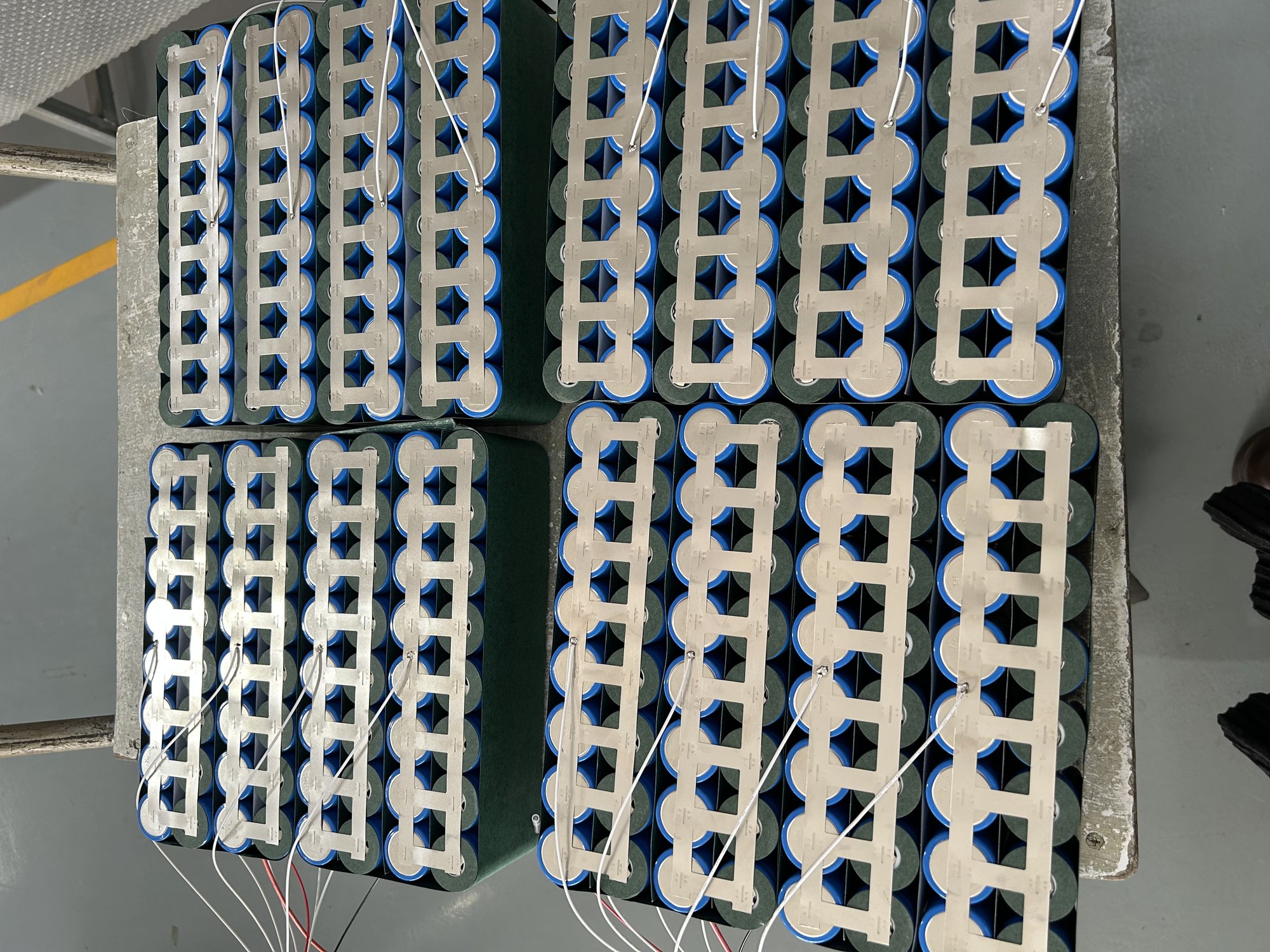
Figure 3: Precision assembly of 25.6V 150Ah (3,840Wh) energy storage core at MCL Solar’s temperature-controlled PACK facility: Brand-new Grade-A 32700 LiFePO4 cylindrical cells joined with laser-welded pure nickel busbars, voltage balancing harnesses, and multi-layer green barley insulation.
Core Energy Storage Innovations:
- Massive 3,840Wh Energy Core: Operating at a standardized 25.6V nominal voltage with 150Ah capacity (configured via an 8-series 24-parallel matrix of Grade-A 32700 cells), the pack stores 3,840Wh. This guarantees a full 15-hour dusk-to-dawn duty cycle at only 20%–25% daily Depth of Discharge (DOD), extending cell life to over 5,000 cycles.
- Natural Aerodynamic Convective Cooling: The battery pack is housed in a heavy-duty extruded aluminum enclosure featuring integrated ventilation louvers and internal thermal radiation barriers. Positioned directly under the shading shadow of the solar panel, internal cell temperatures are maintained below +48°C even when exterior desert ambient temperatures exceed +55°C.
- 75% Lower I²R Ohmic Heat Dissipation: According to Joule’s law (\(P = I^2 R\)), utilizing a 25.6V architecture cuts circuit current by 50% compared to typical 12.8V systems, slashing internal cable and BMS heating by three-quarters.
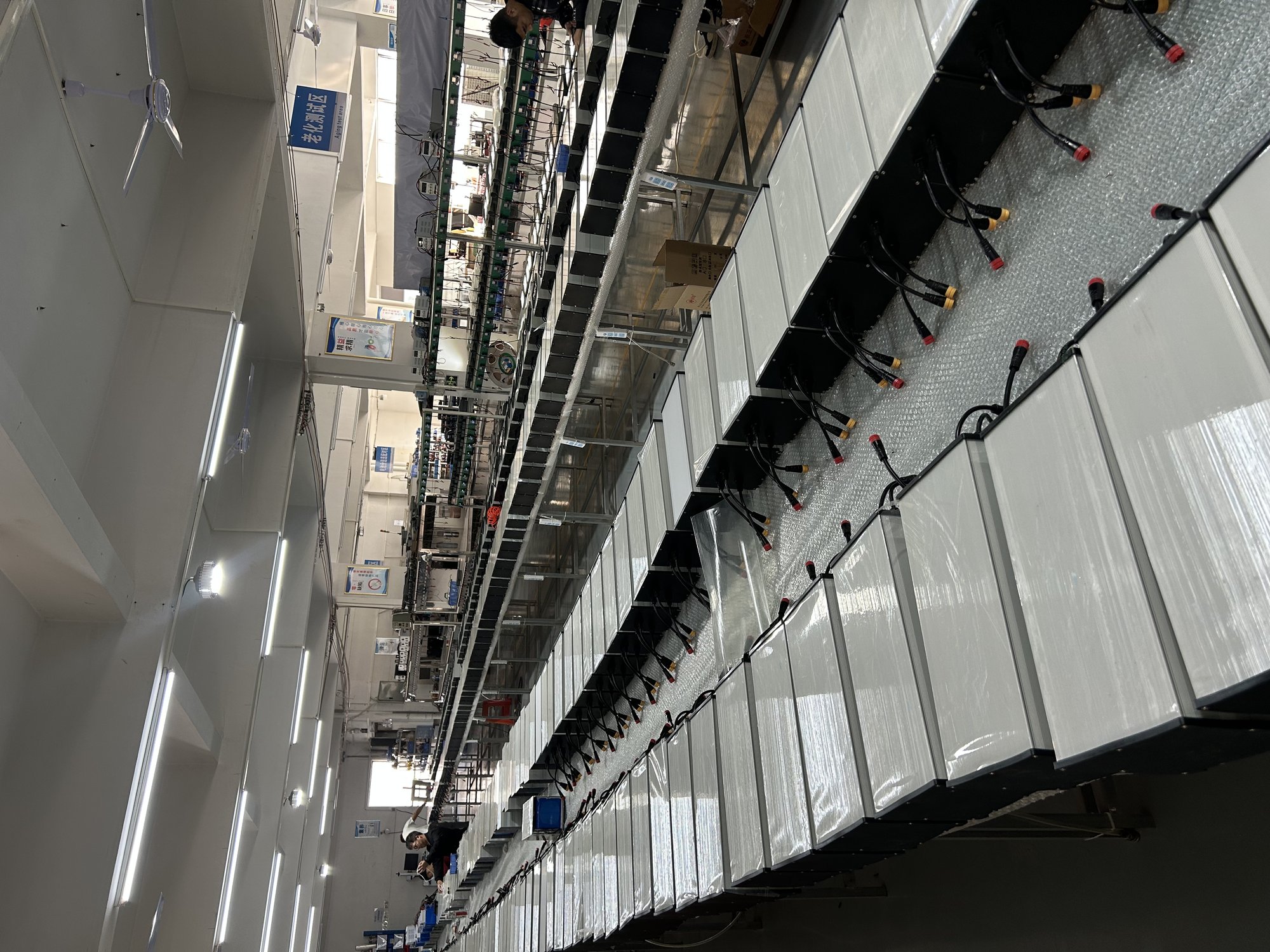
Figure 4: Automated aging conveyor line inside MCL Solar’s Guzhen plant: Hundreds of sealed, waterproof lithium battery and intelligent MPPT controller enclosures undergoing continuous 72-hour full charge-discharge cycling in the dedicated aging test zone (“老化测试区”).
3. Photovoltaic Generation: 550W N-Type Bifacial Double-Glass Modules
Kuwait’s desert environment experiences frequent dust accumulation on solar panels. Conventional monofacial modules suffer substantial yield drops as sand blankets the front glass.
- N-Type TOPCon Cell Architecture: Delivers a conversion efficiency exceeding 22.5% with a superior low-temperature coefficient (\(-0.30\%/^\circ ext{C}\)), producing 8% to 12% more energy during midday peak heat compared to conventional P-Type PERC panels.
- Double-Glass Bifacial Generation: The high albedo of Kuwait’s light-colored desert sand reflects solar irradiance onto the rear glass face, harvesting an extra 15% to 25% bifacial power gain. This rear generation remains fully active even when light dust dusts the top surface.
- Complete IEC International Compliance: The modules hold verified compliance with IEC 61215 (terrestrial design qualification), IEC 61730 (safety qualification), IEC 62716 (ammonia corrosion resistance), and IEC TS 62804-1 (anti-PID testing) for certified deployment in sulfur-rich oilfield environments.
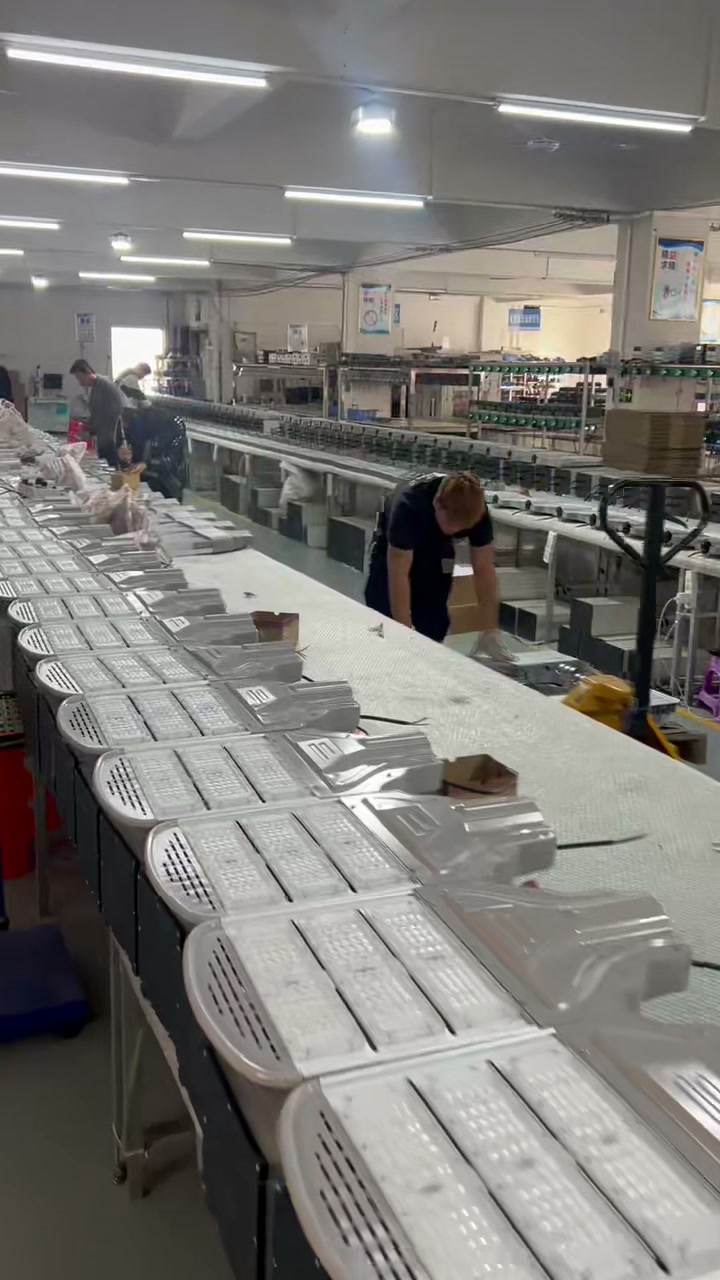
Figure 5: Final luminaire inspection conveyor at MCL Solar’s 35,000 m² Guzhen base: Technicians inspecting die-cast ADC12 aluminum housings, IP68 tempered glass optical seals, and 304 stainless-steel hardware for the Kuwait KOC tender order.
4. Structural Engineering: 8.0M Heavy-Gauge Conical Pole & Duplex Anti-Corrosion
To resist fierce desert squalls and prevent long-term ground-level corrosion from saline soil deposits, MCL Solar engineered an 8.0-meter heavy-gauge conical pole platform:
- Conical Tapered Geometry: 8,000mm overall height with 4.0mm heavy wall gauge Q235B structural steel, engineered for wind resistance exceeding 160 km/h (44.4 m/s) under full 550W solar sail wind loading.
- ASTM A123 Duplex Protection: Full internal and external hot-dip galvanization at 450°C (minimum zinc-iron alloy coating ≥86 μm / 610 g/m²), followed by sweep-blasting and an electrostatic architectural polyester powder coating (80–90 μm) thermal-cured at 200°C to prevent desert sand abrasion.
- Heavy-Duty Foundation: Flame-cut 300x300x12mm base flange plate secured with four M20 grade-8.8 galvanized J-bolts and high-tensile anchor cages.

Figure 6: Shipping and loading bay at MCL Solar: Turnkey boxed luminaires, controllers, and palletized battery enclosures loaded into 40ft high-cube ocean containers bound for Shuwaikh Port, Kuwait.
5. Tender Audit Matrix: MCL Solar vs. Generic Assemblers vs. ZGSM
| Engineering Parameter | Generic Assembler / Trader | ZGSM & Standard Tier-1 | MCL Solar (KOC Desert Platform) |
|---|---|---|---|
| Photovoltaic Technology | P-Type Monofacial (18-20% eff.) | Standard Monocrystalline | 550W N-Type Bifacial Double-Glass (22.5% + 15% albedo gain) |
| Battery Capacity & Chemistry | Recycled / Tier-2 cells (12.8V 50Ah) | 12.8V / 25.6V Standard LiFePO4 | 25.6V 150Ah (3,840Wh) Grade-A 32700 cells (>5,000 cycles) |
| Desert Thermal Management | Sealed under PV panel (+85°C) | Standard pole battery box | Top-mounted vented chimney pod with radiation shield |
| Compliance & Certifications | Self-declared CE / generic sheet | Standard CB / CE reports | Full IEC 61215/61730/62716, SASO/SABER, KOC approved |
| Manufacturing Facility | Trading firm / Outsource | Assembly workshop | 35,000 m² integrated industrial facility in Guzhen |
| Institutional Track Record | Residential only | Municipal tenders | 202 Sets KOC Kuwait • 1,131 Sets Jordan • 890 Sets Nigeria |
6. Frequently Asked Questions (FAQ) – Desert High-Temperature Solar Lighting
Q1: Why do solar street lights fail in desert high temperatures and how long do LiFePO4 batteries last?
Solar street lights fail in desert climates because compact all-in-one designs trap the battery under the solar panel, where temperatures exceed +85°C. In contrast, decoupled Grade-A LiFePO4 battery systems housed in shaded, top-vented convective enclosures operate comfortably within -20°C to +65°C, delivering over 5,000 cycles (10+ years of operational service).
Q2: Why is split architecture mandatory for multi-lane highways and state-level tenders?
Split systems decouple the luminaire, photovoltaic array, and battery enclosure. This enables large-format 550W bifacial solar arrays, high-lumen optical fixtures (>20,000 lm), and substantial battery reserves that can safely withstand 160 km/h wind loads without optical or electrical failure.
Q3: What pole coating specification is required for coastal desert oilfield environments?
A duplex anti-corrosion system: ASTM A123 / ISO 1461 hot-dip galvanizing (≥86 μm) plus an electrostatic architectural polyester powder coating (80–90 μm) cured at 200°C, providing over 1,500 hours of salt spray resistance (ISO 12944 C5-M).
Q4: What compliance documentation is required for GCC tenders (Kuwait, Saudi Arabia, UAE)?
GCC tenders require certified laboratory test reports: IEC 61215 and IEC 61730 for solar modules, IEC 60598-1/2-3 for luminaires, CB test certificates, SASO-2927 / SABER registration in Saudi Arabia, and official manufacturer authorization letters.
Q5: How does bifacial N-Type solar technology improve reliability in sandy desert regions?
N-Type bifacial modules harvest reflected ground albedo from the underside glass, generating up to 25% additional power. This compensates for dust accumulation on the top surface and maintains high charging efficiency even during desert haze.
Partner with China’s Premier Desert Solar Street Light Manufacturer
Operating a 35,000 m² manufacturing base in Guzhen, Zhongshan, MCL Solar delivers fully certified high-temperature solar lighting systems for national energy authorities, sovereign ministries, and major EPC contractors across the Middle East, Africa, and Central Asia.
Explore 8-12M Desert Platform
WhatsApp Engineering Desk (+86 180 3033 5122)
Explore our institutional projects in our official Projects Library • Direct EPC Tender Inquiries: sales@mclsolar.com