
Key Takeaways
- Battery chemistry matters: LiFePO4 (lithium iron phosphate) batteries, used in MCL Solar products, are more tolerant to heat and humidity than traditional lead-acid or NMC batteries.
- Heat accelerates degradation: For every 10°C above 25°C, battery lifespan can be cut by up to 50%, making thermal management essential in tropical climates.
- Humidity causes corrosion: High humidity and condensation can damage battery terminals and controller electronics unless the system is sealed and rated for outdoor use.
- Real-world validation: MCL Solar installations in the Philippines (tropical humidity) and Kazakhstan (extreme cold) demonstrate that proper battery selection and system design mitigate temperature-related risks.
- Smart controllers optimize life: Intelligent MPPT controllers with temperature compensation help maintain battery health across varying operating conditions.
1. Introduction
If you are planning a solar street lighting project in a tropical or humid region, you are likely wondering: How will the local climate affect my battery’s lifespan? Heat and humidity are the two most common environmental stressors that reduce lithium battery performance in solar street lights. Yet, many system specifications ignore these factors, leading to premature failures, costly replacements, or poor nighttime illumination.
This article explains exactly how operating temperature and humidity affect solar street light battery life, what design strategies address these risks, and what you should look for when selecting a system for hot, humid environments. We will draw on real project evidence, including MCL Solar installations in tropical Philippines and cold Kazakhstan climates, to show how proper battery chemistry and controller technology extend service life.
2. How Heat Accelerates Battery Degradation
Core Conclusion
Elevated temperatures increase internal chemical reaction rates inside lithium batteries, which speeds up capacity loss and shortens cycle life. For solar street lights operating under direct sun, battery compartment temperatures frequently exceed 40°C–50°C, causing accelerated aging.
The Science Behind It
Lithium batteries, including LiFePO4, are designed to operate optimally between 20°C and 30°C. At higher temperatures:
- Self-discharge increases: Stored energy leaks away faster, reducing usable capacity.
- SEI layer breakdown: The solid-electrolyte interphase (SEI) layer deteriorates, consuming lithium irreversibly.
- Side reactions accelerate: Electrolyte decomposition and gas generation shorten battery life.
A general rule of thumb: for each 10°C rise above 25°C, battery cycle life is reduced by roughly 30–50%. This means a battery rated for 5,000 cycles at 25°C may only deliver 2,500 cycles at 45°C.
Practical Recommendation
- Choose batteries with a high tolerance for elevated temperatures. LiFePO4 chemistry is inherently more stable than NMC or lead-acid.
- Look for battery enclosures that provide thermal insulation or ventilation. MCL Solar’s all-in-one street light designs integrate the battery within a weatherproof housing that limits direct solar heat gain.
- Use temperature-compensated MPPT controllers, which adjust charge voltage based on cell temperature to prevent overcharging in heat.
3. How Humidity and Moisture Damage Batteries
Core Conclusion
High humidity environments, such as the tropical Philippines (relative humidity often above 80%), promote condensation inside the battery compartment. This moisture can cause corrosion of battery terminals, short circuits in the battery management system (BMS), and accelerated aging of seals.
Real-World Scenario
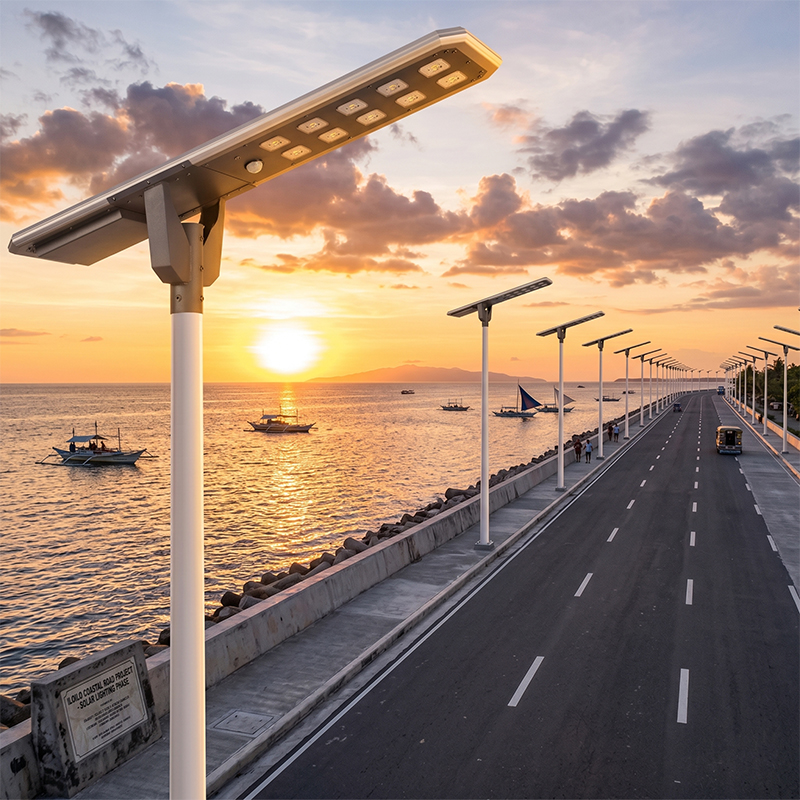
Consider the MCL Solar project in Bohol, Philippines. The tourism highway installation uses 100W all-in-one solar lights with Grade-A LiFePO4 batteries. The primary environmental challenge was tropical humidity. The solution was an integrated design that sealed the battery compartment from moisture ingress. Without proper sealing, condensation alone can reduce battery lifespan by 20–40% within two years.
What Happens Inside
- Condensation forms on battery terminals when warm, humid air meets cooler battery surfaces.
- Corrosion increases electrical resistance, leading to voltage drops and uneven charging.
- Water inside the battery housing can trigger BMS failure, causing the battery to shut down prematurely.
Practical Recommendation
- Verify that the battery enclosure meets IP65 or higher ingress protection standards.
- Choose systems with moisture-absorbent packaging or desiccant vents (e.g., Gore vents) that allow pressure equalization without letting water in.
- For coastal or high-humidity projects, like MCL’s residential community upgrade in Quezon City, request LiFePO4 batteries with conformal coating protection on PCBs.
4. Best Battery Chemistry for Hot, Humid Climates: Why LiFePO4 Wins
Core Conclusion
LiFePO4 (lithium iron phosphate) batteries offer the best balance of thermal stability, safety, and cycle life for solar street lights operating in heat and humidity. They are significantly more tolerant than lead-acid, NMC, or LCO chemistries.
| Battery Type | Max Operating Temp | Cycle Life at 45°C | Humidity Sensitivity | Heat Failure Risk |
|---|---|---|---|---|
| Lead-Acid | 40°C | 300–500 cycles | High (gassing, acid leaks) | High |
| NMC | 50°C | 1,000–2,000 cycles | Medium | Medium |
| LiFePO4 | 60°C | 3,000–5,000 cycles | Low (with proper sealing) | Low |
Evidence from MCL Solar Projects
- Philippines (Bohol): LiFePO4 batteries withstood tropical humidity in an all-in-one integrated design.
- Quezon City: Grade-A LiFePO4 batteries used in a residential upgrade, with Real MPPT controllers for thermal management.
- Kazakhstan (Astana): Ultra-low-temperature LiFePO4 batteries performed under extreme winter snow and low temperatures, demonstrating the same chemistry’s versatility.
Why It Matters
- LiFePO4’s chemical structure resists thermal runaway, making it safer at higher temperatures.
- It maintains greater capacity retention at elevated temperatures compared to NMC.
- Lower self-discharge rates mean less waste during hot days.
5. Design Strategies to Mitigate Heat and Humidity Effects
5.1 Smart Controllers with Temperature Compensation
Intelligent MPPT controllers adjust charging parameters based on battery temperature. In hot conditions, they lower the absorption voltage to prevent overcharging. MCL Solar’s Real MPPT Smart Controller is one example that adapts in real time.
5.2 Integrated vs. Split Systems
- All-in-one lights (e.g., MCL’s 60W, 100W units) enclose the battery within the fixture housing, reducing exposure to ambient humidity but potentially raising internal temperature.
- Split-type lights allow the battery to be mounted separately, possibly in a shaded, ventilated location. This can lower battery temperature by 5–10°C. Split systems are recommended for high-power or highway applications where thermal loads are significant.
5.3 Battery Compartment Ventilation and Insulation
- Passive ventilation: Small vents that allow hot air to escape while blocking rain.
- Thermal insulation: Foam or reflective baffles inside the housing reduce solar heat gain.
5.4 Grade-A Cell Selection
Cells rated as “Grade-A” (like those in MCL’s projects) have tighter manufacturing tolerances and lower internal resistance, generating less heat during charge/discharge cycles.
6. Frequently Asked Questions
Q1. Can I use ordinary lithium batteries in hot tropical climates for solar lighting?
It is risky. Standard lithium batteries (NMC, lead-acid) degrade rapidly above 40°C. For tropical conditions, always use Grade-A LiFePO4 batteries designed for elevated temperatures, ideally with an operating range up to 60°C.
Q2. How do I prevent humidity from damaging my solar street light battery?
Choose sealed enclosures with IP65+ protection. Consider using split-type systems for high-humidity coastal areas, where the battery can be mounted in a separate, ventilated box. Also, ensure connectors and controllers have moisture-resistant coatings.
Q3. Will high temperature reduce the energy output of my solar panels too?
Yes, solar panel efficiency drops by about 0.3–0.5% per °C above 25°C. However, the more critical impact is on battery life. The controller and battery design matter more than panel efficiency for overall system reliability in heat.
Q4. What is the best battery management system (BMS) for hot climates?
Look for a BMS that includes temperature sensing and over-temperature protection as mandatory features. Some BMS units also support active balancing, which reduces heat stress during charging.
7. Conclusion
Heat and humidity are not reasons to avoid solar street lighting in tropical regions. They are challenges that can be managed with the right technology choices:
- Battery chemistry: Prioritize LiFePO4 for its thermal stability and cycle life.
- System design: Choose either integrated (all-in-one) or split-type based on whether heat or humidity is the dominant factor.
- Smart control: Use MPPT controllers with temperature compensation to prevent overcharging.
- Verified quality: Select systems backed by proven installations in similar climates—like MCL Solar’s portfolio in the Philippines, Kazakhstan, and other challenging environments.
When evaluating solar street light suppliers, ask specifically: What is the battery’s expected cycle life at 45°C and 80% humidity? If they cannot answer, move on. The difference between a system that lasts 3 years and one that lasts 10 years is often the thermal and moisture management design—not just the battery capacity.
Invest in a system that engineers for climate. Your lighting will stay reliable, and your total cost of ownership will shrink.
Engineering & Manufacturing Verification at MCL Solar
All commercial solar street lighting luminaires, intelligent MPPT controllers, and Q235 hot-dip galvanized steel poles are manufactured in-house by Zhongshan Chengyu New Energy Technology Co., Ltd. at our 35,000 m² production facility in Guzhen Town, Zhongshan, Guangdong, China.
Explore our verified municipal track record: Saudi Arabia 253 Sets 55°C Desert Highway Project, Philippines Coastal Highway Typhoon-Resistant Installation, or inspect third-party IEC/CE/ISO test reports at our Compliance Verification Center.
Need Engineering Sizing or EPC Tender Support?
Contact MCL Solar’s engineering division for complimentary DIALux road lighting simulations, solar autonomy calculations, and direct factory pricing for municipal and commercial infrastructure projects.