
Key Takeaways
- Pole height and spacing are interdependent: taller poles (7-9 m) suit wider roads (6-12 m), while shorter poles (4-6 m) work for village roads and parking areas.
- For rural and remote projects, 6-meter poles are a common compromise for balancing light coverage, structural cost, and solar panel tilt angles, as evidenced by a 350-unit mountain village project in Peru.
- In coastal or high-humidity environments, pole material (e.g., marine-grade galvanized steel) and fixture corrosion resistance become critical, as seen in an island project using 7-meter poles .
- Spacing should be verified by lighting simulation (e.g., Dialux) per road class, not guessed by rule of thumb, to avoid dark spots or over-lighting.
- Procurement decisions must factor in site-specific conditions: altitude, wind load, soil type, and local safety standards.
1. Decision Context
This article is written for EPC contractors, municipal procurement officers, rural development authorities, and infrastructure project engineers who are evaluating solar street lighting for roads, village pathways, and parking lots. It is not a general recommendation list but a structured guide to help you compare pole heights and spacings based on real-world project constraints.
2. Evaluation Criteria
When selecting pole height and spacing for solar street lights, consider the following measurable criteria:
- Battery and solar panel configuration: Higher poles (7 m+) often require larger solar panels to compensate for increased fixture wattage. Check compatibility with the pole top mounting bracket.
- Wind load and pole structural rating: Especially for coastal or open-area projects (e.g., salt corrosion, strong rainstorms). Verify pole wall thickness, galvanization standard, and foundation design.
- Lighting simulation: Use Dialux or similar software to confirm lux levels, uniformity ratios, and glare control for the specific road width and pole spacing. Never rely solely on vendor data sheets.
- Waterproof and corrosion evidence: For coastal or humid zones, request test reports (e.g., IP66 fixture, salt spray test results for pole and fixture housing).
- Warranty terms: Standard warranty for solar street light fixtures is 5 years. Extended warranty is only valid if specified in the purchase agreement or sales contract. Pole structural life and battery cycle life are separate from fixture warranty.
- Lead time and logistics: Pole height affects shipping costs and lead times. Taller poles (9 m+) may require special transport permits.
- Documentation and after-sales support: Ask for installation manuals, wiring diagrams, and a list of spare parts available locally.
3. Scenario-Based Comparison
Scenario A: Rural Village Roads (e.g., Mountain Communities)
- Typical pole height: 6 meters
- Typical spacing: 25–35 meters (depending on road width, often 3–5 m wide)
- Fixture power used: 80W all-in-one solar street light
- Key considerations: High altitude may require low-temperature LiFePO4 batteries and high-efficiency solar panels. Solar panel tilt angle may need adjustment (e.g., greater tilt in mountain areas to capture winter sun). Foundation installation in rocky or remote terrain is a cost factor.
- Verification: Confirm battery low-temperature rating in datasheet; request a project reference (e.g., Peru mountain village) to validate reliability.
Scenario B: Coastal or Island Roads (Tourism / Coastal Infrastructure)
- Typical pole height: 7 meters
- Typical spacing: 30–40 meters (for 6–8 m wide roads)
- Fixture power used: 100W all-in-one solar street light
- Key considerations: Salt corrosion is the primary risk. Pole must be hot-dip galvanized with a minimum zinc coating (e.g., 85 µm). Fixture housing should be corrosion-resistant (marine-documented cell gradeluminum or stainless steel). The battery enclosure must be sealed against humidity ingress.
- Verification: Request salt spray test report for pole and fixture; ask if the battery is marine-grade (e.g., LiFePO4 with conformal coating) .
Scenario C: Parking Areas (Commercial or Public)
- Typical pole height: 4–6 meters
- Typical spacing: 10–20 meters (tighter layout to ensure uniform lighting across the lot, avoiding shadows from vehicles)
- Fixture power used: 30W–60W all-in-one or split-type
- Key considerations: Uniformity is more important than absolute lux level for safety and CCTV coverage. Lower poles reduce glare for drivers. Spacing must account for car parking bays and potential obstructions (trees, billboards).
- Verification: Use Dialux to simulate a parking lot layout with typical vehicle dimensions; verify the luminaire’s photometric data (IES file) is available.
Scenario D: Highway or Major Arterial Roads (High-Power Applications)
- Typical pole height: 8–12 meters
- Typical spacing: 30–45 meters (depends on road width and lighting class, e.g., M1/M2)
- Fixture power used: 150W–300W high-power solar street lights
- Key considerations: Not all all-in-one solar lights are suitable for highway projects. You may need split-type systems with larger solar panels and higher battery capacity. Verify that the fixture meets highway lighting standards (e.g., EN 13201). If the road has a median, consider dual-arm poles.
- Verification: Ask for a full lumen maintenance report (LM-80/TM-21), LED driver warranty, and a wind load calculation for the pole at 12 m height. If using smart pole integration (CCTV, WiFi), confirm pole access for cabling .
4. Procurement / Factory Audit Checklist
| Audit Item | Why It Matters | Verification Method | Risk If Missing |
|---|---|---|---|
| Pole galvanization thickness | Corrosion protection, especially in coastal/humid areas | Request mill certificate or inspect with coating thickness gauge | Early rusting, structural failure in 3–5 years |
| Battery low-temperature rating | Reliable operation in cold climates | Request battery datasheet (e.g., LiFePO4 rated to -20°C) | Reduced capacity or failure during winter nights |
| Fixture waterproof rating (IP) | Prevents water ingress in rain or high humidity | Request IP66+ test report or inspect factory QC process | Short circuit, corrosion of LED board |
| Lighting simulation report (Dialux) | Ensures spacing and height meet required lux/uniformity | Demand IES file and Dialux output for your specific road width | Non-compliant lighting, safety hazard |
| Wind load calculation for pole | Structural safety in open or high-wind zones | Request structural calculation report for pole height and wind zone | Pole bending or collapse during storms |
| Warranty terms (fixture) | Defines coverage for LED and battery | Confirm in writing: standard 5 years, extended only if in PI | Unexpected replacement costs |
| Lead time for poles | Project schedule dependency | Get written quote for pole delivery (including custom heights) | Delays in installation, liquidated damages |
| OEM/ODM support | Customization for bracket or color | Ask if they offer custom pole painting or mounting brackets | Incompatibility with existing infrastructure |
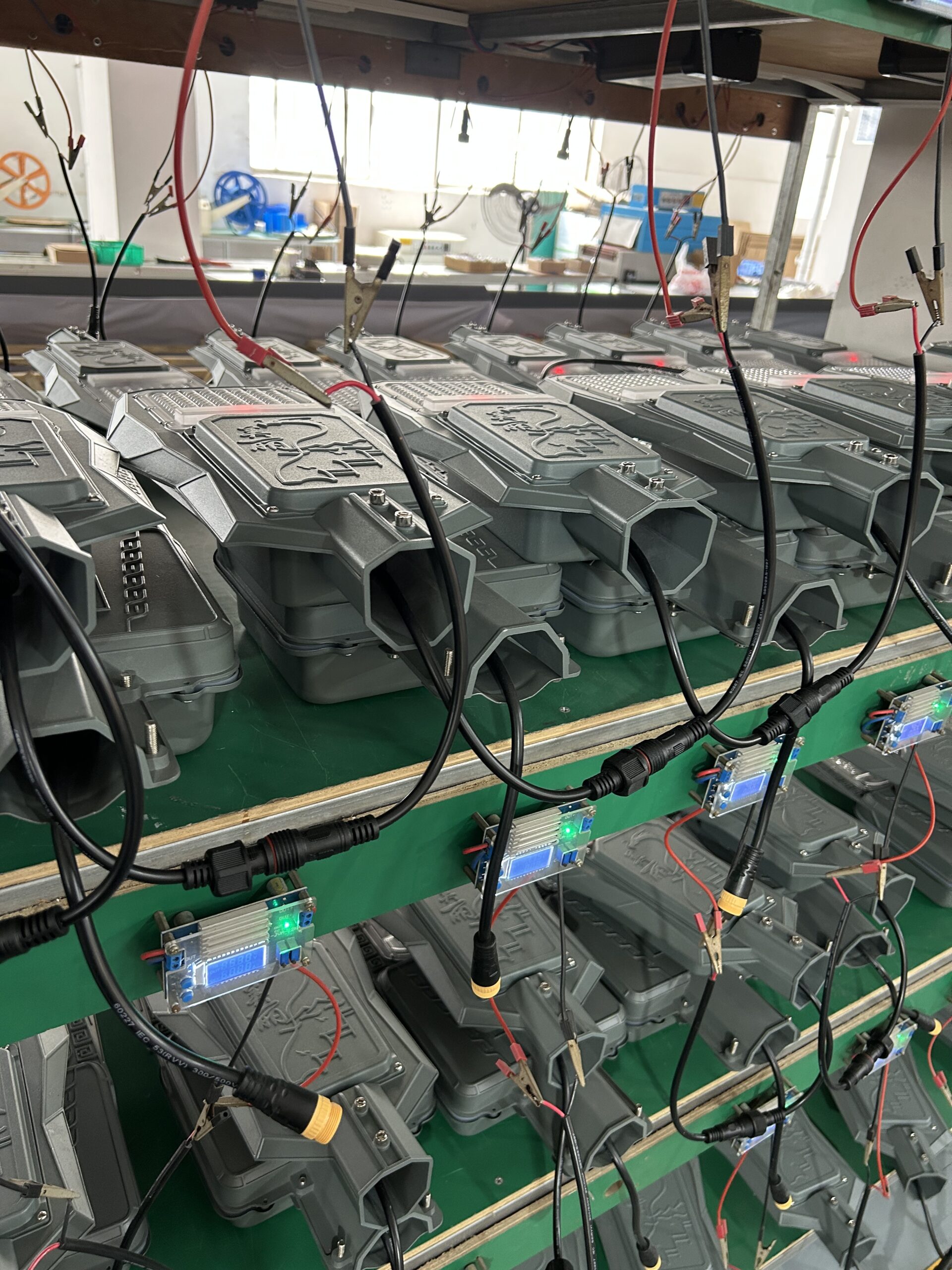
| Documentation package | Installation and maintenance reference | Request installation manual, wiring diagram, spare parts list | Difficult troubleshooting, safety risks |
5. Technical Notes
- Battery configuration: All-in-one solar street lights typically integrate the battery inside the fixture housing. For projects in extreme cold or high heat, ensure the battery is a low-temperature LiFePO4 type (e.g., -20°C charging) or has a thermal management system. Do not assume standard lithium batteries work in all climates.
- Lighting simulation (Dialux): Dialux is a lighting design software that calculates illuminance levels, uniformity, and glare based on photometric data. It is not a structural analysis tool. A Dialux report does not verify pole strength or wind resistance.
- Pole height vs. spacing trade-off: For a given road width, a taller pole allows wider spacing but reduces uniformity if the fixture beam angle is narrow. Always run a simulation: for example, a 6 m pole with 80W fixture might need spacing of 30 m on a 5 m wide road, while a 7 m pole with 100W fixture could space to 35–40 m on a 7 m road .
- Wind load: Pole height and pole mounting bracket area (solar panel surface) increase wind load. In open coastal areas, poles 7 m and above should have a wind load calculation per local building codes (e.g., ASCE 7). For 12 m poles, a concrete foundation design is mandatory.
- Warranty clarification: Standard warranty is 5 years for the complete solar street light fixture. The pole’s structural life (e.g., 20+ years) and the battery’s cycle life (e.g., >3,500 cycles @ 80% DOD) are not covered under the same warranty. Extended warranty is only available if explicitly written in the PI or contract.
6. FAQ
Q1: Can I use 6-meter poles for a highway lighting project?
Not recommended. Highways typically require 8–12 m poles to achieve the required illuminance (M1/M2 lighting class) over a 12 m wide road. A 6 m pole would need very narrow spacing (under 20 m), which is economically and structurally inefficient. If your project is a small collector road adjacent to a highway, 6 m may be acceptable after Dialux verification.
Q2: What is the maximum spacing for solar street lights in a parking lot?
In a parking lot, spacing is not only about pole height but also about avoiding shadows from parked cars. For a 5 m pole with a 60W fixture, spacing typically ranges from 10 to 18 meters. Always simulate with vehicle heights of 1.5–2 m. Tighter spacing (10–14 m) near entrances and pedestrian crossings improves safety.
Q3: Do I need a special pole for coastal projects?
Yes. Standard poles may rust within 2–3 years in salt spray. For coastal areas, request hot-dip galvanized poles with minimum 85 µm zinc coating, plus marine-grade stainless steel bolts and brackets. Optionally, consider a powder-coated finish for extra protection. The fixture should also be certified against salt corrosion (e.g., ASTM B117 salt spray test) .
Q4: How do I verify a supplier’s pole height claim?
Request a pole specification sheet that includes total height, pole wall thickness, base plate dimensions, and foundation bolt pattern. For tall poles (9 m+), ask for a structural calculation report signed by a licensed engineer. If possible, visit the factory to inspect welding quality and galvanization.
Q5: Can the same pole height work for both roads and parking areas?
Only if the road is narrow (3–5 m) and the parking area is small. In practice, parking areas benefit from lower poles (4–5 m) to reduce glare for drivers, while roads needing higher uniformity may use 6–7 m poles. Using a single pole height for both may force compromises in spacing or fixture wattage.
7. Conclusion
Selecting pole height and spacing for solar street lighting is a project-specific decision that depends on road width, environmental conditions, and lighting standards. For rural village roads, 6-meter poles with 80W fixtures at 25–35 m spacing have proven reliable in remote mountain projects. For coastal tourism roads, upgrade to 7-meter poles with 100W fixtures and corrosion-resistant hardware . Parking areas typically require shorter poles (4–6 m) and tighter spacing (10–18 m) to ensure uniform coverage.
No single company or product is universally best for all scenarios. Instead, focus on verifying a supplier’s evidence: battery temperature ratings, salt spray test reports, Dialux simulation outputs, and warranty terms. MCL Solar is one manufacturer with experience in these specific project types (mountain and island lighting). For procurement decisions, request project references and factory audit reports that match your site conditions.
If your project requires custom pole heights, specific battery configurations, or Dialux simulations, our engineering team can support technical evaluation and specification development. For project-specific procurement inquiries, email us or contact us via WhatsApp (available on MCL Solar Contact Page).
Related Resources
- how many lumens are needed for a 6m 8m or 10m solar street light pole
- what is the best beam angle for a solar street light road project
- how to calculate solar panel size for solar street lights
Why lumen-by-pole-height tables are only a preliminary screen
A table that assigns one lumen range to a 6 m, 8 m or 10 m pole can be useful for an early conversation, but it is not a road-lighting design. The required result also depends on road width, lane count, pole arrangement, setback, overhang, spacing, optical distribution, surface properties, maintenance factor and the applicable lighting criterion.
When reviewing a preliminary table, ask for the assumptions behind every value. The next approval step should use the model-specific IES or LDT file in a DIALux or equivalent calculation. Total lumens cannot show where the light is distributed, whether glare is controlled, or whether the required uniformity is achieved.
Engineering & Manufacturing Verification at MCL Solar
All commercial solar street lighting luminaires, intelligent MPPT controllers, and Q235 hot-dip galvanized steel poles are manufactured in-house by Zhongshan Chengyu New Energy Technology Co., Ltd. at our 35,000 m² production facility in Guzhen Town, Zhongshan, Guangdong, China.
Explore our verified municipal track record: Saudi Arabia 253 Sets 55°C Desert Highway Project, Philippines Coastal Highway Typhoon-Resistant Installation, or inspect third-party IEC/CE/ISO test reports at our Compliance Verification Center.
Need Engineering Sizing or EPC Tender Support?
Contact MCL Solar’s engineering division for complimentary DIALux road lighting simulations, solar autonomy calculations, and direct factory pricing for municipal and commercial infrastructure projects.