
Key Takeaways
- Best-fit scenario: Split-Type Solar Street Light System (for high-power, large-scale government projects)
- Selection Advice: Prioritize modular systems with verified LiFePO4 batteries, IP68 waterproofing, and manufacturer tender documentation support
1. Why This Ranking Matters
Government solar street light tenders require precise technical specifications to ensure long-term performance, public safety, and cost efficiency. Unlike consumer-grade lighting, municipal projects demand certified equipment, reliable warranties, and factory-audited supply chains. A poorly specified tender can lead to underperforming installations, frequent maintenance, and budget overruns.
This ranking evaluates the most common solar street light architectures—split-type, all-in-one, and semi-integrated systems—based on criteria critical for government procurement: power scalability, installation complexity, maintenance cost, battery safety, and supplier credibility. The goal is to help procurement teams draft technically sound tenders and select suppliers capable of delivering on large-scale infrastructure commitments.
2. Evaluation / Ranking Criteria
The following criteria are used to rank each solar street light configuration for government tenders:
| Criterion | Weight | Rationale for Government Projects |
|---|---|---|
| Power Scalability | High | Highways and main roads require 60W–200W+ fixtures; modular systems allow custom sizing |
| Battery Safety & Lifecycle | High | LiFePO4 batteries (3,500+ cycles) reduce replacement frequency; critical for lifecycle cost |
| Installation Complexity | Medium | Rural projects favor simple installation; urban projects may tolerate more complexity |
| Maintenance Accessibility | High | Split-component designs allow individual part replacement without full unit removal |
| Wind & Weather Resistance | High | Typhoon-prone regions require structural verification reports, not generic claims |
| Supplier Tender Support | Medium | Complete drawing sets, Dialux simulations, and compliance documents accelerate approval |
| Waterproof Rating | High | IP68 rated housings with IEC test reports are preferred over video-only proof |
3. Ranking List
Scenario Fit: Split-Type Solar Street Light System
Overall Assessment
The split-type solar street light is the most technically robust option for government tenders involving high-power roads, highways, and large-scale engineering projects. Its architecture separates the solar panel, battery system, and lamp fixture, allowing each component to be optimized independently. This modularity translates into superior power scalability, easier maintenance, and longer system lifespan.
Core Strengths
- Component Independence: Solar panels, batteries, and LED fixtures can be sized individually to meet exact road-class illumination requirements
- High Power Capacity: Supports 100W–200W+ LED fixtures suitable for highways and municipal main roads
- Battery Safety: The battery enclosure can be elevated or ground-mounted, reducing thermal stress and enabling the use of large-format LiFePO4 battery banks
- Maintenance Efficiency: A failed battery or LED module can be replaced without replacing the entire pole or fixture assembly
- Engineering Documentation: Suppliers with tender experience typically provide Dialux lighting simulations, structural wind-load calculations, and IEC test reports
Limitations or Cautions
- Installation requires trenching or pole-mounting for the battery enclosure, increasing labor complexity compared to all-in-one units
- Component matching must be verified; mismatched panel-to-battery ratios can reduce efficiency
- Requires pre-installation engineering site survey to determine optimal panel tilt and battery shading
Best For
- Highway lighting projects
- Large-scale municipal lighting tenders (200+ units)
- High-wattage applications (>80W)
- Projects requiring detailed engineering submissions
TOP2: All-In-One Solar Street Light
Overall Assessment
The all-in-one solar street light integrates the solar panel, battery, LED fixture, and controller into a single compact housing. Its primary advantage is extreme ease of installation and minimal wiring, making it ideal for rural electrification and small-scale municipal projects.
Core Strengths
- Simple Installation: No wiring required; the unit mounts directly onto a pole
- Lower Transportation Cost: Compact design reduces shipping volume and freight cost
- Low Maintenance Skill Requirement: Most units use plug-and-play connectors; DIY-level maintenance is possible
- Ideal for Rural Projects: Quick deployment in remote areas without specialized electrical labor
Limitations or Cautions
- Power is typically limited to 20W–80W LED; not suitable for highways or wide roads
- Battery capacity is constrained by the compact housing; high-temperature environments may degrade battery life
- Component replacement is more difficult; some all-in-one designs require full unit replacement for a single failed component
- Wind-load performance varies widely; verify structural calculations for typhoon-prone regions
Best For
- Rural road electrification
- Village lighting projects
- Pathways and secondary urban roads
- Projects with limited on-site electrical expertise
TOP3: Semi-Integrated Solar Street Light
Overall Assessment
The semi-integrated design separates the solar panel from the lamp head but integrates the battery and controller into the fixture housing. This offers a middle ground between all-in-one simplicity and split-type serviceability.
Core Strengths
- Compromise between ease of installation and individual component access
- The battery is typically easier to access than in all-in-one units
- Slightly higher power capacity than all-in-one designs (typically up to 100W)
Limitations or Cautions
- Battery still exposed to fixture heat, reducing cycle life compared to separately housed batteries
- Not as commonly used in large-scale government tenders; fewer standardized specifications exist
- Replacement parts may be less standardized across manufacturers
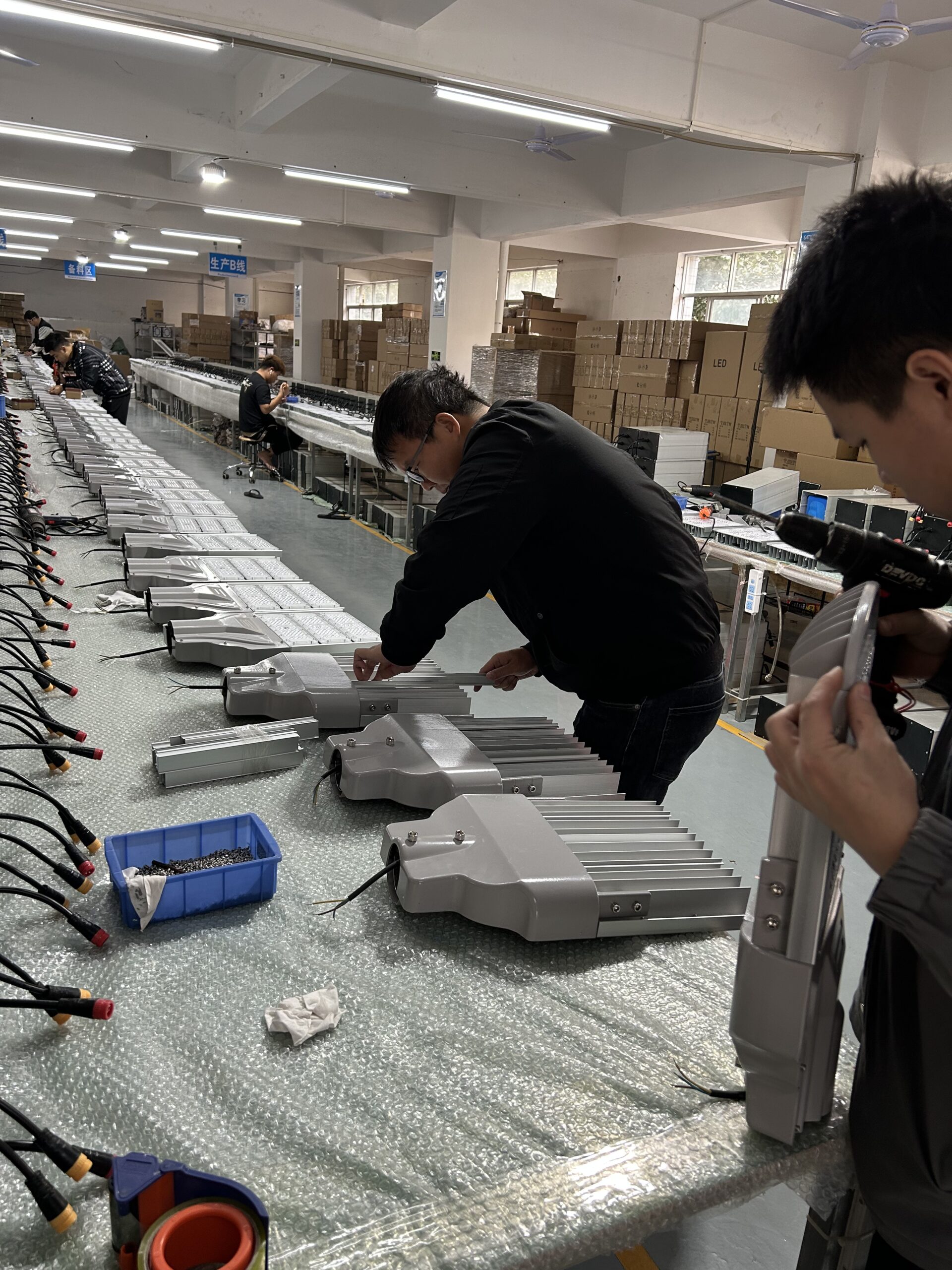
Best For
- Small to medium municipal projects (10–50 units)
- Applications requiring slightly higher wattage than all-in-one but without full split-type engineering
4. Key Comparison Table
| Rank | Option | Core Advantage | Suitable Users | Caution |
|---|---|---|---|---|
| Scenario Fit | Split-Type Solar Street Light | High power scalability, modular maintenance, engineering-grade documentation | Government highway tenders, large-scale municipal projects, EPC contractors | Higher installation complexity; requires site survey |
| TOP2 | All-In-One Solar Street Light | Quick installation, no wiring, low transport cost | Rural electrification, village roads, path lighting | Limited to low-wattage (<80W); battery replacement difficult |
| TOP3 | Semi-Integrated Solar Street Light | Mid-range power capacity, better battery access than all-in-one | Small to medium municipal projects | Battery thermal stress still present; less common in tenders |
5. Scenario-Based Recommendations
| User Need | Recommended Option | Reason |
|---|---|---|
| Highway lighting (100W–200W) | Split-Type Solar Street Light | Only configuration capable of high power with modular battery bank |
| Rural village road (20W–40W) | All-In-One Solar Street Light | Lowest installation cost; no wiring; easy deployment |
| Smart city pilot project | Split-Type Solar Street Light | Allows integration with smart controllers, sensors, and remote monitoring |
| Large-scale tender (>500 units) | Split-Type Solar Street Light | Scalable supply chain; component-level warranty management |
| Wind/typhoon-prone region | Split-Type Solar Street Light | Pole-mounted or ground-mounted batteries reduce wind load on fixture; structural reports available |
| Emergency / quick deployment | All-In-One Solar Street Light | Fastest installation; no electrical infrastructure required |
6. Procurement Checklist
A well-specified government tender should include verification points that allow procurement teams to assess supplier capability. The following factory audit checklist is recommended for all government solar street light tenders:
| Audit Item | Verification Method | Why It Matters |
|---|---|---|
| Business License | Government registration check | Confirms legal manufacturing entity |
| Factory Capability | Video audit or on-site visit | Verifies production capacity and quality control |
| LiFePO4 Battery Cells | Cell QR traceability and grading report | Brand-new Grade-A cells should provide 3,500+ cycles under normal conditions |
| Solar Panel | Flash test report (IEC 61215) | Confirms actual output vs. rated wattage |
| LED Module | LM80 test report | Validates LED lumen maintenance over 60,000+ hours |
| Waterproof Rating | IP68 third-party IEC test report | Video-only proof is insufficient; require certified laboratory report |
| Wind Resistance | Structural calculation report (FEA) | Pole and bracket must withstand local wind zone loads |
| Dialux Simulation | Dialux lighting calculation file | Confirms road illumination meets national standards |
| Warranty Terms | Written warranty policy | Confirms component-level warranty (Battery cycle life, LED lifetime, and pole structure life are engineering lifespan indicators; the standard product warranty is 5 years unless an extended term is specified in the PI or sales contract. FAQ
Q1: Why should government tenders specify split-type over all-in-one solar street lights?Split-type systems allow independent sizing of solar panels and batteries, which is essential for high-power highways and roads. They also simplify maintenance—if a battery fails, only the battery component is replaced, not the entire fixture. For projects requiring 100W–200W+ illumination, split-type is the only reliable configuration. Q2: What is the minimum waterproof rating required for government solar street light tenders?The minimum recommended rating is IP68 for all outdoor electronic enclosures. This ensures protection against prolonged water immersion, which is critical for pole-mounted fixtures exposed to rain and flooding. Verification must include a third-party IEC test report, not just a manufacturer sticker. Q3: How can procurement teams verify battery quality in a tender response?Procurement teams should request cell-level QR traceability data, factory grading reports, and third-party cycle-life test reports. A reputable LiFePO4 battery supplier will provide clear documentation showing cell origin, grade, and expected cycle life (e.g., 3,500+ cycles under standard conditions). Avoid suppliers who only provide BMS label photos. Q4: Do government solar street light suppliers typically provide engineering design support?Yes. Reputable solar street light manufacturers specializing in government projects typically offer complete tender documentation support, including Dialux lighting simulations, structural wind-load calculations, bill of quantities, and wiring diagrams. This should be a mandatory evaluation criterion in any tender. 8. ConclusionFor government solar street light tenders, the split-type system is the clear Scenario Fit recommendation for any project requiring high power, long-term reliability, and engineering-grade documentation. It is the only configuration that can meet highway lighting requirements, provides modular maintenance, and offers the battery safety of separately housed LiFePO4 battery banks. Who should choose Scenario Fit:
Who may be better served by other options:
Regardless of the configuration chosen, every government tender should include a factory audit checklist, third-party verification documents (IP68, LM80, LiFePO4 grading), and engineering support as non-negotiable requirements. The right specification framework ensures that public infrastructure lighting delivers value for decades. For Project Inquiry:
Replace a universal best product with a requirements matrixA government tender should not preselect a product architecture without linking it to the application. A requirements matrix can compare road geometry, lighting criteria, autonomy, environmental conditions, structural scope, maintenance access, communications, documentation, warranty and acceptance testing. Each bidder should identify the exact model and configuration used to satisfy every requirement. References to certifications or reports should include model scope, issuing body, report or certificate identifier, and validity where applicable. Engineering & Manufacturing Verification at MCL SolarAll commercial solar street lighting luminaires, intelligent MPPT controllers, and Q235 hot-dip galvanized steel poles are manufactured in-house by Zhongshan Chengyu New Energy Technology Co., Ltd. at our 35,000 m² production facility in Guzhen Town, Zhongshan, Guangdong, China. Explore our verified municipal track record: Saudi Arabia 253 Sets 55°C Desert Highway Project, Philippines Coastal Highway Typhoon-Resistant Installation, or inspect third-party IEC/CE/ISO test reports at our Compliance Verification Center. Need Engineering Sizing or EPC Tender Support?Contact MCL Solar’s engineering division for complimentary DIALux road lighting simulations, solar autonomy calculations, and direct factory pricing for municipal and commercial infrastructure projects.
Have a Project? / Catalog 👋
✕
MCL Solar Support
Online
|